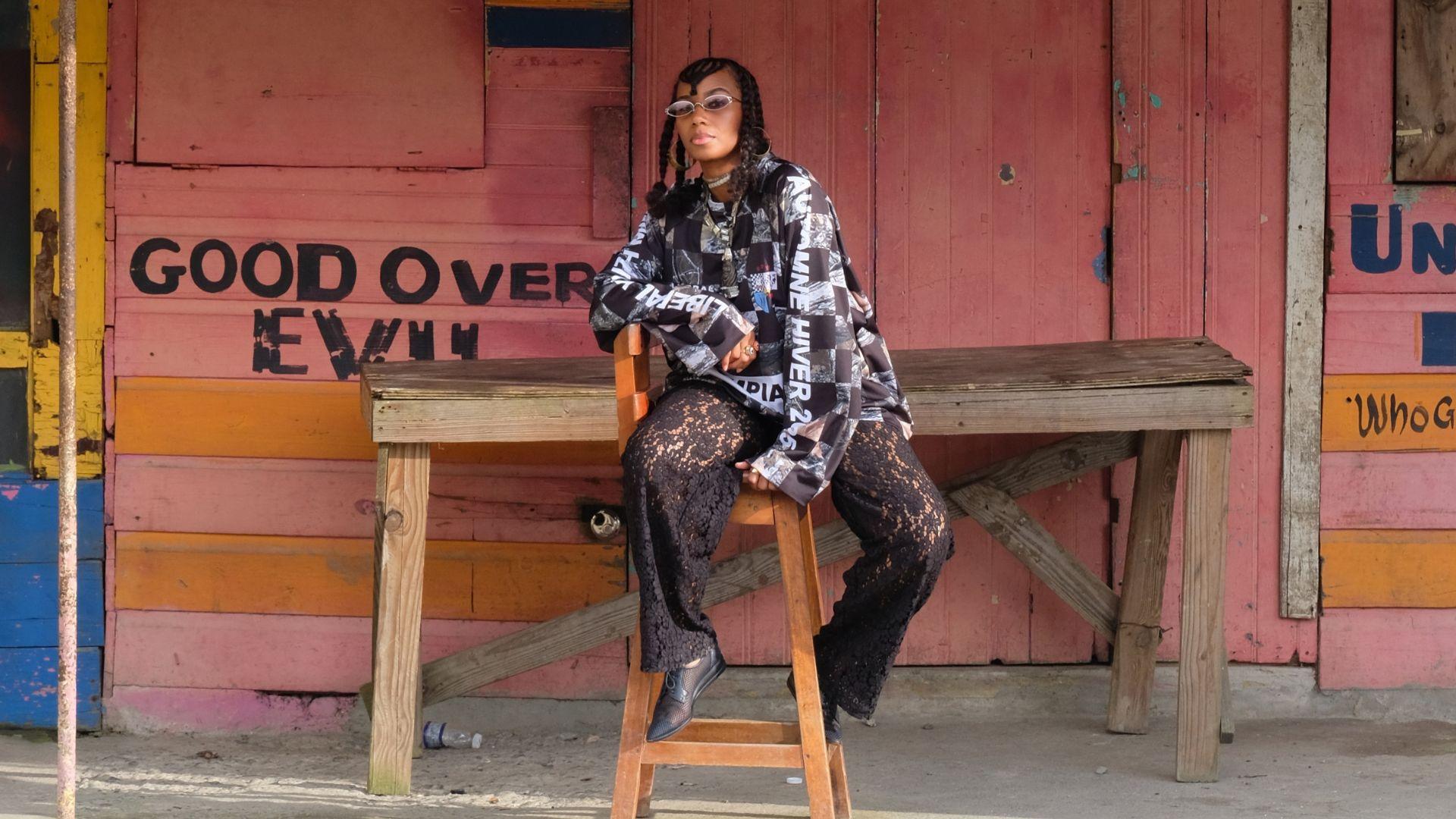
Santigold photo

Audio By Carbonatix
Quiet as it’s kept, Santigold helped redraw the map for alternative pop long before the industry had language for it. Before “genre-fluid” became marketing shorthand and playlists collapsed scenes into searchable moods, Santi White was already fusing punk, dub, reggae, ska, electronic music, and hip-hop into something instinctual and difficult to categorize. Her music never sounded like crossover. It sounded like a collision.
That refusal to sit comfortably inside one tradition is precisely what made her essential. Emerging in the late 2000s during an era still obsessed with rigid genre identities, Santigold occupied a strange cultural space: too punk for mainstream R&B, too rhythmic for indie rock purists, too intellectually slippery for pop’s conventional machinery. Yet her influence quietly spread outward, informing a generation of artists who would later build careers on stylistic hybridity.
Ahead of her May 23 performance at ZeyZey Miami, Santigold speaks to Miami New Times about artistic independence, Black lineage in punk music, the collapse of the modern music economy, and why authenticity remains her only real compass. The critically acclaimed artist is still touring behind Spirituals, her 2022 album that arrived as survival document, with music written from inside exhaustion, anxiety, motherhood, and emotional unrest.
“Authenticity is very important,” she explains. “I’ve always been indie in spirit. Even when I was working within bigger systems, I never really operated from a place of trying to fit into something.”
That independence has become increasingly radical in an industry now dominated by algorithms, short-form virality, and aesthetic recycling. Santigold’s catalog, from the explosive urgency of “Creator” to the feverish daze of Master of My Make-Believe, feels almost resistant to optimization. The songs breathe, mutate, and destabilize themselves. They reward immersion rather than passive consumption.
Importantly, she never approached music from an intellectualized blueprint. The experimentation came naturally.
“I wasn’t trying to be consciously intellectual,” she says with fervor. “Music is instinctive for me. It’s an intuitive process. I don’t sit down and think, ‘I’m going to blend these genres to make some statement.’ It’s really about following feeling.”
That feeling often manifests as atmosphere before structure. Listening to Santigold can evoke the same emotional disorientation found in the work of the Breeders, Hope Sandoval, or PJ Harvey, a hazy tension where melancholy, danger, cool detachment, and vulnerability coexist simultaneously. Her music rarely moves in straight lines. Instead, it flickers between abrasion and beauty.
“I create atmosphere and mood first,” she says. “I can have some grimy drums and just one bass line and write a whole song from that. Atmosphere emerges naturally.”
On Spirituals, that atmosphere often feels ritualistic. The standout track “High Priestess” glides with a ghostly Euro-disco pulse, shimmering somewhere between nocturnal escape and spiritual possession. Elsewhere, “Shake” channels the communal ache of a traditional Negro spiritual, Santigold’s voice moving like a call through smoke and thunder while her tambourine rattles with the urgency of revival music. The song feels less performed than summoned, music for surviving the collapse without surrendering joy.
That sensibility can be traced back to her upbringing. Santigold describes a household where musical curiosity outweighed genre loyalty. Her father’s record collection became an accidental education in sonic borderlessness.
“My dad was a huge record collector,” she recalls. “He took me to see artists like Nina Simone, Fela Kuti, and Sade. But I was also listening to stuff that people didn’t necessarily expect Black kids to listen to, the Cure, Bad Brains, Fishbone, Led Zeppelin. All of those genres shaped me.”
Long before Santigold emerged as a solo artist, she fronted the Philadelphia punk band Stiffed, whose EP Sex Sells and album Burned Again fused hardcore abrasion with dub, soul, and art-punk experimentation. Both projects were produced by Darryl Jenifer, bassist for Bad Brains, a foundational group whose influence on punk remains immeasurable.
That eclecticism would later become foundational to her solo work, though the industry initially struggled to contextualize it. At a time when Black artists were still heavily compartmentalized by format and demographic expectations, Santigold’s refusal to conform often felt less like innovation and more like resistance.
“You can’t escape lineage,” she says emphatically. “There are so many different types of Black music. Punk has roots in the Black experience too, even if people don’t always acknowledge that history.”
Indeed, Santigold belongs to a broader continuum of Black artists who disrupted genre as an act of autonomy rather than novelty. Like Bad Brains before her, she approached punk less as a sonic template and more as a philosophy, one centered around disruption, self-definition, and creative freedom.
When asked what systems still need dismantling in modern music, she doesn’t hesitate.
“The corporate structure is unsustainable,” she says. “It has ruined the ecosystems. Artists can’t really recoup albums anymore, and streaming services don’t pay artists fairly.”
She speaks passionately about publishing rights and the diminishing value assigned to musicians in the streaming era, particularly for artists committed to experimentation rather than mass-market replication. For Santigold, the issue is larger than individual success stories. It’s about the long-term survival of artistry itself.
“There’s this expectation now that artists should constantly create content, constantly chase attention,” she explains. “But that doesn’t necessarily lead to meaningful work or longevity.”
Ironically, the same internet economy that accelerated oversaturation also created new forms of liberation. Santigold acknowledges that digital platforms have enabled artists to bypass many traditional gatekeepers that once controlled visibility.
“The internet helped open things up,” she says. “You can market yourself now. You can create your own music, release it independently, build your own audience. That’s powerful.”
Still, she remains skeptical of trend-chasing disguised as innovation. In an era where aesthetics are rapidly mined and repackaged into algorithms, Santigold believes timelessness comes from artistic self-awareness rather than market responsiveness.
“Artists shouldn’t chase trends,” she says confidently. “That doesn’t have staying power. My music lasts because it’s centered around who I actually am.”
That commitment to self-definition may explain why her career has often felt ahead of its time. Long before alternative Black artistry became institutionally celebrated, Santigold existed in a liminal space that could sometimes feel punishing rather than validating.
“There were definitely moments where it felt difficult,” she admits. “When you don’t fit neatly into categories, people don’t always know what to do with you.”
Yet that ambiguity ultimately became her strength. Younger artists now move through musical hybridity with far greater freedom, partly because artists like Santigold absorbed the friction first.
“I’m happy if I’ve inspired artists who want to paint outside the lines,” she gleefully says.
What remains most striking about Santigold, however, is not simply her innovation but her steadiness. While the culture repeatedly reinvents itself around spectacle and immediacy, her work remains entirely detached from trend cycles. There’s no desperation to remain relevant because relevance was never the mission.
“My job is to create art,” she boasts. “The rest works itself out.”
Then, after a pause, she adds the line that perhaps best summarizes her entire career: “I don’t think I could’ve done any of this if it wasn’t on my own terms.”
Santigold. Saturday, May 23, at ZeyZey Miami, 353 Northeast 61st Street, Miami; 305-456-2672. General admission tickets are $73.20 and $115.20 for VIP via zeyzeymiami.com