

Click here to view a slideshow of the bridge community.
Another one showed up last night. Around 10 — just before curfew — a car rolled in under the bridge and the newcomer got out with his wife. She hugged and kissed him goodbye, pulled the car out along the road, and disappeared into a sea of headlights.
The new guy sits by the side of the Julia Tuttle Causeway, talking to a group of men huddled atop a collection of lawn chairs, buckets, and plastic crates facing the water, toward the Miami skyline.
"I can't believe this shit," he booms. Nearly six feet tall and 250 pounds, endowed with a voice like a fire engine, he has already earned his new nickname: Big Man. The men listen with mild sympathy. "They're shocked; the new guys are in shock," explains Patrick Wiese, who has been living under the bridge since July.
Until last week, Big Man was serving a four-year sentence for cocaine possession. A few days ago, he was looking forward to leaving prison and reuniting with his wife, until he got the news: Instead of going home, he'd be living under a bridge, a parole commission officer told him. That's because 23 years ago, when he was 19 years old, Big Man was charged with sexual assault on a minor. (He claims the victim was his girlfriend and that it was consensual.)
"When they told me I was coming down here, my legs was shaking," he says. "Me and my wife drove around all day trying to find the place. She was saying, 'Maybe you should go back to jail; I don't want you living under no bridge.'"
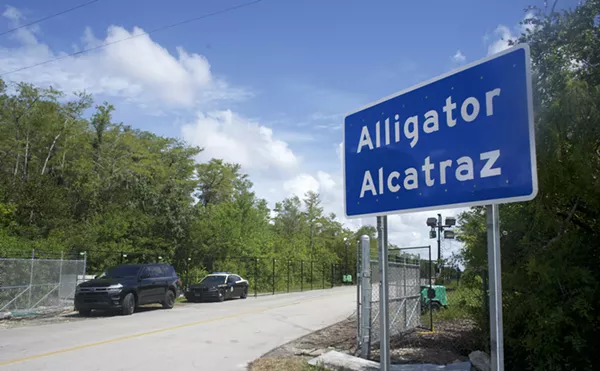
In March, New Times revealed the Florida Department of Corrections was housing sex offenders under an overpass near the county courthouse; the state responded by moving the men here. The reason: A 2005 county ordinance prohibits sex offenders from living within 2,500 feet of any school, so nearly the entire county has become off-limits to them.
The story was picked up by national media outlets, and for a few weeks the bridge was a source of widespread disbelief. Statements were made, resolutions were passed, letters were sent — but nothing changed. Since then, much to the relief of local politicians, no doubt, the situation seems to have quietly faded from public memory.
But the numbers kept growing. More than 30 men have been sent to live here in the intervening months. A few have since left — the majority of them arrested for minor violations of probation, two or three were able to move out, and two have disappeared. But most — as of press time, at least 20 — remain under the bridge, even though many have families willing to house them. Everyone agrees the situation under the Julia Tuttle has become untenable, but so far neither local politicians, nor the courts, nor the state legislature have been willing to do anything about it.
And so the men have begun to settle in. From discarded wood, they've built 15-foot ladders to ascend the concrete embankment that leads to a small, flat space beneath the bridge, where they sleep. A system of handmade pallets elevates them above the water that collects in their sleeping quarters when it rains (luckily for them, there weren't any hurricanes this year). One bridge dweller bought a generator; the others are expected to pitch in for the privilege of electricity with whatever they can — money, food, beer, or labor. Every night, work projects are afoot: cleaning the ground beneath the bridge, futzing with the generator, tending a grill large enough to cook for all of them at once. At least six animals share quarters with the men — a Doberman, a pit bull, a Yorkshire terrier, and three cats.
"We are a colony," Wiese explains, "and we gotta work it like that."
Long before dawn, the men are up and packing. Silently they stow their bedding, brush their teeth, and perform perfunctory toilet duty by the bay. The minute their curfew ends, at 6 a.m., they are gone. The drivers pull out along the muddy grass by the causeway, through a break in the railing, and into the stream of traffic. The walkers ascend the embankment by the bridge, step over the rail, and make their way along the causeway. From the top of the bridge you can see them, every morning, their figures getting smaller and smaller until they vanish in the pale light of another day in Miami.
Two years ago, Miami Beach Mayor David Dermer successfully pushed an ordinance that prohibited sex offenders from living within 2,500 feet of any school in his city — two and a half times farther than the state law's distance, which already prohibited offenders from living within 1,000 feet of schools, daycare centers, and playgrounds.
The ordinance came at a time when states across the nation were cracking down on sex offenders in the wake of the horrific rape and murder of nine-year-old Jessica Lunsford in Homosassa, Florida, by John Couey, a 47-year-old drifter with a criminal history of child molestation. Mayor Dermer intended his ordinance to set the high water mark, and it did. In a city surrounded by water and barely a mile wide at its thickest, the 2,500-foot ordinance effectively made Miami Beach the first city in America to exile sex offenders — a fact Dermer has acknowledged proudly.
In an interview on NPR's Talk of the Nation, host Neil Conan asked Dermer point-blank: "What do you say to the communities where they move to?" For the only time in the otherwise exuberant conversation, Dermer sounded flustered. "Well, those communities," he said, "obviously if they have inquiry as to what we're doing, we're happy to assist them in any way."
The point of the question was not lost on Miami-Dade politicians, who nervously watched Dermer's actions from across a half-mile of water. Where would sex offenders go if banned from Miami Beach? To the rest of the county, of course. Within a year, the Miami-Dade County Commission unanimously passed a mirror ordinance, banning sex offenders from living within 2,500 feet of any school.
How much of Miami-Dade County, exactly, does the 2,500-foot ordinance cover? Pretty much all of it, according to a map produced by the county and distributed to police and newly released sex offenders. It shows schools in the county — private, charter, and public — each with a colored blob around it representing the 2,500-foot sex-offender no man's land. The blobs cover the map; the only open patches are Miami International Airport, a few farm tracts in the Redland and near the Everglades, and, perhaps ironically, much of the well-to-do town of Pinecrest, which is protected from most sex offenders by property values instead of ordinances. (Sex offenders, like any other kind of felon, overwhelmingly tend to be poor.)
It's one thing to pass a law; it's another to make it work. Even as county commissioners patted themselves on the back, state probation officers — who are responsible for overseeing all offenders released on probation — were already having a difficult time enforcing the state's 1,000-foot law, let alone Miami's new 2,500-foot ordinance. At first, they simply rearrested sex offenders who couldn't find a legal residence before their release date. But a judge's ruling in July 2006 led to an internal memo ending that practice. Probation officers were in a bind: The offenders had to be released — but to where?
And so they began to crop up in strange places. On January 4, two homeless sex offenders living on bus benches in Broward County were arrested for disorderly conduct, according to DOC e-mails obtained by New Times. "The offenders were charged with hanging their clothing, that had become wet during a rainstorm, over some bushes," wrote a probation officer. In another e-mail, a probation officer in Sanford, near Orlando, wrote to a colleague: "I hate to tell you, but this is Sex Offender Square; there are approximately 11 of them living out there.... The only way we could [count them] was to line them up, like at Publix deli."
The storm came to Miami in August 2006, when 66-year-old sex offender Angel Sanchez was released after serving a year and a half for molesting a relative on at least two occasions, when she was nine and 13 years old. Sanchez couldn't go home. But his social security income meant he could pay rent elsewhere. Sanchez proposed nearly a dozen residences to his probation officer, Benito Casal, and Casal diligently checked them. But each one violated the state ordinance.
When Sanchez got out of jail, Casal ordered him to live under the Dolphin Expressway overpass at NE 12th Avenue and 12th Street, across the street from the county courthouse. A few months later, another sex offender fresh out of lockup was sent to join him. Then, several weeks later, another. The three men slept in cardboard boxes and on piles of rags in the parking lot. Casal enforced their curfew — 10 p.m. to 6 a.m. — by briefly pulling into the lot before dawn every day to make sure the three were there.
New Times's March 8, 2007 story ("Swept Under the Bridge") sparked a flurry of e-mails within the department of corrections. "It was the only known location that sex offenders in Dade County could reside," probation supervisor Patricia Nelson wrote in an incensed e-mail to probation officers and supervisors. "We are instructing our offender[s] to move from that location. Where, we do not know, but [they] will have to find a location by curfew this evening or face arrest."
Nelson's e-mail didn't end there:
"We will then face the sentencing Court, who may reprimand us for arresting the offender and who will restore the offender to supervision, dismissing our violation. We will then research a new address for compliance which will require a web search of Google Earth, the county website, GPS mapping, Children and Families Day Care website, and a personal visit to measure 1,000 ft. as the crow flies, 2,500 ft. for ordinance compliance, and about 2-3 hours of officer time and travel expense only to find that the location is not in compliance.
"Collectively, we have exhausted all efforts to locate affordable motels, rooming houses, street corners, abandoned junk cars, or any other location that could serve as a residence for sex offenders that are not in violation of the 1,000 foot law or any ordinance.... We are requesting guidance and direction from the department, the Courts, the legislature, or anyone else who would address the homeless sex offender problem."
That guidance wouldn't come anytime soon. Meanwhile probation officers came up with a location for the offenders that state, county, and municipal ordinances couldn't touch. They were ordered to report to the Julia Tuttle Causeway or go to jail. They complied.
On average, a new sex offender has arrived under the Julia Tuttle every week since April.
Enrique Ortiz was 13 years old when he acquired the status of sex offender for life. According to state prosecutors, Ortiz, armed with a flare gun, forced his way into an apartment on the 900 block of NW 28th Street in which two preteens were present and, after stealing jewelry and clothing from their mother's bedroom, forced them into a closet, where he allegedly forced one child to perform oral sex on him.
The case was far from straightforward. After the crime, investigators combed the neighborhood and found Charles Jackson, who was in possession of a piece of the stolen jewelry. Jackson said the ring had been given to him by Ortiz. Jackson was not arrested, detained, or questioned further. Instead police hunted down the adolescent Ortiz, arrested him, and charged him with 11 counts, including burglary, kidnapping, and sexual battery.
Ortiz, now 29 years old, says he's innocent. "Charles? He was the one who did it. I was small; he used me to go through the bars. I broke in, yeah, but then I waited for him outside."
Guilty or not, it wasn't a sex offense that landed Ortiz under the bridge. After spending eight years in jail for a burglary, he'd lived in Miami since 2003 with a spotless record until, this past June, he was caught riding a scooter without a license in Miami Beach. The officer, seeing Ortiz was a registered sex offender, took him to jail and, the cop claimed, found three Ecstasy pills on him — a violation of Ortiz's probation. The sentence: two years of state supervision, under the bridge.
When Ortiz arrived, he found the situation intolerable. "I was like, 'You know what? Fuck this. If I gotta be here, I'm gonna live comfortable.'"
The handsome Puerto Rican keeps his head and face clean-shaven, and he is always well dressed. He has an easy, charismatic personality, and cuts a lean and muscular figure, walking around under the bridge as if it were the backdrop to a photo shoot: shirtless, his Yankees cap tilted to the side, implausibly still-club-worthy jeans sagging suggestively low at the waist. "I'm a beach boy," he affirms with pride.
Ortiz is also tough. He holds an unnervingly steady gaze, a look that can be commanding. Quietly, subtly, he's the boss. (Sometimes not-so-subtly — he gave one of the guys a black eye recently when he thought the offender hadn't been chipping in enough for electricity.)
Ortiz took charge and set about transforming the area into a livable space. He claimed a hefty quarter of the concrete shelf below the bridge for himself. He set up a sleeping area, a closet, and a 12-foot living room, replete with an entertainment center, a pantry, and — the centerpiece — a big, comfy pink love seat. Ortiz, who is gay, built wooden rafters not only on the ground but also among gaps in the cement ceiling, on top of which he stores his possessions, and below which his shirts hang neatly from wire hangers.
It was Ortiz who bought the generator, Ortiz who bought the lights, the wood, the TV set, and the water cooler buckets the men use as showers. Ortiz is house fisherman and head chef. Occasionally he has cooked meals for the entire encampment.
"When I first got here, nobody was motivated to do nothing but burn shit. All they did was burn crap and wood and all that. And drink. Bonfires and drinking, and always in the darkness...," he says. "Then I started saying, 'I want to build this and this and this' ... I brought life to this place."
On a trip to get water from a recently discovered spigot, Ortiz says, "It pisses [probation officers] off to see people like me. You put a person in this type of predicament, and what you actually are trying to do is break their spirit. Just like a dog — you put a dog in a cage, you break his spirit ... but little did they know they had somebody who was already adjusted to this situation. I've been on the streets since I was 12.... I live flexible to life, you know, because you never know where you're going to end up."
"The Bridge Man," as the offenders call probation officer Benito Casal, noted with uncharacteristic alarm the rapidly increasing population. In a July 7 e-mail to superiors, Casal wrote about showing up at the Julia Tuttle only to be accosted by a bridge dweller who demanded to know "'who the hell was sending all these sex offenders here.' He stated there are eight sex offenders residing under the bridge, and there is no more room here for them."
Casal was further distressed by the presence of a couple with a young girl, who were there to fish. Casal told the family that the people under the bridge were sex offenders. Upset at the comment, the mother of one offender — who had moved to the bridge to take care of her son — lashed out at Casal. The situation escalated, and he threatened to call police.
Eventually things quieted down, Casal wrote, but he ended his e-mail on an ominous note: "In dealing with the sex offenders in the Julia Tuttle Causeway, I have noticed some of them are becoming more hostile. I believe this is because of their living conditions [and] the amount of sex offenders that are under the bridge.... I believe the situation that presently exists in the Julia Tuttle Causeway is a recipe for disaster, and it is only a matter of time until a very serious incident occurs out there. I am requesting that management advise the probation officers in Circuit 11 not to send any more homeless sex offenders to the Julia Tuttle Causeway."
Since then, the number of sex offenders under the bridge has doubled.
Increasing numbers of inhabitants have, like Ortiz, been out of prison for years, living and working without incident, until they violated probation (sometimes for something as simple as forgetting to re-register), were taken to jail, and then sent under the bridge. Nearly half the men would be out of here in a heartbeat if residency restrictions didn't prohibit them from living with their families.
While still on probation, interior designer Ricardo (not his real name) lived in an apartment in Miami, traveled regularly for work, and lived without incident until he violated probation by staying away from Miami-Dade longer than a judge had allowed him. He was sent under the bridge. Now he sleeps in the back of his pickup, leaving every morning at 6 a.m. and driving to his sister's house in Hollywood, where he showers, eats breakfast, and cleans up for a day of work. He has maintained freelance work despite having to inform each of his employers of his offense, molesting a close relative. Each evening he returns to his sister's house for dinner, waiting as long as he can before going back to the bridge to climb into the bed of his trunk and sleep.
Another of Ricardo's sisters agreed to speak about her brother. "It was very hard for me, especially because I have children — my girl is 12 and my son is 10," she says, asking that her name be withheld. "But I still think he has the right to be able to make it, and to get back into society to be a productive human being."
When bridge dweller Kevin Morales was released from prison, his daughter — who was also his victim — sought permission from the judge to maintain a relationship with her father. "I can see it from both ends, and I don't think anybody could be more credible to talk about it than me," says Sandy (she declined to give her real name). "If my father wasn't a decent and hard-working man, and he didn't have his family to support him, I'm sure he would have wanted to escape from that bridge. But he's not like that. He wants to be a part of society and have a job and a family like everyone else."
Offender Steven Gilley is joined every night by his brother, who sleeps under the bridge at least three times a week."My brother, he was a nerdy type — he's not streetwise and all that," he explains. "My mama's 72 years old and she was worried about him. I said, 'Mama, I'll take care of him.' We already offered him a home, but they turned him down. I got two kids, and I trust him. And they love their uncle."
The oldest offender is 82-year-old Manuel Perea, an arrival of just a few weeks ago. Perea, who is deaf, was sent to live under the Julia Tuttle after being arrested for his second sex offense, allegedly fondling three children while handing them a puppy on the street. He was fitted with a GPS unit, but can barely hear someone screaming into his ear, let alone the soft beeping of the box.
About a third of the men are harnessed with GPS monitors — despite the fact that they have no regular access to electricity to charge the batteries. If the generator is working, Ortiz usually obliges; otherwise the men either allow their boxes to shut down — technically a violation of their probations that could land them in jail — or resort to more extreme measures. One offender sometimes walks across the causeway to Wendy's, where he surreptitiously charges his box from a booth.
"What are you going to do with an 82-year-old guy who's a dirty old man?" says his lawyer, Ted Mastos, a former circuit court judge and state prosecutor. "The guy's got a problem — he's done it before. He's a problem, we recognize that, and that's the reason we entered a plea. But in our wildest dreams we never thought this would have happened.... His son is a very responsible guy and he's done yeoman service to try and find a place for his father," Mastos says. "And now an 82-year-old man has to die under a bridge, and nobody cares."
Manuel Perea walks a mile and a half along the causeway every night with slow, painstaking steps, carefully lifting his legs over the railing and descending under the bridge, politely waving a large wrinkled hand at the rest of the bridge dwellers as he passes by. Each night he slowly unpacks his bedding, lays it out on a concrete block, and goes to sleep. In the mornings, it takes him more than a half-hour to pack up the bedding.
"How the fuck can they put an 82-year-old man down here?" Ricardo asks one night, as the old man walks by, waving as usual. "That first night he got here, I hear beep beep beep.... I go, 'Fuck, it's the old man.' He can't even hear the box when it's right next to him."
"It's comedy," Ricardo murmurs, watching the old man's retreating shadow. "It's comedy and tragedy at the same time."
State and local leaders have taken turns abdicating responsibility for the problem of homeless sex offenders — that is, sex offenders made homeless by local law. Politicians have dumped it, whenever possible, back and forth onto one other like a game of hot potato.
Dermer set the tune, passing the potato unapologetically to the county, which promptly dumped it, piping-hot, into the lap of probation officers. Behind the scenes, corrections officials tried on numerous occasions to get City of Miami and county officials to take responsibility for a situation that had resulted mostly from their own legislation.
On April 13 of this year, DOC secretary Jim McDonough sent a letter to Miami Mayor Manny Diaz and County Commissioners Bruno Barreiro and Rebecca Sosa (the latter had cosponsored the 2,500-foot ordinance, along with Commissioner Pepe Diaz), proposing the formation of a joint committee to address the problem. The task force that eventually convened issued a memorandum addressing homeless released prisoners in general, but not sex offenders in particular. In fact the problem of housing sex offenders is barely noted in the document, and no mention at all is made of the Julia Tuttle Causeway.
Ron Book, who chaired the task force, dismisses the idea that the 2,500-foot ordinance has failed the county. As for the men under the bridge, he answers, "I would say to you that is not the ideal solution, but ... I'm not sure that 20 is any demonstration of failure at all."
Book is right: There are other places sex offenders can live. On Krome Avenue in Northwest Miami-Dade — past the vacant lots, junkyards, and farms — sits a small, rundown trailer park, inhabited mostly by Mexican families, laborers, and agricultural workers. Three sex offenders are registered as living there. Far from any school, park, playground, or daycare center, the location might seem ideal. Except for one thing: Every day, around 3 p.m., a dozen women gather in front of the park to wait for a dusty yellow school bus to drop off their children. They scream and squirm their way to their mothers' sides and walk away with them, hand in hand.
Asked if the 2,500-foot ordinance is pushing sex offenders into poor communities, Book pauses. "I don't have to like it," he says. "Look, I don't have all the solutions."
Commissioner Sosa refuses to revisit the ordinance. "I feel that I helped create a solution," she insists. Asked if she knows how many men are living under the bridge, she answers, "Yes, many.
"I guess that at some point, the system will have to address that issue," she concedes with vague cheerfulness. "But I am not ready to address that issue. Maybe another commissioner should address that issue.... Your question is: Am I going to do something? The answer is no."
Since tighter sex offender laws sprung up across the nation in the wake of Miami-Dade's, a number of challenges have followed. In January 2006, public defenders and state prosecutors in Iowa joined forces and issued a statement calling for the repeal of the state's 2,000-foot residency restriction, which, they said, "does not provide the protection that was originally intended."
In Florida, the ground is moving under our feet. Weston, which has a 2,500-foot ordinance, settled in a suit in September brought by Thomas Lacorraza, a 23-year-old sex offender who was fined for living at his grandparents' house after being released. In the end, the city said he could stay. Lacorraza's lawyer, Chris Mancini, is currently representing another offender — 25-year-old Lee Chang, convicted of having sex (consensual, Mancini says) with a girl in her early teens — who was told he could not live with his mother, and was sent instead to live under a bridge in Miramar, where he sleeps in his car. In July, Fort Lauderdale probation officers came up with six different bridges to which they planned to assign sex offenders on a rotational basis.
"When you have bad laws, you see ridiculous outcomes," says Mancini.
At least two challenges to Miami-Dade's ordinance are already brewing. On November 7, the Public Defender's Office filed a memo in support of a motion to declare the county ordinance unconstitutional and pre-empted by state law. The ACLU is looking into challenging the law as well.
There is abundant evidence that residency restrictions do nothing to reduce sex crimes against children. For one thing, the vast majority of sex offenses are not committed by strangers: According to the Bureau of Justice Statistics, nine of 10 victims under the age of 18 know their abusers, and 34 percent were family members. And while residency restrictions target those who have already offended, most sex offenses — 87 percent — are committed by individuals with no prior records.
On top of that, there is reason to believe that residency restrictions actually push sex offenders further underground. "We know that criminals are more likely to resume a life of crime when they have instability in their life, when they lack social and family support, and when they lack employment," points out Jill Levenson, an assistant professor of human services at Lynn University in Boca Raton.
Florida DOC statistics chart a steady increase in the number of sex offenders who have fled probation and whose whereabouts are now unknown. Statewide, the number of absconders has tripled in the past three years, but in Miami-Dade, the increase is almost tenfold since the 2,500-foot ordinance went into effect in 2005. In that year, the DOC recorded three absconders; this year so far, at least 22 sex offenders have gone missing in Miami-Dade.
At least two of the those were assigned to the Julia Tuttle. Carlos DeNacimiento, who pleaded guilty to raping a 10-year-old girl, and Humberto Danetra, convicted of exposing himself to two 13-year-old boys, were, like the others, assigned to live under the causeway upon their release from prison. Unlike the others, they declined to do so. Both offenders told their probation officers they would report to the location; neither was seen again.
"Sometimes there's a perception that those of us who oppose residency laws are advocating for sex offenders," Levenson says. "We're all on the same side — which is the side of public safety."
Around 7 p.m. on a recent Sunday, a car pulls in under the bridge and a rare thing happens: A woman steps out. Bending down and reaching across the driver's seat, she straightens up again with an armful of supplies — a small cooler, paper plates, and a package wrapped in plastic. The bundle nearly reaches her chin. It's Big Man's wife.
Since arriving a week ago, Big Man has made a place for himself under the bridge. He sleeps on a mottled white sofa that abuts Ricky Ortiz's side of the shelf. He has set up his things — a few pairs of shoes, a stack of clean clothes, some toiletries, a microwave, and a tattered Bible.
Big Man's wife smiles as he climbs down the ladder, smiling back, and takes large, bounding steps toward her. They embrace, and then his eyes move from hers to the food. "Go heat it up in the microwave," she tells him. He relieves her of the bundle and dutifully mounts the ladder again.
"He done tore up three pairs of shoes, 'cause he gotta climb up and down this wall here, and that's something he's not used to — he's a heavy man. So I had to get some rubber shoes so he can go up and down," she says, watching his clumsy ascent.
Big Man's wife (both requested that their names be withheld) is neatly dressed, with an ample frame and a soft face. One front tooth is capped in gold, and when she smiles, it flashes. As soon as Big Man vanishes into the gloom above the embankment, her smile disappears with him.
"Look at this place!" she says angrily. "There's no running water to take a shower; there's no toilets.... My husband can't work now; nobody's going to hire him. So I have to do the providing."
She drives down from her job in Boca Raton almost every night to take care of her husband. "I come down here, I do his laundry, make sure he's got a hot meal — because he can't cook. How's he gonna eat?"
Big Man emerges from the darkness and descends the ladder, paper plate in hand, gnawing on a chicken wing. His wife eyes the food disapprovingly: "Look how my baby got to eat — everything dried out from the microwave."
Later the couple climbs into her car and drives over to the water. They reappear after 15 minutes, when Big Man hops out, grabs the cooler, and vanishes with his wife back into the shadows.
"Big Man's getting cookie," someone says cheerfully.
A few weeks ago, the generator conked out. Wiese and Ortiz took it apart, piece by piece, until they had dismantled it entirely. They put it back together, and it still didn't work.
Eventually Ortiz was able to make good on the manufacturer's warranty and wrangle a new one, but on a recent night, most of the bridge is shrouded in darkness anyway; everyone has run out of money to pay for gas. The mood is glum. Wiese sports a black eye that Ortiz gave him — a money dispute, Wiese says. Big Man has finished off a decent amount of vodka, and the roar of his profanities echoes off the concrete from all directions. "I'm getting real tired of that guy," one man mumbles wearily as he sits on a crate beside his tent, staring idly at a candle and drinking a Miller High Life. "That's my last one," he says, nodding at the candle. "When that bitch goes out ..."
On top of everything, another offender arrived tonight. His parents had driven him under the bridge and spent the afternoon building him a little wooden house with a canvas roof. He's still in shock, the men say.