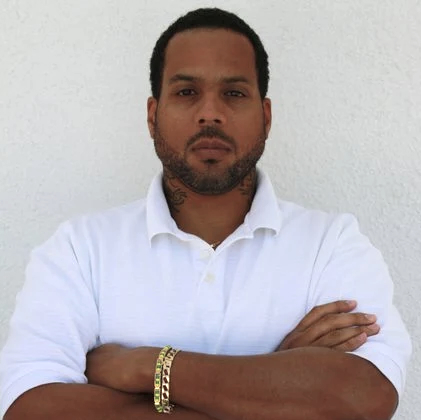

Letón Pé photo.

Audio By Carbonatix
For many outside the island, the sound of the Dominican Republic is instantly recognizable as the galloping rhythms of merengue, the heart-tugging sway of bachata, and the booming pulse of dembow. These genres have long defined the country’s global musical identity. But to stop there is to miss a much wider, more experimental, and increasingly global conversation happening among Dominican artists today.
That evolving sonic landscape arrives in Miami this month with two performances that feel less like concerts and more like cultural statements: Letón Pé at Hoy Como Ayer on April 23, and Alex Ferreira at ZeyZey Miami on April 30. Together, they offer a window into a Dominican music scene that is as diverse as it is deeply rooted, and one that is increasingly refusing to be defined by a single genre or exportable sound.
A Scene Beyond Borders
“I listen to music from all over the world, especially Africa, Brazil, and Norway,” says Alex Ferreira, who has been releasing music since 2010. His sound, a dreamy blend of indie pop, folk, and Latin textures, resists easy categorization, and that is precisely the point.
“There are hip-hop artists in Japan. Artists in Spain are not just doing flamenco,” he continues, pushing back against the tendency to flatten entire cultures into a single genre. Ferreira, now based in Mexico City for over a decade, sees Dominican music as part of a broader global dialogue rather than a fixed tradition.
Still, the island remains central to his identity. “La Zona Colonial is a meeting place for musicians with so much history,” he says, referencing Santo Domingo’s historic district, where generations of artists have crossed paths, collaborated, and tested new sounds in intimate venues and open-air spaces. That sense of place lingers in his work, even as his latest album, El Arte de Esperar, signals a shift inward.
“Before, my focus was on romantic songs, but now, looking ahead, I would like to delve into the social and political,” Ferreira explains. “Although, during these chaotic times, love is a revolutionary act.”
His evolution mirrors a broader shift among Dominican artists, who are expanding lyrical themes beyond romance and dance-floor escapism. Instead, many are engaging questions of identity, migration, urban life, and emotional complexity, often within genres that traditionally prioritized simplicity and rhythm over narrative depth.
Letón Pé and the Power of Specificity
If Ferreira’s work stretches Dominican music outward, Letón Pé pulls it inward, embracing language, rhythm, and identity with fearless precision.
The singer behind tracks like “Madrugá” and “Granada” has emerged as one of the most compelling voices in the island’s alternative pop scene. Her music blends tropical rhythms with experimental production, creating something that feels both distinctly Dominican and globally resonant, without losing its cultural specificity.
“I once thought about not using Dominican slang in my music because I thought some people would not understand it, say in Colombia or other parts of Latin America,” she says. “But then I would be thinning it.”
That realization became a turning point. Rather than dilute her voice, Letón Pé leaned into it, allowing local expression and linguistic texture to become part of the music’s artistic identity rather than something to smooth out. The result is Golosa, a new album that celebrates specificity in language, culture, and sound.
“I don’t want my sound to be general,” she says simply.
Her approach reflects a larger generational confidence among Dominican artists who are no longer writing for external validation. Instead, they are creating from within, trusting that authenticity travels further than translation. In this way, slang, cadence, and cultural references become assets rather than barriers.
A New Wave of Dominican Music Takes Shape
Letón Pé and Ferreira are far from alone. Across the Dominican Republic, a growing network of artists is redefining what Dominican music can be, often drawing on unexpected sources while remaining grounded in local tradition.
Acts like Mula fuse merengue with electronic textures, creating hypnotic, danceable soundscapes that feel equally at home in Santo Domingo and Berlin. Their work exemplifies how electronic production has become a bridge between Caribbean rhythm and global club culture, opening new spaces for merengue’s evolution beyond its traditional orchestration.
Meanwhile, pioneering figures like Xiomara Fortuna continue to champion Afro Dominican traditions, connecting contemporary sounds to deeper ancestral roots. Her influence is especially visible in the way younger artists are beginning to re-engage percussion, call-and-response structures, and spiritual elements that were historically marginalized in mainstream Dominican pop.
Bands such as Pororó and La Marimba, along with projects like Whitest Taino Alive, expand the spectrum further, incorporating elements of rock, folk, experimental composition, and Caribbean psychedelia. These projects often operate outside commercial circuits, building audiences through live performance, word of mouth, and digital platforms rather than traditional industry gatekeepers.
Emerging artists, including Martox and Snenie, bring fresh energy to this evolving ecosystem, often blending Afro-Dominican rhythms with contemporary production styles influenced by global electronic, hip-hop, and indie sounds.
Together, they form a scene that is less about genre and more about possibility. It is a musical landscape defined not by what it excludes, but by how much it can hold at once.
Miami as a Cultural Bridge
It is no coincidence that this wave is touching down in Miami. As a city shaped by Caribbean and Latin American diasporas, Miami has long served as a cultural bridge, a place where sounds evolve, collide, and find new audiences while remaining in constant conversation with their places of origin.
Venues like Hoy Como Ayer and ZeyZey Miami have become crucial platforms for artists who exist outside the mainstream, offering spaces where experimentation thrives alongside community and nightlife culture. These rooms function not just as performance spaces, but as informal cultural laboratories where genres blur and audiences expand their understanding of what Latin music can sound like.
For Miami listeners, these upcoming shows are invitations to rethink what Dominican music sounds like in 2026 and to consider how national identity itself evolves when it is carried across borders.
Because while merengue, bachata, and dembow remain vital and beloved, they are only part of the story.
What artists like Letón Pé and Alex Ferreira reveal is a Dominican Republic that is sonically restless, globally engaged, and unapologetically diverse. It is a scene that refuses to be boxed in, even as it honors the rhythms that came before, holding tradition and experimentation in the same breath.
And in a moment when music often feels driven by algorithms, playlists, and categories, that refusal might be the most radical act of all.
Stream our Nueva Ola Dominicana playlist on Spotify.
Letón Pé. Thursday, April 23, at Hoy Como Ayer, 2212 SW 8th Street, Miami; 786-822-7640. General admission tickets are $31.38 via shotgun.live
Alex Ferriera. Thursday, April 30, at ZeyZey Miami, 353 Northeast 61st Street, Miami; 305-456-2672. General admission tickets are $31.38 via zeyzeymiami.com