

Photo by Gabriel Kaplan/Flickrhttps://www.flickr.com/photos/ukapa/10218819233/

Audio By Carbonatix
While not all of us were fortunate enough to land a Tartan heartthrob during the 2026 FIFA World Cup, Miami-area short-term rental hosts apparently scored big during the tournament by earning more rental revenue than any other city across Canada, Mexico, and the United States (U.S.), according to a new study.
With a reported record $15 billion in revenue generated this year, the tournament (the biggest in its history in terms of teams and matches) was clearly a financial boon for many. According to a study released this week by short-term rental-tracking firm AirDNA, Airbnb and other rental hosts earned more than $1.3B, including about $42.7M earned by those in Miami.
It likely comes as no surprise for those who’ve been tracking the World Cup (or Miami for that matter). Miami ranked as the second-most expensive World Cup host city before the tournament even started, with the average ticket price at $2,094 (more than $600 above the tournament average).
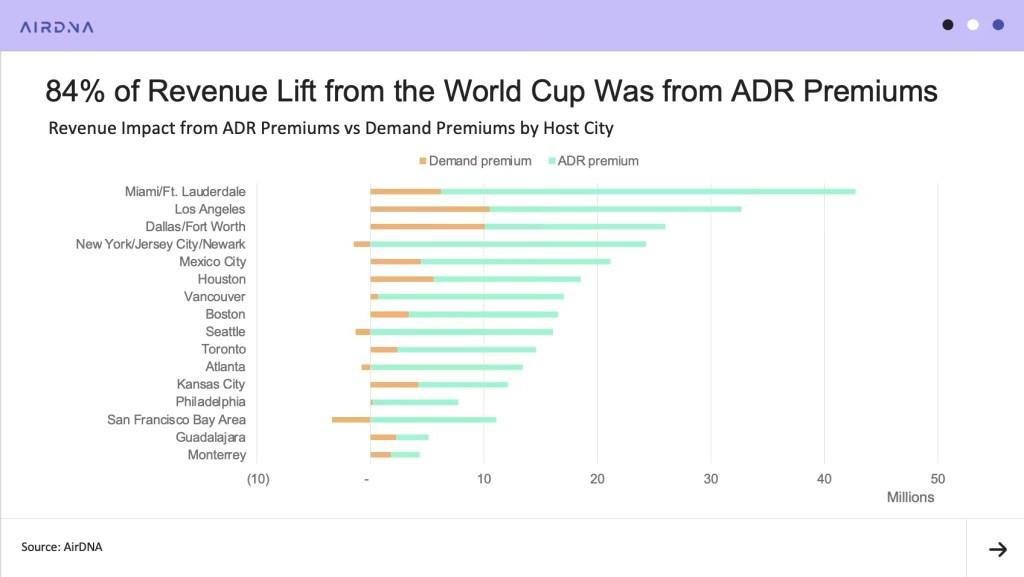
While Miami did host its fair share of highly coveted games that would attract any soccer fan, including hosting tournament darlings Cabo Verde twice, runners-up Argentina once, and the unforgettable 6-4 England/France bronze medal match, the major driving force for Miami’s earnings likely comes down to price, an AirDNA spokeswoman told New Times in a statement.
“$36.5 million of the $42.7 million additional revenue came from higher nightly rates, and $6.2 million from additional nights booked,” spokeswoman Sabrine Louhichi said in the statement.
That said, Miami’s marquee matchups did do the heavy lifting, Louhichi said.
“Occupancy and rate gains for Brazil vs. Scotland and Colombia vs. Portugal in the group stage far outpaced Miami’s other games, beating its Round of 32 (Argentina vs. Cape Verde) and quarterfinal (Norway vs. England) matches,” she said in the statement. “As one of the most supply-rich lodging markets in the tournament, Miami gave guests plenty of options, which is why rate growth, not occupancy, carried the revenue gain.
“Miami’s story is that scale plus the right fixtures beats everything: even modest percentage growth on a market this large translated into the biggest paycheck of the tournament.”