
Photo by Warren LeMay/Flickr

Audio By Carbonatix
Reading the name Center for Immigration Studies, you’d be excused for confusing it with some sort of legitimate body that dissects immigration without an agenda. After all, CIS describes itself as “an independent, non-partisan, non-profit research organization founded in 1985” and “the nation’s only think tank devoted exclusively to research and policy analysis of the economic, social, demographic, fiscal, and other impacts of immigration on the United States.”
What the description fails to convey is that it was founded by Otis L. Graham, historian and author of Unguarded Gates: A History of America’s Immigration Crisis, and white nationalist and eugenics champion John Tanton. CIS’s mission is not to provide well-researched information about immigration to the United States. Its core belief is that immigration is fundamentally bad for America, with its “scholars” pushing various flavors of the Great Replacement conspiracy. In fact, the Southern Poverty Law Center designates CIS as a hate group, owing to the group’s advocacy against all immigration, legal and illegal, use of bad stats and studies to demonize immigrants, and cozying up to known racists.
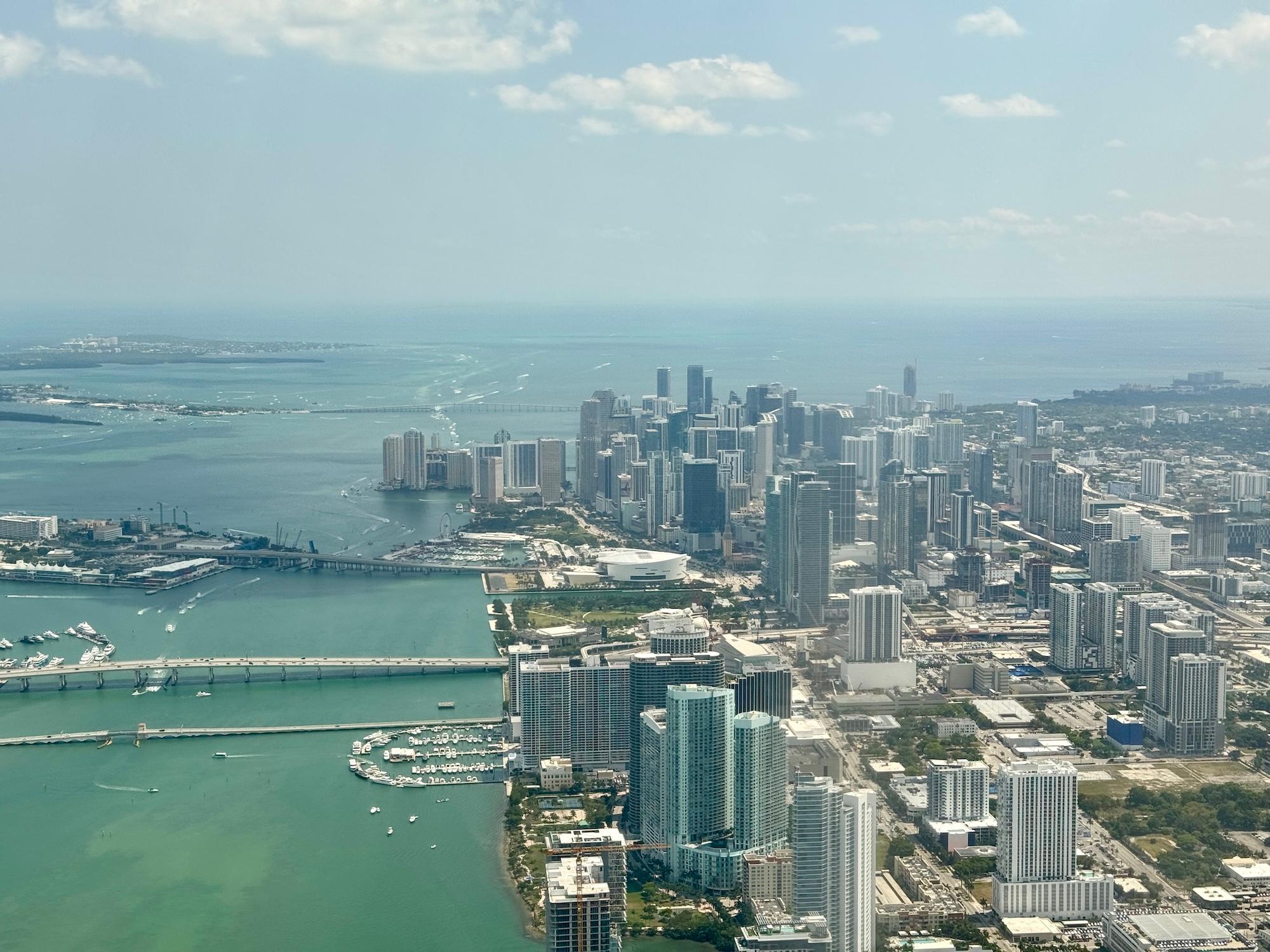
That’s why a recent CIS article titled “Miami: A Failure of the Assimilation Model” should be read with a heavy dose of skepticism. Author Jason Richwine begins his argument by citing political scientist Samuel Huntington, who was accused of using pseudoscience to support his theories, and points to Miami’s Spanish-speaking residents as a group that has determined assimilation and Americanization are largely unnecessary and undesirable.
Richwine then uses the 2026 World Baseball Classic championship game, in which the Venezuelan team beat the United States 3-2, as an example of Huntington’s 2004 observations that the Spanish language unites most of Miami’s population, and claims that it’s even more true today. Richwine is seemingly aghast at witnessing the Venezuelan diaspora in the stands cheering for the Venezuelan team, and argues that the American team was merely a visitor in a game played in Miami, an American city.
However, if you know anything about Latin American geopolitics, you’d know that much of the Venezuelan diaspora that calls Miami home these days hasn’t been here for very long. A major exodus began in 2002, when Venezuelans fled amid strikes and even an attempted coup in the aftermath of Hugo Chavez’s reelection, and continued throughout the tenure of his successor, Nicolás Maduro. So, is assimilation to be expected in this short timeframe?
Richwine argues that Miami has only grown more resistant to assimilation over the decades, cherry-picking census data to support his claim. You only need to know a bit of Miami’s history to know that comparing 1980s Miami to 2020s Miami is comparing apples to oranges. Miami-Dade experienced its own version of white flight in the 1980s, when the area was experiencing demographic change thanks to the Mariel boatlift and the rise of the cocaine cowboys. Richwine acknowledges “an exodus of non-Hispanics from the city in the 1980s and 1990s,” but insinuates that it was due to “multilingualism,” ignoring other factors. In 1992, Hurricane Andrew’s massive destruction of the county’s southern reaches, where most of the area’s white residents lived, was the final blow. Many packed up and left for good.
Ultimately, bad-faith arguments are nothing new for Richwine, who has spent most of his life advocating for anti-immigration policies. He is also a contributor to the Heritage Foundation’s Project 2025, the controversial initiative largely credited with the federal government’s right-wing turn.
If you need further proof that Richwine has an agenda, just know that he believes that Hispanic Americans are less intelligent than white Americans. It’s not that he believes Hispanics are at a societal disadvantage that perhaps contributes to the group’s purported lower IQ. No, he believes that Hispanics are genetically predisposed to have a lower IQ than whites. (See: white supremacy.)
As a Dominican-American who grew up in South Florida, I can dismantle most of Richwine’s arguments that Hispanics in Miami refuse to assimilate. My dad arrived in Miami in 1965 after the U.S. invaded the Dominican Republic during its civil war. At 24, with an eighth-grade education, he eventually earned his GED, then studied at Miami-Dade Community College and graduated as an engineer from Embry-Riddle Aeronautical University. He assimilated into American culture, speaking English in everyday life, including to my sister and me.
My mother, on the other hand, arrived in 1980, at 33, after marrying my father in a beautiful ceremony in the Dominican Republic following a three-month courtship. She arrived in Florida to move into my father’s Boca Raton apartment, where most residents lived up to the state’s former nickname, “God’s waiting room.” My mother gave it her all to learn English, including watching episodes of Sesame Street alongside me as a toddler.
To this day, she still finds it incredibly difficult to communicate in English without a sense of dread taking over. She understands it perfectly well, but freezes up when trying to talk. This is a woman who has read Leo Tolstoy’s War and Peace in English from cover to cover but cannot for the life of her spit out a complete English sentence without mangling the syntax or grammar. Most of my youth was spent defending my mother against people who spoke to her in a slow, over-enunciated drawl, as if she were a 5-year-old. “She can understand everything you’re saying!” I would always snap back.
Regardless of whether a person assimilates into a culture — in my opinion, that is a personal choice — the process of assimilation isn’t easy or linear. Richwine fails to acknowledge that many of Miami’s residents are still undergoing that process. And though he tries to poke holes in that argument by noting more Miami-Dade residents speak Spanish at home than ever, he fails to address the area’s demographic changes over the decades, as well as the fact that many second-generation Hispanics still speak Spanish at home to communicate with their parents and grandparents. Never mind that many parents choose to raise their children bilingual, speaking Spanish at home while their child sharpens their English-language skills at school. The report also does not differentiate between speaking a combination of English and Spanish at home.
There’s also the question of whether language is a good measure of assimilation, as if being proficient in English alone is necessary to integrate into American culture. Multiculturalism is the boogeyman for Richwine and his ilk, but America has never been a culturally homogeneous nation.
But also, Richwine, if you don’t like immigrants cheering for their home country, go to Tampa next time, pendejo.