Photo by Jesus Eduardo Uzcategui Veliz

Audio By Carbonatix
A couple of years ago, during a Noche Buena family gathering, we decided to celebrate the arrival of Baby Jesus by doing a little karaoke. I kicked things off with the classic Christmastime love ballad, “Cada vez que pienso en ti” by the late Cuban comedian Guillermo Álvarez Guedes. While my mom, siblings, and in-laws burst out laughing, my father, who abhors profanity and nasty talk, chugged a Corona and silently pondered where he went wrong as a parent when I got to the song’s most memorable verses, “Me cago en el año viejo/me cago en el año nuevo/me cago en el arbolito, y me cago en ti.” Translation: I shit on the old year, I shit on the new year, I shit on the little Christmas tree, and I shit on you.
Even though I am Nicaraguan, Álvarez Guedes was a prominent figure for old Miami heads like me during my adolescent years in the 1980s and 1990s. Hell, anybody who wasn’t Cuban growing up back then was bound to have some “azucar!“ infused into their daily lives. For me, it went beyond being surrounded by Cuban classmates. For most of my childhood and teen years, I primarily lived with my grandmother and my step-grandfather. A Black Cuban who emigrated to New York shortly after Fidel Castro rose to power on the island nation, he traveled the world and made his second home in Nicaragua, where he married my grandmother and solidified his right-wing worldview.
In 1979, the Sandinista rebellion forced my family to flee to Miami, where Cubans embraced us as brothers and sisters fleeing the growing threat of communism across the Western Hemisphere. At the time, Miami Latinos worshipped Ronald Reagan much the same way many of today’s Miami Latinos adore Donald Trump, but I digress.
I am not sure how old I was, but one day, while my grandparents were out partying with their fellow anti-communists, I was bored at home with a couple of friends. I rummaged through my step-grandfather’s stash of VHS tapes of recorded movies. Across one of the tapes were the names of Richard Pryor, Eddie Murphy, and Álvarez Guedes. We spent the night laughing our asses off at their stand-up shows, but the comedy by the Cuban with the frizzy black hair and bushy mustache resonated with us for years to come. Álvarez Guedes captured the zeitgeist of Old Miami.
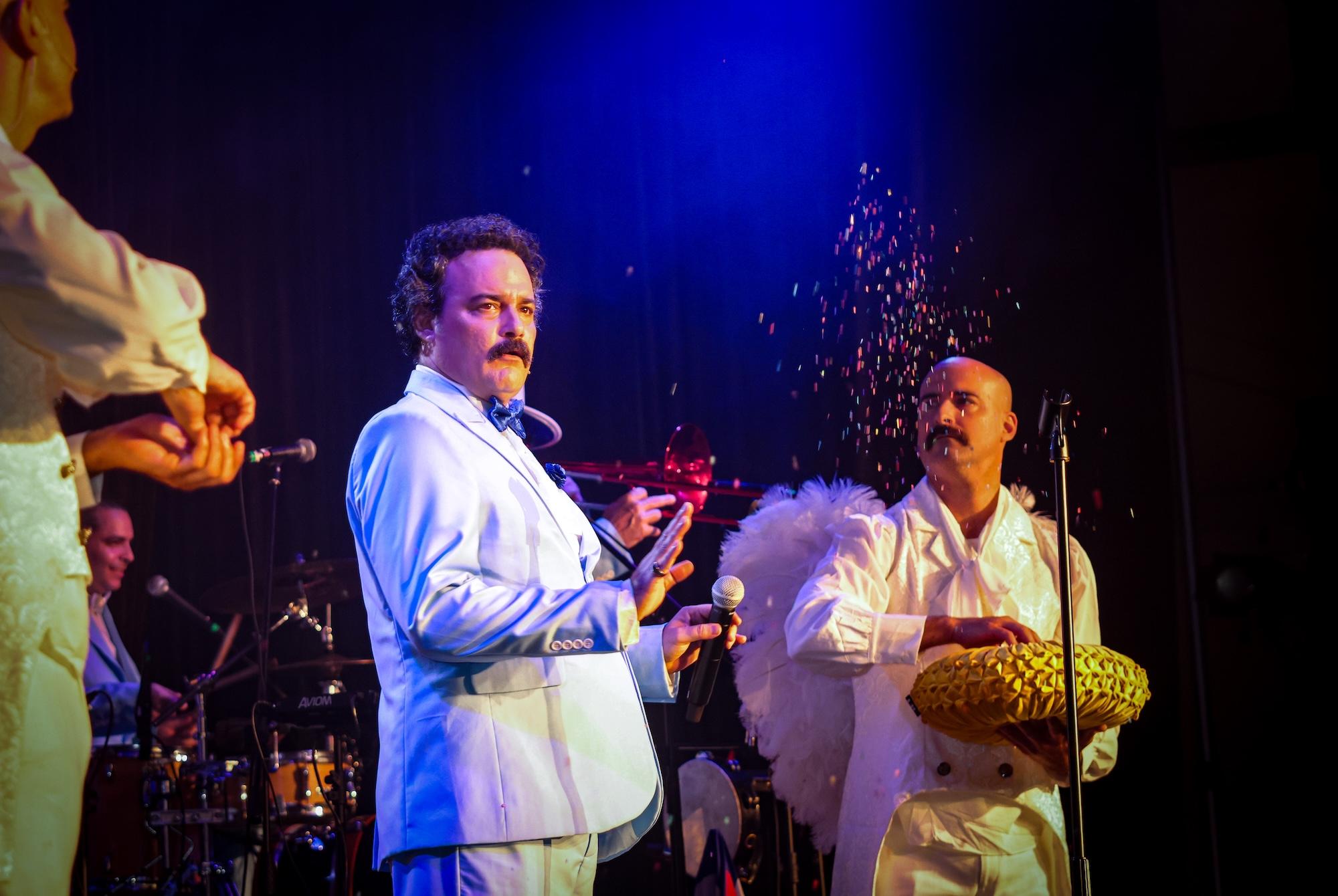
Through June 21, under a custom-built venue at Tropical Park in Westchester, a cabaret-style show aims to revive his era. Muerto de Risa: El Último Show de Álvarez Guedes stars Cuban actor Ariel Texido, who leads a small ensemble cast and a full orchestra on a nostalgic trip full of laughs and Miami Latino pride. Texido fully immerses himself in the role, deftly mimicking Álvarez Guedes’ deep, gravelly baritone as he reenacts famous stand-up routines from the late comedian’s career.
Muerto de Risa is the brainchild of Nelson Albareda, a Miami-based producer, music executive, and CEO of Loud and Live, the Doral-based events company behind the city’s new amphitheater. Albareda has won three Latin Grammys, including in 2024 for the album Celia Cruz En Vivo: 100 Años de Azúcar. He teamed up with Cuban-American actors Héctor Medina and Robby Ramos to co-direct and co-write Muerto de Risa. (Full disclosure: Albareda and I are former elementary school classmates.)
“If you grew up in Miami in the 1970s and 1980s, Álvarez Guedes was the godfather of Latin comedy,” Albareda says. “My memories are of getting with the family around the record player and listening to his albums.”
In Muerto de Risa, Álvarez Guedes gets permission from Saint Peter to return to Miami for one last show, Albareda explains. “It’s an immersive experience, full of dancers, full of music, and full of comedy.”
Born in Matanzas, Cuba, in 1927, Álvarez Guedes started performing as a child, bouncing through theater, circus work, and singing gigs, and eventually making his way into radio and television. He left Cuba after Castro’s revolution, first landing in New York, then passing through Puerto Rico and settling in Miami, where the exile community became both his audience and his material.
He distilled the exile experience into jokes that felt both local and universal. He worked in Cuban slang, streetwise insults, sexual innuendo, and family dynamics, then packaged it all with a rhythm that traveled across Latin America and the U.S. He was also fearless about translating Cuban politics and Miami social climbing into comedy. He mocked the pretensions of prosperous exiles, skewered the spread of Chupacabra hysteria, and parodied astrology with filthy one-liners. He captured the city’s contradictions better than most commentators ever could, which is why his work still resonates over a decade after his death in Kendall in 2013.
Muerto de Risa is reminiscent of Álvarez Guedes’ infamous performances at Tropigala, the long-gone entertainment venue at the Fontainebleau Miami Beach. That influence is felt throughout the production, which opens with Álvarez Guedes walking down a flight of heavenly stairs in a powder-blue tuxedo. There are dancers, live music, theatrical flourishes, and the kind of absurdist touches that would have made Álvarez Guedes himself smirk.
The setup is equal parts tribute and inside joke. A version of the comic’s old world comes alive again, only this time as a heightened spectacle built for an audience that still knows every punch line by heart.
Albareda compares Álvarez Guedes to another towering figure in American comedy. “He is the Richard Pryor of the immigrant story, which was painful, but people laughed about it,” he says.
With Muerto de Risa, Álvarez Guedes gets one more show, a heavenly sendoff, and a Miami-style wake. Attendees get something too: a reminder that for a certain generation, no one said the unsayable quite like him.
Muerto de Risa: El Último Show de Álvarez Guedes. Thursday to Sunday through June 21 at Tropical Park, 7900 SW 40th St., Miami; alvarezguedesmiami.com. Tickets cost $79 to $139.