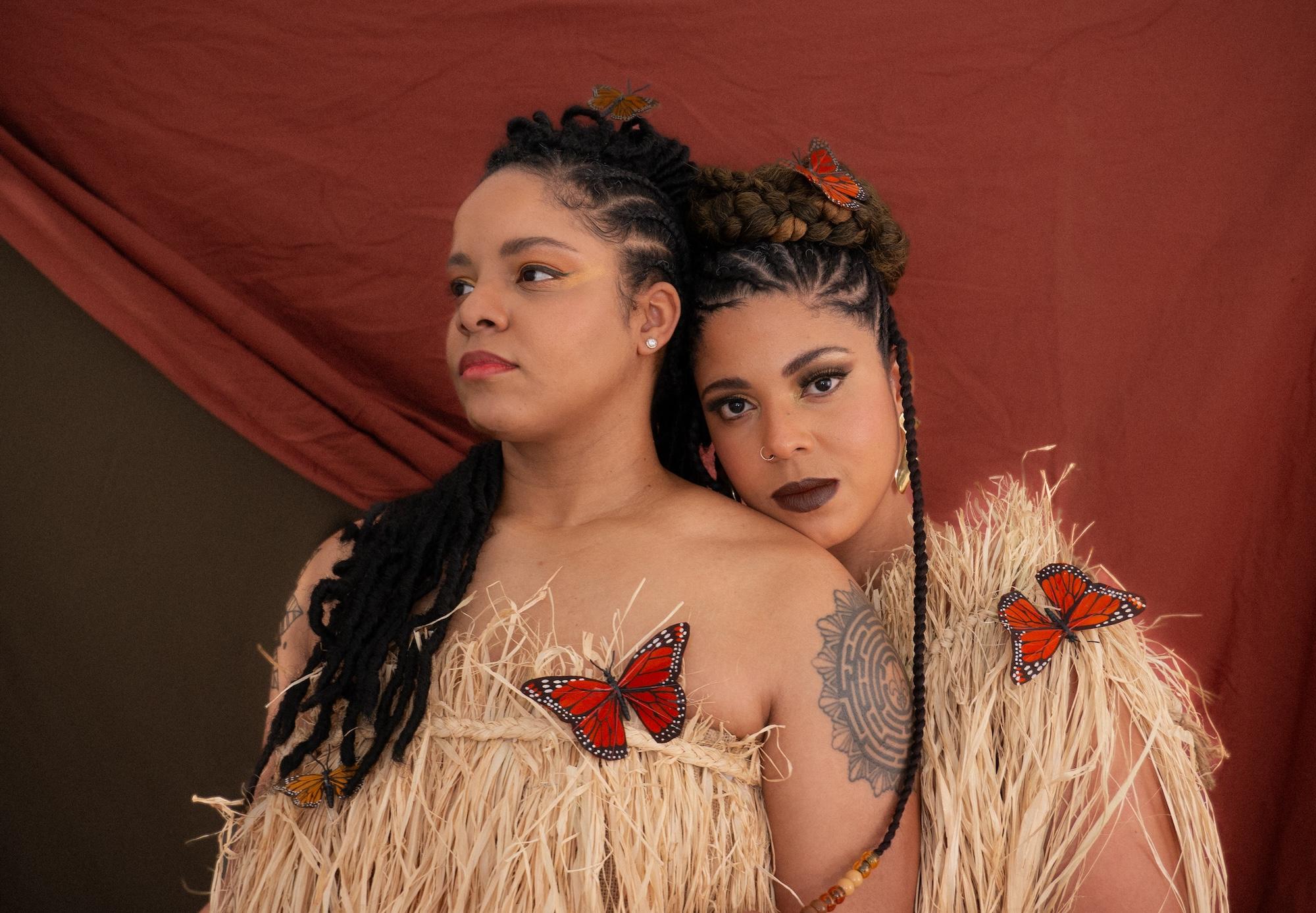
Photo by Luisa Maria Gonzalez

Audio By Carbonatix
The ocean shimmered beyond Palace’s rooftop, drag queens held court below, and somewhere between the sequins and the sea, Okan began talking about Cuba: their music reaching backward through Afro-Cuban traditions while stretching across the diaspora toward something entirely their own. Palace, a Miami Beach institution, felt like an unlikely but fitting place to talk about a journey that has taken Okan from Cuba to Canada and now South Florida. The setting felt almost ritualistic. Yemayá, the Afro-Cuban Orisha of the ocean, has long been an important presence in Okan’s spiritual and musical world, and there she was in a sense: the Atlantic stretching toward the horizon, the water moving beneath us, the city glittering at its edge.
For Elizabeth Rodriguez and Magdelys Savigne, the journey has been about more than geography. It has been about carrying a musical inheritance across borders, reshaping it along the way, and figuring out what home means when you’ve had to build it more than once.
We were at Palace, after all. Between talking about diaspora, identity, and the musical traditions they carry with them, I ate Thai mushroom dumplings and an Impossible Burger. The word “Impossible” seemed fitting as we talked about the improbable path that brought them here, and how, somewhere along the way, it made owning a home possible.
Rodriguez is from Havana; Savigne grew up in Santiago de Cuba. Both were introduced to music early, but Cuba gave them something deeper than technical training. “Cuba taught us how to be perfectionists,” Savigne says. “It taught us how to be disciplined.”
For Savigne, the path to percussion was not exactly conventional. She played piano as a young girl, but everything changed when she discovered drums. “When I first played, I could feel my heartbeat with each pounding,” she remembers.
The problem was that the musical world she wanted to enter was not particularly interested in making room for women. “Back then, no one wanted a female percussionist,” Savigne says. “We couldn’t even play the religious instruments.”
And jazz was difficult to access. The women were largely exposed to classical Cuban composers such as Manuel Saumell and Ignacio Cervantes. There was no internet, and Rodriguez remembers a tightly controlled musical environment. “We only heard Cuban music from Cuban artists,” she says. “We weren’t allowed to listen to anything else.”
Still, music found a way through the cracks. Underground connections exposed them to sounds beyond the island, while timba was emerging and expanding the possibilities of Cuban popular music.
The women met in Canada while playing in another group. There, they encountered another kind of limitation. Their former band’s lead composer, they say, was a white woman who appropriated Black and Afro-Cuban musical traditions without understanding the meaning behind the songs. “We would be in Black spaces, and she would give an explanation of a song, and the audience would look at her as if she had two heads,” Rodriguez recalls.
Eventually, they realized that if they wanted their music to be understood — and their talents used properly — they had to leave. They formed Okan, a vessel for everything they had carried with them: Afro-Cuban traditions, jazz, global music, Orisha spirituality, migration, and the complicated experience of being Cuban women creating music outside Cuba.
Their approach isn’t about placing those traditions behind glass. It’s about allowing them to evolve. “We play Cuban music with a contemporary lens,” Savigne ignites.
That lens has grown increasingly expansive. Their music incorporates Afro-Cuban rhythms and chants dedicated to Orishas, including Obatalá, Oyá, and Oshun, while contemporary production and sounds from Cuba and its diaspora — including reparto — push the music forward.
Their upcoming album, “Ife ara”, which means “self-love,” traces what happens after rupture: grief, anger, reflection, healing, and eventually the reclamation of the self. It asks what it means not simply to love yourself, but to trust your instincts, inhabit your body, reclaim your voice, and recognize what you deserve.
The album’s first single, “Te Falta Grasa,” featuring Afro-Cuban singer and composer Daymé Arocena, brings that message to the dance floor. With a seductive reggaeton pulse and an irresistible rhythmic swagger, the song practically dares you to move. Its playful title and sensual energy turn self-acceptance into something physical and joyful.
“Ashes,” meanwhile, channels Oyá, the warrior Orisha associated with wind and cemeteries. It opens with a declaration of resurrection: I rose from the ruin / Reborn in flame / Not a victim now / I’ve reclaimed my name.
Elizabeth has the combustible charisma of Eartha Kitt, all firecracker energy and unapologetic candor; Magdelys is her cool, composed counterweight, with the unhurried grace of Sade. Even sitting across from them, the contrast is striking. Elizabeth leads with emotion; Magdelys is quieter and more inward, describing herself as someone who retreats into the cocoon of home. “I’m like a mountain,” Savigne whispers.
Rodriguez speaks with particular reverence about La Lupe and Nina Simone, artists whose emotional honesty was never designed to make anyone comfortable.
“I first heard La Lupe when I was 19,” she says. “I had to immediately know who that was coming out of the speakers. The raw anguish emanating from her soul stopped me in my tracks.”
That same refusal to soften herself carries into her understanding of queerness.
Rodriguez was previously married to a man. Savigne is her first relationship with a woman. They have now been together for nearly a decade. Coming out to her family was difficult, but Canada gave Rodriguez an early taste of another kind of freedom.
“Gay Pride in Toronto felt open,” she says enthusiastically.
Their marriage and musical partnership have revealed parts of each woman that might otherwise have remained undiscovered.
“I wouldn’t have known my skills as a composer if it weren’t for Magdelys,” Rodriguez admits. Savigne puts it more simply: “We have a connection that can’t be broken.”
Onstage, that connection becomes something larger. Rodriguez is expansive and commanding; Savigne communicates through her percussion.
“I express myself through my instrument,” Savigne says. “My instrument protects me from the world. Once the music ends, I crawl back into my shell.”
That intimacy has traveled remarkably far. Okan is a two-time Juno Award winner, and their recent Tiny Desk performance introduced their music to an even broader audience.
For Rodriguez, the performance was a dream fulfilled. For Savigne, it was almost surreal. “I was so nervous during our Tiny Desk concert that I couldn’t remember anything until I watched the video,” she says. “Everything was a haze.”
With only three songs to introduce their musical language to a new audience, they wanted to make the complexity of their orchestrations—and the presence of Orisha and immigration — impossible to miss.
After leaving Cuba, Savigne says, she does not spend much time looking backward. “When I leave, I leave,” she says. “I’m constantly looking ahead.”
Rodriguez had a harder time. She cried every winter in Canada, missing home. Yet neither woman believes belonging is as simple as geography. “We belong to no one and to no place,” Rodriguez says. “We belong to our work.”
Then comes the larger provocation: “Belonging is a construct. Governments create borders, and here we all are on stolen land.”
Miami has made community easier, but Okan’s sense of belonging remains more fluid. They belong to themselves, nature, and their work. That philosophy extends to their politics. “Artists have a responsibility to challenge societal norms without using pretentious language,” Rodriguez says. “The older we get, the more radical we see ourselves getting.”
She remains blunt about cultural appropriation and the imbalance that has long existed in the music industry. “Foreigners go to Cuba, steal the musical culture and sounds, go back home, and make the money,” she says through gritted teeth.
Then, characteristically, she breaks the tension with humor. “Most immigrants come here to work hard and contribute to the economy,” Rodriguez says. “And quite frankly, to add flavor, because without certain immigrants everyone here would just be eating potatoes,” she laughs.
Most Okan performances begin with a tribute to Eleguá, the Orisha who guards the crossroads and opens the way.
Palace has spent nearly four decades as a kind of port of call for Miami’s queer community — a place to arrive, find your people, and be seen. Okan knows something about crossing waters. Their lives have moved through countries and cultures, but the destination has never been as important as what they have created along the way.
A marriage. A home. A musical language.
Okan means heart. After all those crossings, perhaps that is the one place they have never had to leave: the space they have built between them.
Okan + Afromore. Saturday, October 10, at Sanctuary of the Arts, 410 Andalusia, Coral Gables; 786-362-5132. Tickets available via proarteinc.com