
Screenshot via YouTube/James Fishback

Audio By Carbonatix
Advertising Can't Do It Alone
The challenges facing local news organizations are very real. That's why reader support matters more than ever. If you believe independent journalism matters, make a contribution today and help us reach our summer fundraising goal of $10,000 by August 9.
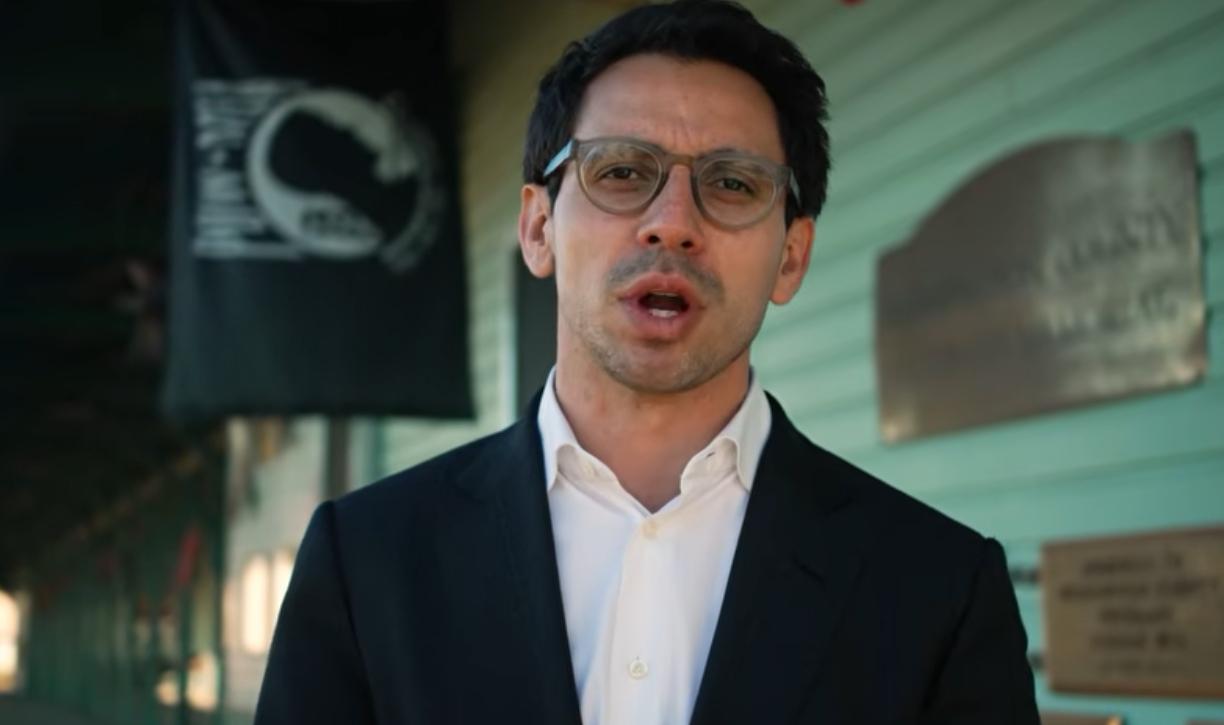
South Florida native James Fishback will remain on statewide ballots in the governor’s race after a Leon County judge Monday ruled he is eligible to run, according to court records.
Fishback, who didn’t respond to New Times’ request for comment, celebrated the ruling in a post on X, writing, “It’s official. I will remain on your ballot. The disgraceful lawfare brought by Jay Collins and fueled by Byron Donalds has failed. This is a victory for our campaign, for the Constitution, and for every Floridian who believes elections should be decided by voters.”
The full statement can be found below.
According to the ruling, which the court posted online late Monday night, Florida’s 2nd Judicial Circuit Court Judge David Frank denied Collins’ motion to remove Fishback from the gubernatorial ballot.
In the ruling (attached below), Frank says he had to evaluate the credibility of the witnesses, including expert researchers on Collins’ side and Fishback’s dad and himself on the defendant’s side, when determining who to trust. He acknowledges the veracity of Fishback’s homestead exemption on the property (something property owners can only have on their primary residence) but ultimately decided to trust Fishback’s word on where he lived — backed by his Florida driver’s license, his 305 telephone number, and state vehicle registration — according to the judge’s ruling.
“Based on the court’s observation of the defendant when he testified, and the credibility determination outlined above, the court finds that despite defendant stating at various points, or someone stating on his behalf, that his ‘residence’ was in Washington, D.C., defendant never had an actual subjective intent to move his permanent residency, his domicile, from Florida to Washington, D.C.,” Frank wrote in the ruling.
He goes on to write, “defendant considered the D.C. condominium his ‘second residence’ and an ‘investment property.'”
Collins’ attorney Mark Meuser blasted the decision and Fishback in a statement to New Times Tuesday morning, arguing Fishback during the trial “demonstrated he does not have the mental capacity to govern himself, let alone Florida.”
“It’s disappointing the court accepted Fishback’s novel legal theory that ‘ignorance of the law’ is now a defense when it comes to Florida residency,” Meuser said in a written statement to New Times. “His defense is he didn’t commit election fraud, he’s just ignorant of the law on who can register to vote and vote; he didn’t commit mortgage fraud, he’s just ignorant of the law on how mortgage and interest rates work; he didn’t commit fraud in obtaining a homestead exemption, he’s just ignorant of the law and what he was signing; he didn’t commit state and federal tax fraud, he’s just ignorant of the law on who has to pay DC income tax.
“His ignorance may be enough to keep him on the ballot, but who wants to vote for a candidate whose own sworn testimony is he committed mortgage fraud and doesn’t understand how the law works when it comes to election integrity and paying state income taxes.”
The race to replace Gov. Ron DeSantis has been fraught with controversy over the past year, with Fishback a prime figure of many of those scandals. Some lowlights of the 31-year-old Davie man’s campaign include: lying about being a commencement speaker at his alma mater Boyd H. Anderson High School in Lauderdale Lakes, wanting to impose a “sin tax” on OnlyFans performers, reportedly owing attorneys more than $150,000 in legal fees, and marrying Valeria Quimby months after posting photos of another woman he referred to as Florida’s future First Lady.
The question of his eligibility to run in Florida has circulated for months. It finally manifested in a lawsuit (attached below) earlier this month.
The crux of Collins’ argument centers on OTR granting Fishback’s D.C. apartment a homestead exemption (a tax break granted only for a homeowner’s primary residence) for his property taxes in 2021. Fishback previously told New Times he bought the D.C. apartment in question in 2021 because it was a block away from his parents’ home, but he never lived there full time as the lawsuit claims.
Fishback had an answer for that, too, telling New Times previously that the tax office erroneously granted the exemption.
OTR public affairs officer Eric Balliet previously told New Times the office “received a homestead deduction application for this property signed by Mr. Fishback and dated Sept. 24, 2021, which was processed by OTR on Oct. 7, 2021.”
Balliet confirmed part of Fishback’s account, saying an April 2026 audit found the homestead exemption had been erroneously applied beginning in 2023. That means the exemption was valid from 2021 until it was incorrectly renewed in 2023 — years that encompass the period during which a 2026 gubernatorial candidate would have had to establish Florida residency.
But, according to state law, Fishback’s own word is the most powerful evidence.
“Florida residency law places great weight on the subjective intent of the person declaring residency. ‘The best proof of one’s domicile is where [the person] says it is.’ That law may be imprudent, or it may give too much leeway to a person seeking or maintaining residency. But it is the law.
“Defendant took the witness stand, was sworn in, and testified under oath that it was always his intention to keep Florida residency, and that he never intended to abandon it.”
Ultimately, the judge sided with Fishback, meaning he’ll appear alongside Collins on the Republican primary ballot on August 18, ahead of Election Day on November 3.