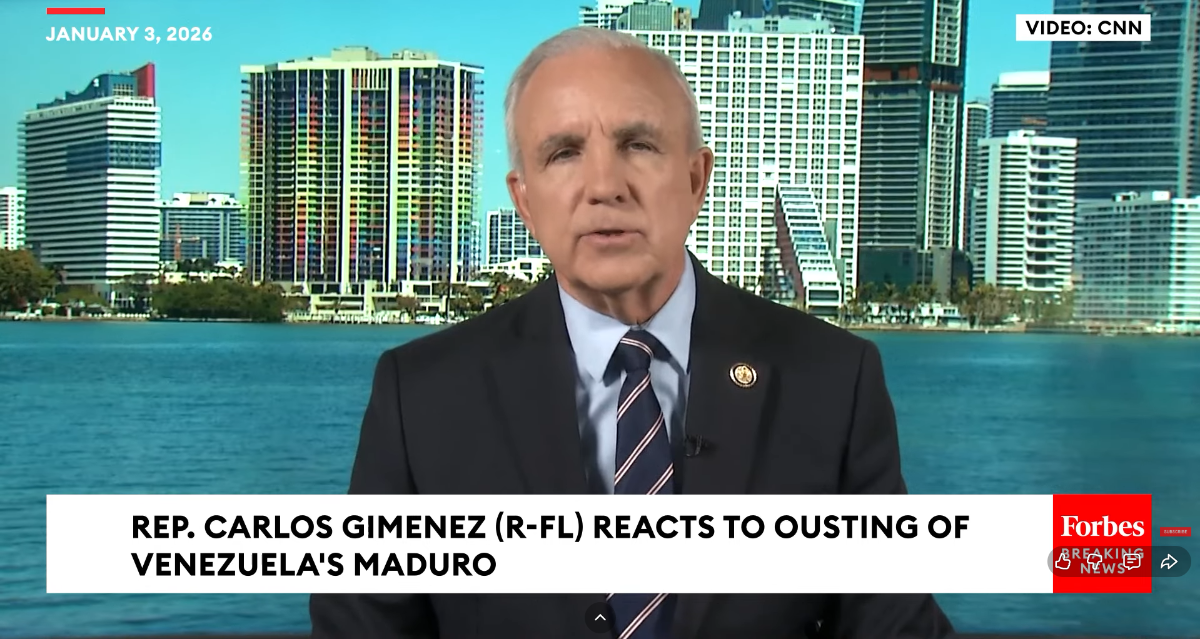
Screenshot via Forbes Breaking News/YouTube

Audio By Carbonatix
Since the United States bombed Venezuela and captured dictator Nicolás Maduro and his wife, Cilia Flores, in an overnight military action on Saturday, much has remained uncertain about the country’s future.
While Maduro is gone, his top allies remain in power in the oil-rich nation, with Delcy Rodríguez, formerly Venezuela’s vice president and oil minister, being sworn in as the country’s interim president late Monday afternoon. President Donald Trump’s administration continues to threaten further U.S. military action in Venezuela (among other Latin American countries). And democracy appears to be sidelined amid the chaos, with Trump telling reporters on Sunday evening aboard Air Force One: “What we want to do is fix up the oil, fix up the country, bring the country back, and then have elections.”
But while those in Trump’s inner circle, including U.S. Secretary of State Marco Rubio, have said that conversations about holding democratic elections in Venezuela are “premature,” not everyone agrees.
Miami congressman Carlos Giménez, who was reportedly among the first members of Congress to speak with Rubio following Maduro’s capture, said the country must hold new elections sooner rather than later.
“It can’t be years, I’ll tell you that right now,” Rep. Giménez told Fox News. “This is what these regimes do. They just negotiate for time, try to wait you out, so you weaken your will. So it can’t be — I’m talking months, I am not talking years.”
Born in Havana, Cuba, Giménez’s family immigrated to the U.S. in the wake of the 1959 Cuban Revolution and settled in what is now known as Miami’s Little Havana neighborhood. He attended the recent Nobel Peace Prize ceremony in Norway honoring Venezuelan political opposition leader María Corina Machado — who was expected by many in Venezuela and abroad to assume leadership after Maduro’s detention, but was ultimately sidelined when the U.S. backed Rodríguez.
Giménez, who chairs the House Homeland Security Subcommittee on Transportation and Maritime Security, told the Wall Street Journal he learned around 4:27 a.m. that Maduro had been seized when Rubio called him with a few simple words: “We got him.”
“I knew who he was talking about,” Giménez said in the interview.
The U.S. seized Maduro and his wife in a military operation Saturday, capturing them in their home on a military base in Caracas and bringing them to New York via the warship USS Iwo Jima. In a press conference early Saturday morning, Trump said the U.S. would “run” Venezuela until a “safe, proper, and judicious transition” of power could take place.
Amid seemingly contradictory messages between Trump and Rubio about who, exactly, is running the Latin American nation, Trump doubled down on his assertion that the U.S. was “in charge” of Venezuela on Sunday evening.
“We’re dealing with the people. We’re dealing with the people that just got sworn in,” he told reporters as he flew from Florida back to Washington. “And don’t ask me who’s in charge, because I’ll give you an answer, and it’ll be very controversial.”