
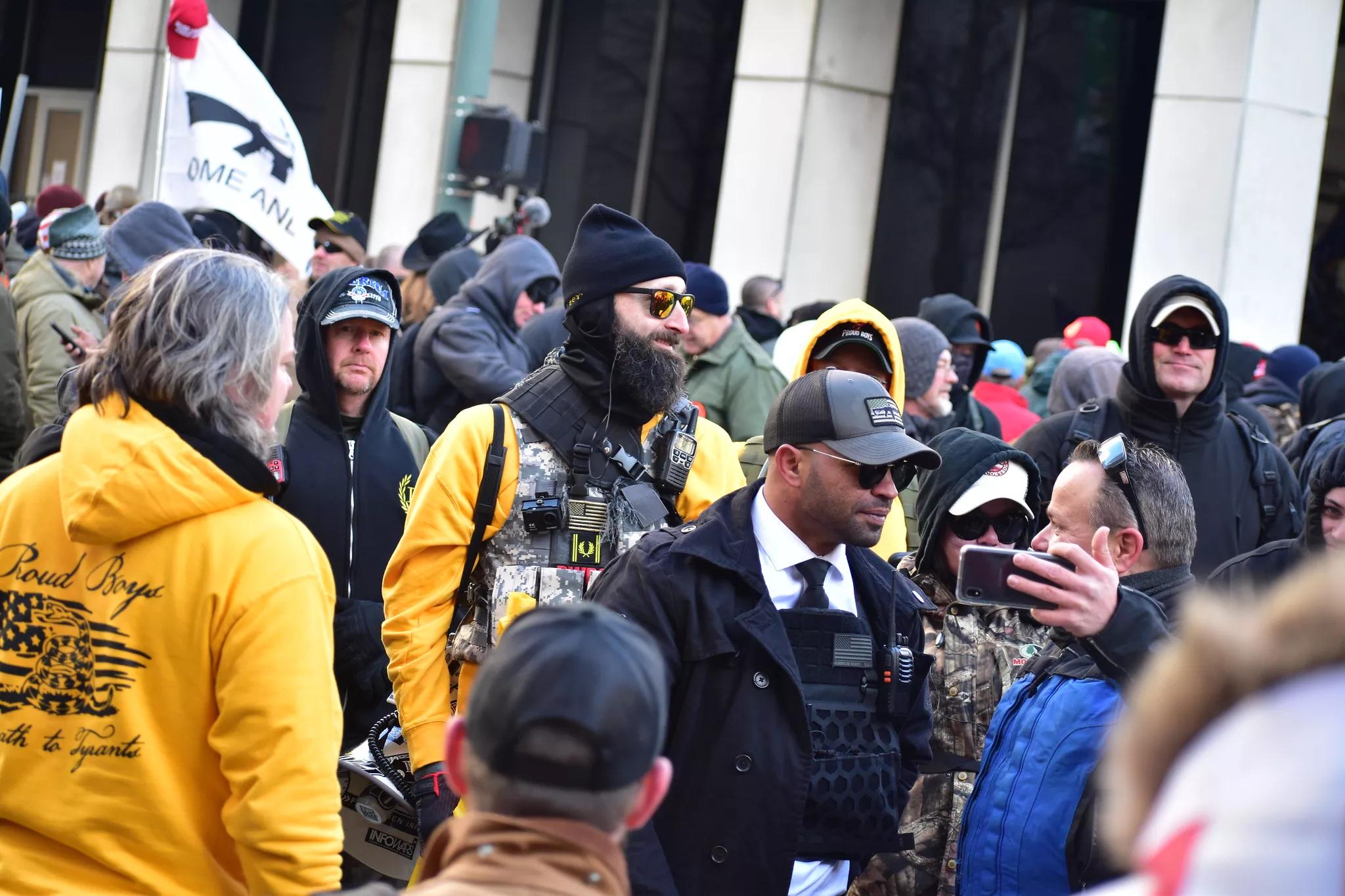
Photo by Anthony Crider

Audio By Carbonatix
On Monday, the U.S. Department of Justice (DOJ) announced the creation of a new $1.8 billion “anti-weaponization” fund to compensate people who claim they have “suffered weaponization and lawfare.”
The announcement provided scant details about how the fund would operate or who would qualify for payouts, but President Donald Trump told reporters the money was intended for people who were “horribly treated,” while Vice President JD Vance said Tuesday that “anybody” can apply. The loose criteria quickly raised questions about whether American taxpayers would ultimately end up bankrolling people prosecuted for the Jan. 6, 2021, attack on the U.S. Capitol.
While legal challenges are already underway to block the fund, at least one Miami-born Jan. 6 figure says he plans to cash in.
In a phone interview with New Times on Wednesday morning, longtime Proud Boys leader Enrique Tarrio said that while he hasn’t taken any concrete steps yet, he will “definitely” seek compensation from the money pot, which he described as “another promise made, another promise kept” by Trump.
“I’ve been pushing for this,” Tarrio said. “I think I was weaponized against. I think I’m a good example of that.”
Tarrio, an Afro-Cuban American who became the Proud Boys’ leader in 2018, steered the group in a more political direction, providing security for right-wing political figures and appearing at rallies on divisive issues, including covid-19 mask mandates and the 2020 presidential election. The Southern Poverty Law Center, a nonprofit civil-rights advocacy organization, has long designated the Proud Boys as a “hate group” because of the club’s frequent brawls with leftist protesters at political rallies and ties to white-nationalist and neo-Nazi groups while Tarrio was chairman.
While Tarrio was not at the U.S. Capitol on Jan. 6, 2021, prosecutors nonetheless cast him as the mastermind of the attack, presenting evidence showing he created a special wing of the Proud Boys called the “Ministry of Self Defense,” which coordinated attacks during the insurrection and celebrated them afterward.
“Make no mistake…we did this,” Tarrio told senior Proud Boy leadership after the attack, according to the DOJ.
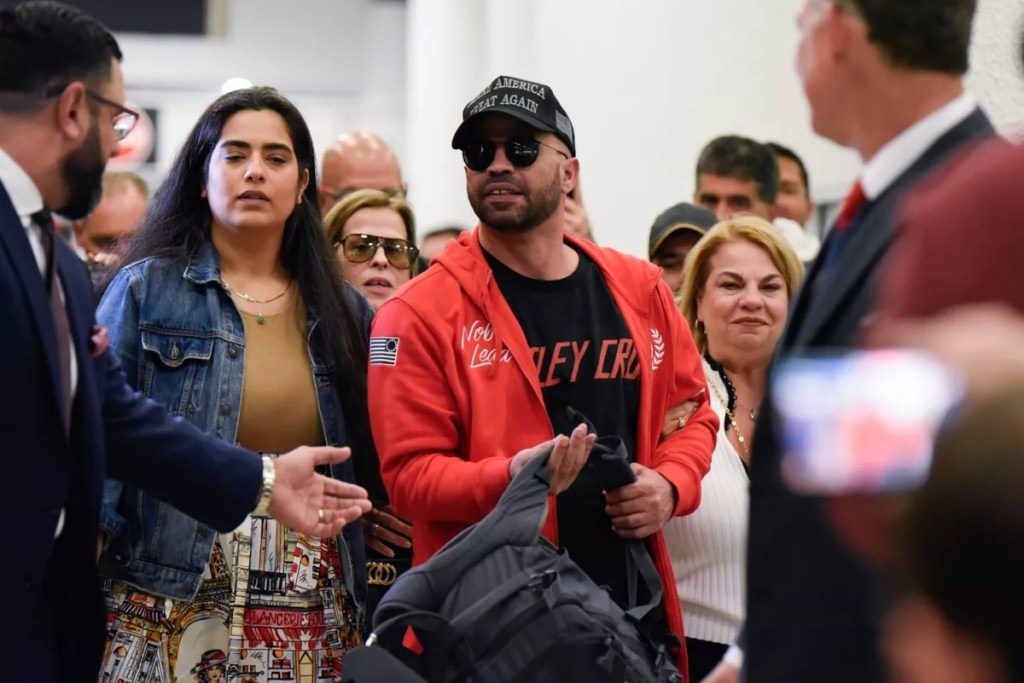
Photo by Michele Eve Sandberg
He was sentenced to 22 years in prison for seditious conspiracy and other charges, the longest sentence imposed on any January 6 defendant. But in January 2025, just 16 months into his sentence, Trump pardoned Tarrio alongside the more than 1,500 people who’d been charged in connection to insurrection at the U.S. Capitol on January 6, 2021. He was freed from prison on January 21, 2025 and returned to Miami. Including his time in jail awaiting trial and sentencing, he spent 34 months behind bars.
During a Senate hearing on Tuesday, Deputy Attorney General Todd Blanche said payouts from the fund will be decided by a five-member commission, four of whom will be selected by the attorney general and one in consultation with Congress.
On Tuesday, longtime Trump ally Michael Caputo filed the first known claim for the fund, seeking $2.7 million in restitution. The political operative, a former spokesperson for the Department of Health and Human Services during Trump’s first term, claims he was the target of an FBI investigation into whether the Trump campaign coordinated with Russian efforts to interfere in the 2016 presidential election.
As for how much money Tarrio would seek?
“How much I think I deserve as a whole other ball game, but I think I’m more realistic than most when it comes to that,” he said. “But yeah, this is definitely a really, really, fucking good step.”
The controversial fund was set up after Trump agreed to drop a $10 billion lawsuit he filed against the IRS over the leak of his tax returns “in exchange” for the establishment of the fund.
But the fund, which has been widely described as highly unusual, has been blasted by critics as a “slush fund” for “insurrectionists.” On Tuesday, two officers who defended the U.S. Capitol during the Jan. 6, 2021 attack sued to block the fund, describing it as a “taxpayer-funded slush fund to finance the insurrectionists and paramilitary groups” that they say committed violence in the president’s name.
“Although Trump and his cronies have been secretive about the fund’s ends, reporting leaves no doubt that it will be used, among other purposes, to pay the nearly 1,600 people charged with attacking the Capitol on Jan. 6, 2021,” the complaint reads.