
Photo by Scott Gries/ImageDirect

Audio By Carbonatix
Picture this: It’s 2045. A group of elementary school students wanders through a museum exhibit dedicated to Celia Cruz. As they stop in front of one of her dazzling stage gowns, the Queen of Salsa begins telling them its story herself — not through an actor, not through a narrator, but in the unmistakable warmth and cadence of her own voice.
It sounds like science fiction. Instead, it’s the future Omer Pardillo has spent years trying to imagine.
The longtime manager, closest confidant, and executor of Cruz’s estate believes artificial intelligence can help preserve one of Latin music’s most recognizable voices long after those who experienced her in person are gone. But only if it’s done with the same care and integrity that defined her life.
That’s the thinking behind the Celia Cruz Estate’s new partnership with ElevenLabs, the AI audio company that has developed an officially licensed digital version of Cruz’s speaking voice. The technology won’t be used to create new songs or resurrect performances. Instead, the estate envisions educational and cultural projects — from narrating museum exhibits to reading children’s books — that allow future generations to hear Cruz tell her own story.
“I was impressed with what ElevenLabs did with Maya Angelou,” Pardillo tells New Times. “The voice sounds just like Celia. This was a very meticulous process, but Celia is an icon, and this endeavor needs to be treated as such.”
Almost immediately after the partnership was announced, it raised the kinds of questions that increasingly accompany AI projects involving artists who are no longer alive. Should technology recreate the voices of cultural icons? Where is the line between preservation and exploitation? Who decides how those voices are used?
For Pardillo, the answer begins with purpose.
The estate’s goal isn’t to create a digital performer. It’s to preserve Cruz’s voice as a historical and cultural resource that allows future generations to experience her personality beyond her recordings. “People need to understand that this is about education and culture,” reinforces Pardillo. “We’re not creating new songs or trying to reinvent Celia. The goal is to let future generations hear her tell her own story in her own voice.”
That philosophy reflects a broader mission Pardillo has embraced since Cruz died in 2003. Rather than chasing novelty, he has spent more than two decades carefully expanding her legacy while protecting the authenticity that made her one of Latin music’s most beloved figures.
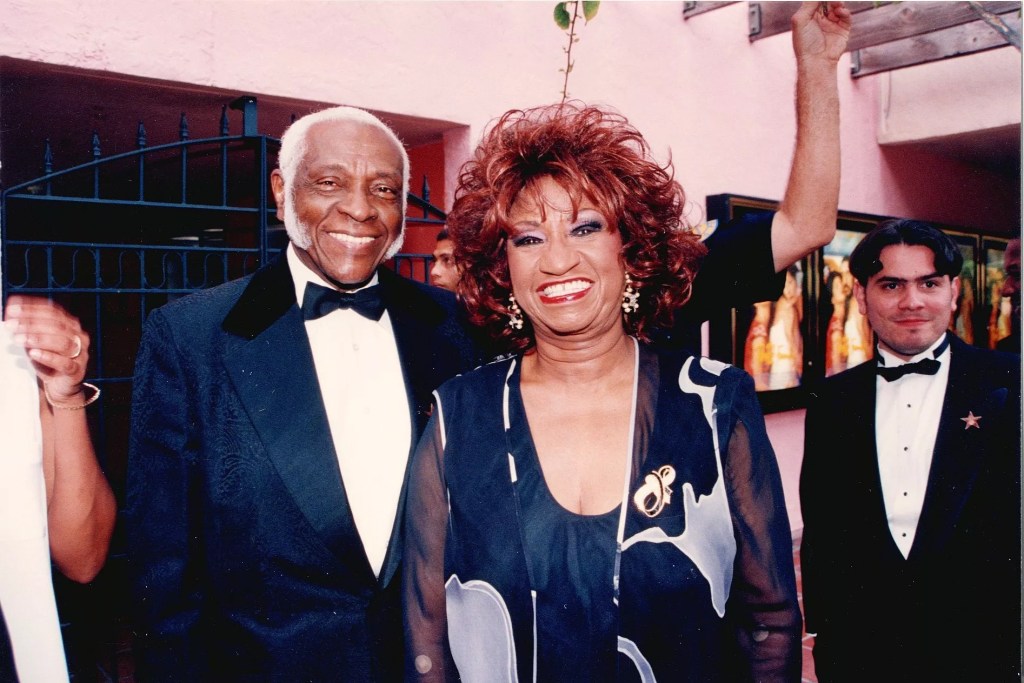
Celia Cruz Legacy Project
His stewardship has included overseeing the Forever CELIA museum exhibition, helping guide Cruz to become the first Spanish-language artist inducted into the Rock & Roll Hall of Fame, celebrating her selection as the first Afro-Latina honored on a U.S. quarter, and continuing the work of the Celia Cruz Foundation, which provides scholarships for underserved students pursuing music.
Artificial intelligence, he says, is simply another chapter in that work.
That philosophy is rooted in a relationship that spans most of Pardillo’s life. He first crossed paths with Cruz as a teenager before eventually becoming her publicist, personal manager, and, after her death, the executor entrusted with protecting her legacy. “Celia trusted me,” he says. “Because of that trust, every decision we make has to protect who she was. We approve everything. No one can simply access her voice and use it however they want. We’re being very deliberate and very careful.”
That care extended to the technology itself. One of the biggest surprises during development wasn’t whether AI could replicate Cruz’s voice, but which version of her voice it captured. “The first demo had to be tweaked,” Pardillo recalls. “Celia was two different people.” The larger-than-life performer audiences knew was only one side of her personality.
“Onstage she was boisterous, loud, and full of energy,” he says. “But offstage she was soft-spoken and articulated every word.”
He laughs while remembering one particularly distinctive trait. “Sometimes Caribbean people shorten certain words,” he says. “Celia never shortened a word.”
Those details mattered. Re-creating Cruz wasn’t simply about matching her cadence or accent. It meant capturing the warmth, elegance, and precision that fans rarely witnessed away from the spotlight. Pardillo believes that same authenticity is what will make the project meaningful for people who never had the opportunity to see Cruz perform live. “My hope is that, 20, 30, even 40 years from now, people will still be able to experience her essence,” Pardillo says. “Technology may change, but her music will always remain exactly as she created it. This is simply another way for future generations to connect with the woman behind the voice.”
Throughout the conversation, Pardillo repeatedly returns to one word: “essence.”
For him, preserving Cruz’s legacy has never been about nostalgia. It’s about ensuring people understand the woman behind the sequined gowns and booming stage presence.
One memory, in particular, remains impossible for him to forget. While receiving treatment for a brain tumor in New York City, Cruz became friendly with two Dominican teenage girls who were also undergoing treatment. The girls excitedly told friends and relatives they had been spending time with the legendary singer, but no one believed them.
“Celia told them, ‘If I feel good after today’s treatment, I’ll go to your neighborhood so everyone can see you really know me,'” Pardillo recalls.
Despite everything she was enduring, she kept her promise. “Celia did exactly that,” he says. “That’s who she was.”
Stories like that explain why Pardillo is comfortable embracing AI only within delicately defined limits. The technology, he believes, should amplify Cruz’s humanity rather than replace it.
The estate has established firm guardrails governing how Cruz’s AI voice can be used. “We have the final say,” Pardillo says. “Her voice will never be used for politics or anything that doesn’t align with who she was. This project is about preserving her legacy, because Celia always believed music had the power to bring people together.”
ElevenLabs, whose AI voice technology has also been used to preserve the voices of notable cultural figures, says it approached the collaboration with the same philosophy.
“There’s no voice quite like Celia Cruz’s, her energy, her joy, and her cultural impact are truly one of a kind,” Bridget Ferris, Talent Partnerships at ElevenLabs, said in a statement. “We are thrilled to partner with her Estate and Xavie Agency to bring her voice into this new chapter of technology in a way that is intentional and worthy of her extraordinary legacy.”
As artificial intelligence continues reshaping the entertainment industry, Cruz’s estate is betting that transparency and restraint will determine whether audiences embrace these projects. Pardillo insists the technology should never overshadow the artist herself.
Instead, he hopes it becomes another bridge between generations—one that allows children who never saw Cruz command a stage to hear the warmth, optimism, and unmistakable cadence that made her beloved around the world.
Asked what Cruz would tell a young person hearing her voice for the first time through AI, Pardillo doesn’t hesitate.
“She would always say, ‘Go to school, study, and do well,'” he says. “But, most importantly, ‘Be you. Keep dreaming until the day you make it.'”
More than two decades after her death, Celia Cruz is still finding new ways to reach people. Not because artificial intelligence can replace her, but because the people entrusted with her legacy believe technology, when used with care, can ensure the Queen of Salsa’s voice continues telling her story for generations to come.