
Karli Evans for Miami New Times

Audio By Carbonatix
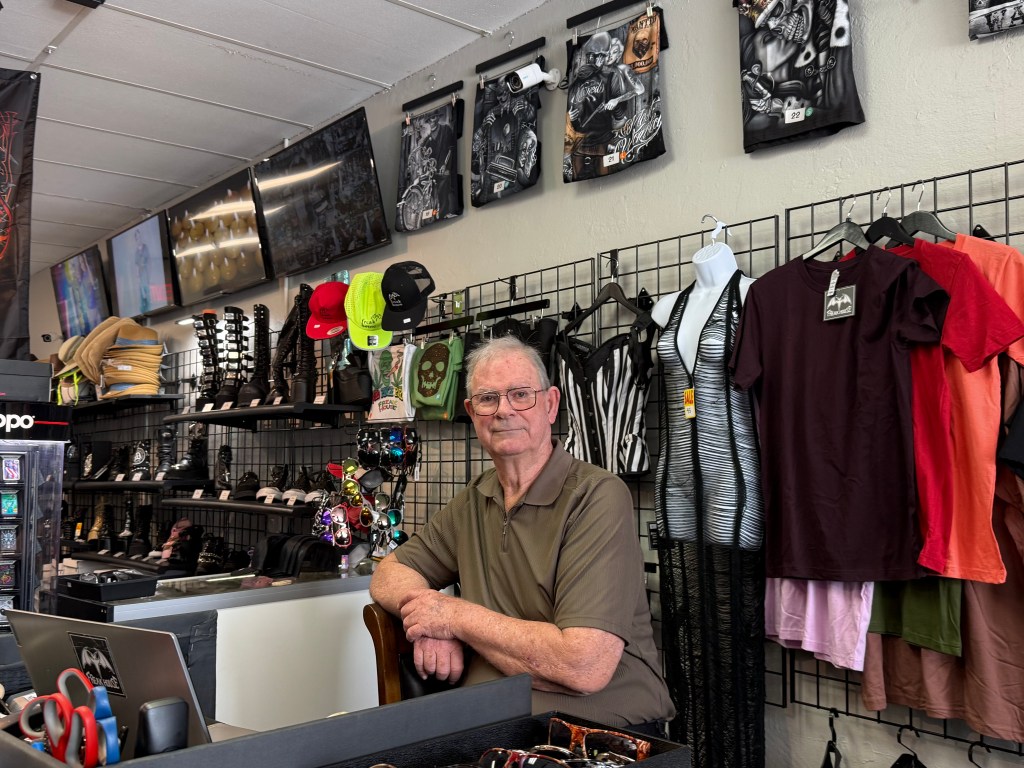
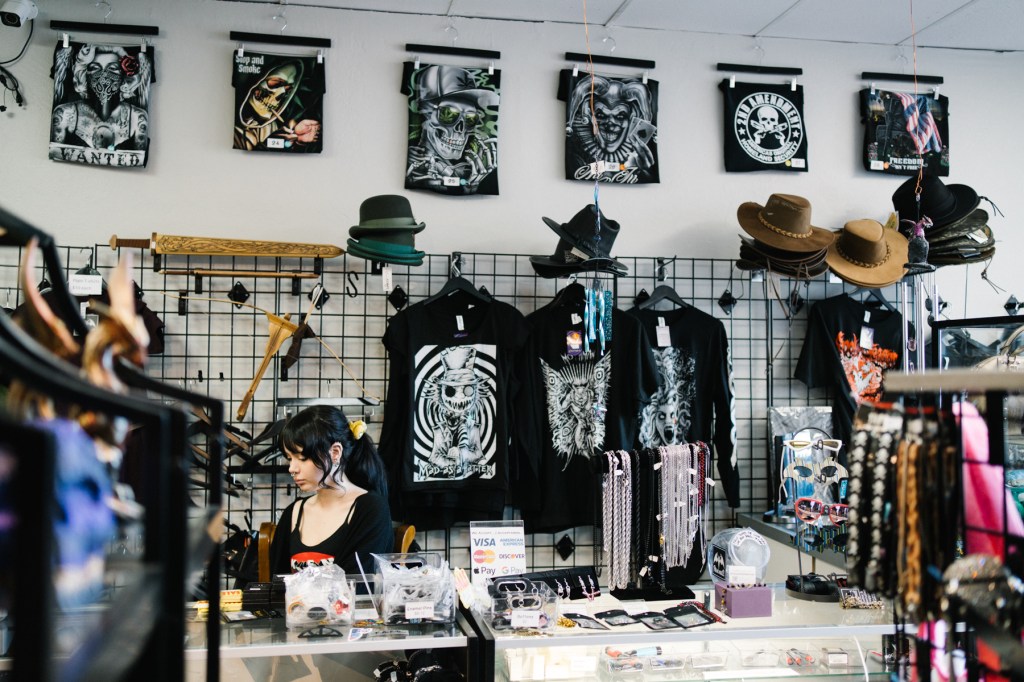
If you pulled together a police lineup of entrepreneurs suspected of running the gothic and alternative boutique Freak House, its actual proprietor, Jim Jones, would almost certainly pull a Keyser Söze and walk away scot-free. A retired IT program manager who, on a surface level, fits the straitlaced profile of his former profession to a T, Jones is an affable, gentle giant of a man whose sartorial vibe is closer to Bill Gates 1990s chic than the metal-studded full-head mask or kitschy bat sunglasses on the glass counter between us. Yet on a more transcendent level, Jones is deeply attuned to his kindred-spirit clientele of iconoclasts, subversives, and through-the-looking-glass fashionistas in a way that is anything but skin-deep.
“I’d say almost every day somebody looks at me like, ‘What are you doing here?’” Jones tells New Times with a soft chuckle, the twang of his Texas youth still curling around the corners of his sentences. “Truth is, I’ve been an undercover freak most of my life.”
Which is to say, growing up in the late ’70s and early ’80s in Dallas, Jones was never able to crack the in-crowd. “I was just kind of the dorky guy sitting off over in the corner by himself while everybody else orbited the cheerleaders and the jocks,” he says.
The sense of separation from those formative years never quite left him. “I think a big part of the reason I get along so well with this community now is that I still feel today what a lot of my customers feel: that just-don’t-seem-to-fit-in-anywhere-you-go-type feeling.”
Jones pauses mid-sentence, turns his gaze out the window, wipes away a few silent tears. When he begins to speak again, he recounts a story of a teenage goth girl coming into Freak House with her parents shortly after its opening. Just beyond the threshold, she stopped, looked around in wonder…and promptly burst into her own tears. “I never, ever thought I would see a store for me,” she said.
“I feel like I’m letting that girl down by not being able to keep this store going,” Jones says, his voice cracking with emotion again. “I feel like we’re letting an entire community of loyal and supportive customers down. That’s probably the thing that’s the most disappointing about it is just leaving a hole in a community that really embraced us.”
Sad but true, fellow freaks: Officially closed on June 26, the safe haven known as Freak House is no more.
Karli Evans for Miami New Times
House of the dragon
Jones lived in Dallas into his early 30s, when he caught a case of wanderlust. After a short sojourn in New York City, he made his way, as so many searchers do, to sunny South Florida. Once here, he met his future wife, Ana, through mutual friends, back in the days before romance was digitized into prompts and algorithms. They shared not only many interests but also an entrepreneurial spirit. They experimented with several side hustles, selling various products at flea markets and on eBay. Jones even did a bit of speculation in buying and selling domain names, taking a stream-of-consciousness approach to his purchases, which is how freak.house struck him like a bolt from the blue one day. (Yes, dot-house is a real domain option, though it’s typically the provenance of realtors and home flippers.) The concept resonated with him for obvious, deep-rooted reasons, but to what end he did not know.
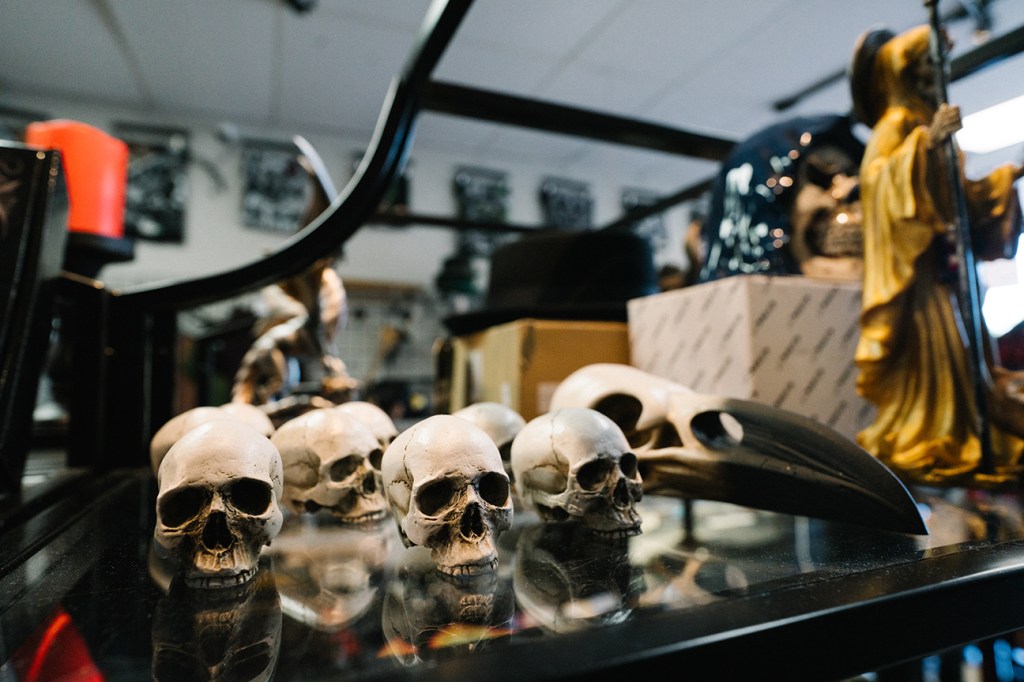
Or at least he didn’t until he bought Ana a dragon figurine on a whim. “She fell in love with it,” he says, “and started collecting other dragons and castles and fairies…” These seemingly disparate strands began to intertwine in Jones’ mind — freak.house, freaky wares, and the desire for an entrepreneurial outlet. The couple put together some cash and a potpourri stock and tried the concept out at the Miami-Dade County Youth Fair & Exposition. Not everyone got it.
“More than one passerby asked if we were devil worshippers,” Jones recalls. The people who liked it, however, really liked it. A few other pop-ups later, they settled into a year as a vendor at Redland Market Village in Homestead, building a following and winning the 2024 New Times Readers’ Choice poll for Best Clothing Shop.
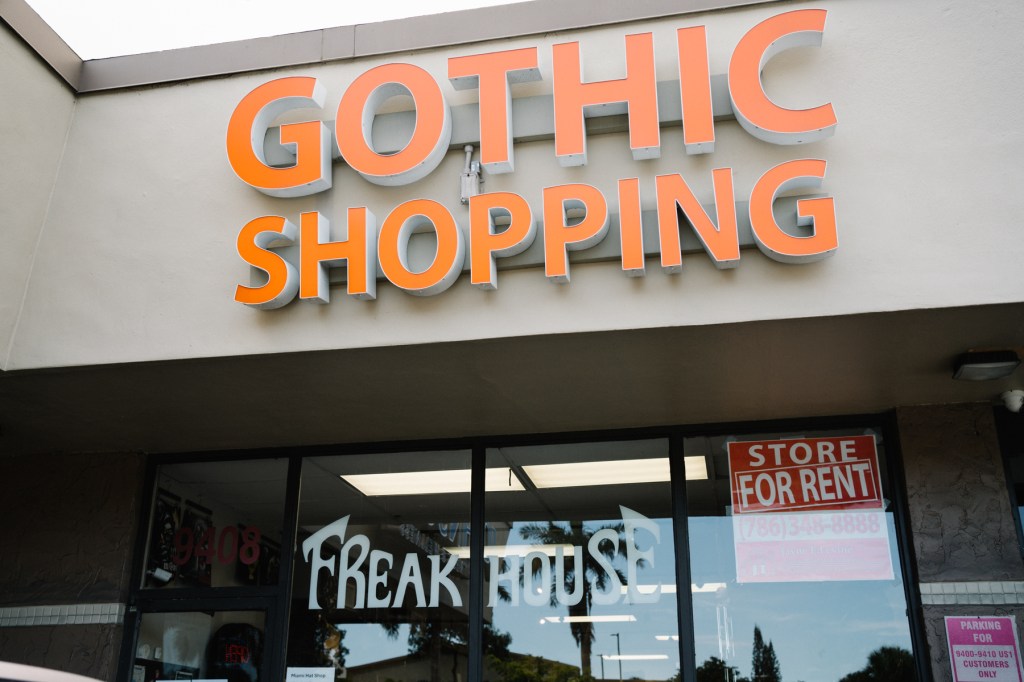
The Joneses decided to ride that cresting wave into the brick-and-mortar spot of which they’d long dreamed, settling on the U.S. 1 location to capitalize on the prodigious traffic. They weren’t exactly shrinking violets about it, either, installing a large “Gothic Shopping” sign above the door.
Karli Evans for Miami New Times
Inside, the inventory was co-curated with the patrons, who steered Jones’ buying towards apparel brands like Vampire Freaks, Tripp NYC, and Foxblood, among others. “I like the fashion, especially for women, but I am by no means an expert,” Jones says. “I’ve seen men who can pull it off — and, though I got a couple pieces, I’m not necessarily one of them. I quickly came to realize this fashion, like the music, acts as a signal for people who feel the same kind of “different” gravitate toward each other. So, it only made sense to follow our customers’ lead instead of the other way around.”
As for the store’s general design, Jones credits his wife. “Ana’s got better taste than I do, and a lot more ability to make things as pretty and inviting as possible,” he says, pulling back a piece of fabric to reveal a small box chugging along like The Little Engine That Could. “She even had the idea to get this scent machine so everyone who comes in would be greeted with a pleasant aroma.”
Alas, if serving and elevating a niche community is what made Freak House great, it was also an Achilles’ heel in a city where affordability has quickly shifted from an economic crisis to an existential one.
“We’ve been pretty much losing money from the beginning, and we never stopped the bleeding,” says Jones, who owns the trademark for Freak House and plans to continue to develop it as its own online brand. (Interestingly, one of his online side hustles, Miami Hat Shop, has sold some 20,000 hats over the last five years, effectively underwriting Freak House.)
“I mean, did we hope to make some money at it? Well, yeah,” he adds. “But if we could’ve so much as barely broken even, I swear to you I would choose to tread water and keep this community alive.”
Shawn Macomber for Miami New Times
Goth moths to a flame
Freak House sells a children’s picture book entitled “Goth Moth,” and the store’s staff, whom Jones describes as family, have been drawn to the store like iterations of the titular character are attracted to a black flame.
Take, for example, Dzhuliana Khalilova. Born in Central Asia before immigrating to South Florida in 2012, she followed a childhood love of gothic literature (Poe, Mary Shelley) to Bauhaus and Peter Murphy to local goth nights, darkwave, and the accompanying underground fashions and aesthetic. In a scene crowded with fiery, loud hardcore and techno, it felt good to discover a thriving community in the cool shadows.
Khalilova first discovered Freak House at the Redland market. She started selling her own gothic jewelry line, Lovesick Cherries, on consignment with Jones and naturally transitioned into a role at the physical store when it opened. “Jim is a great guy,” she says. “Very creative, very passionate. I always appreciated that his number one goal wasn’t necessarily a sale but to make sure everybody who walked through those doors felt welcomed and like they could be themselves.”
Khalilova found her purpose at Freak House in styling patrons, helping them build out general ideas into a holistic, interconnected whole, or amplifying an already close look. “Fashion, makeup, accessorizing — it’s all self-expression,” she says. “I know I feel a lot more confident in a style that represents who I am rather than just conforming to regular Miami club attire or whatever. None of that stuff really calls to me, and it doesn’t call to a lot of people. So, when someone can come into a place like Freak House and find a style that actually communicates who they are and their authentic selves…that really matters. It makes a real difference in how they feel about themselves and what they feel is possible for them.”
Karli Evans for Miami New Times
Miami native and Freak House regular Lauren Fealy agrees. She stops in on this day because she sees the “For Rent” sign in the window and is in a bit of shock.
“Oh, no — this is terrible,” she says when Jones breaks the news to her. “A major loss.” Fealy looks a bit undercover today in a light sundress. “I’m not very alternative today,” she admits. “I don’t wear a lot of black, honestly. I like to mix a softer color, very cutesy vibe, with a bit of a grunge side. I get a lot of my shoes, accessories, and jewelry here. I think a lot of people hide the more gothic or alternative side because it’s hard to visualize yourself in it if it’s just online. Being able to see it and feel it and try it on in person makes it possible to embrace different styles and express yourself in new ways.”
In the end, what Freak House provided was the infrastructure for self-actualization. And because Jones didn’t look like his clientele yet nurtured and accepted them, he let the outsiders know that the world, at its best, is not some brutalist Manichean realm of allies and adversaries. The value and dividends of acceptance and self-expression are proofs of concept as valid as those dragon and fairy figurines.
Freak House is dead. Long live Freak House.