Morgan Sophia Photography

Audio By Carbonatix
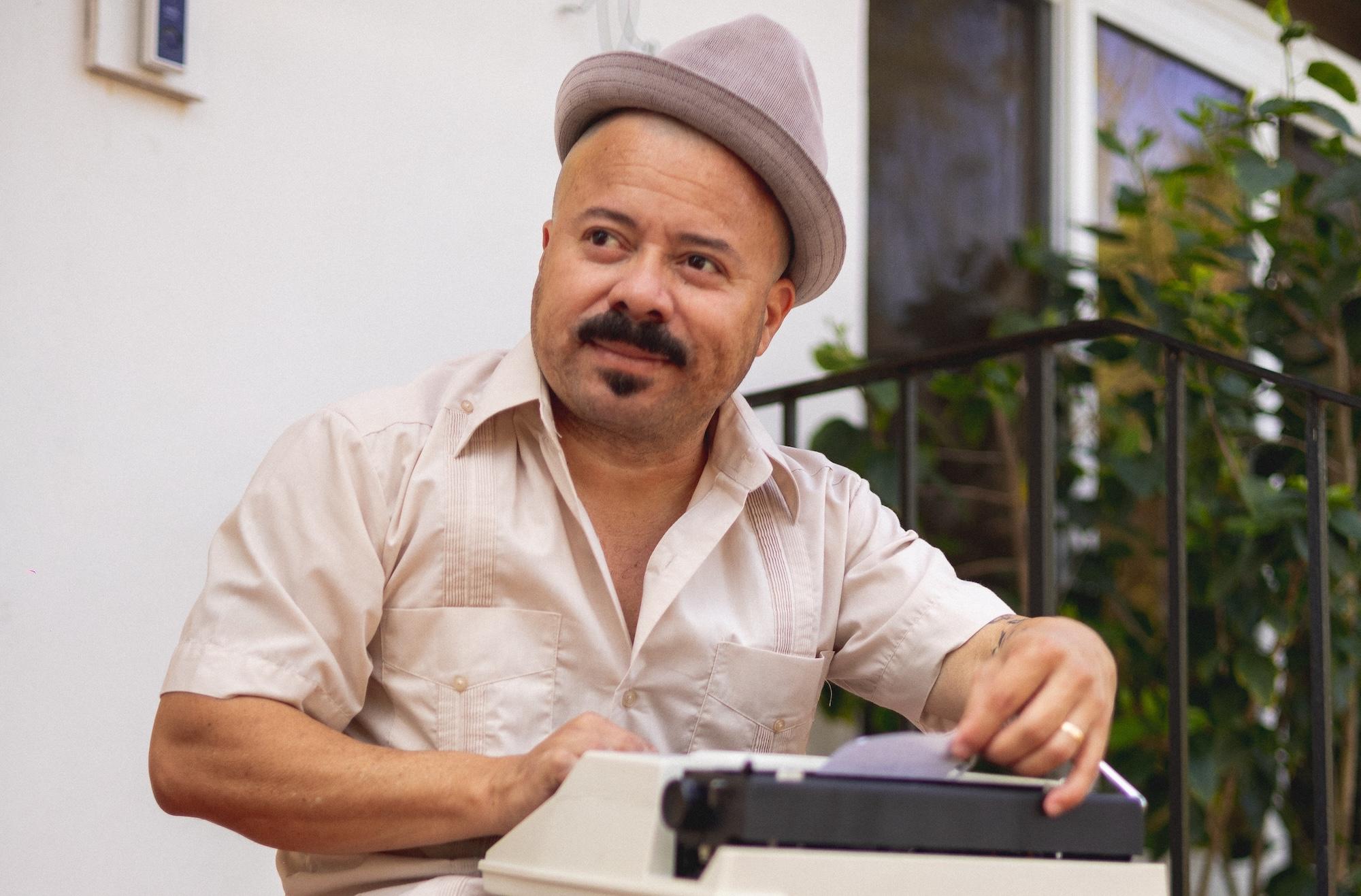
The Biscayne Poet cuts a memorable figure around town with his trademark hat, shades, and mustache. But his most recognizable feature might be the trusty typewriter he uses to crank out uplifting poetry at supersonic speeds around Miami and beyond.
You’ve likely seen him typing away at local cultural festivals, or hosting live poetry readings at Books & Books — or perhaps you saw him on the big screen during the Miami Film Festival, in the Aaron Glickman-directed “Poetry City,” which documents Miami’s expansive literary scene. And now, The Biscayne Poet, whose ID cards list him as Oscar Fuentes, has a new poetry collection out, “Geography of Light.” It’s partly inspired by his parents, whose story will resonate with anyone who’s keeping tabs on escalating immigration raids in South Florida and throughout the country.
“I was born in New York City in 1975 to illegal immigrant parents from Honduras,” Fuentes tells New Times. “I have three siblings, and I was the only one born in the U.S.” In 1983, his family moved to Miami, where he was exposed to imagery that later influenced his poetry. “The 1980s were the most interesting time in Miami. I’d drive with my dad in his construction truck to his job at the Sonesta Hotel on Key Biscayne. I remember seeing those pink islands that the artist Christo made.”
Fuentes says he was a shy, insecure kid who came out of his shell as a teenager. As a high school student, he read poets like Walt Whitman, but wasn’t ready to write his own poems. He was more interested in theater, particularly mime.
Even if he’d had the inclination to write poetry back then, he says, he wouldn’t have had the time. “My parents were tired of living in the shadows, so they moved back to Honduras. I stayed in Miami and took a job tending bar.”
As a student at Miami-Dade College, Fuentes fell under the influence of creative writing teacher Michael Hettich. “He was my mentor. He took me under his wing and guided my poetic form and sensibility.”
Fuentes wrote his first poem during downtime while he was working as a bartender on a glass-bottom boat. Further poetic inspiration came in unlikely locales, namely a seedy apartment building he called home at the turn of the century.
“I lived in a building right next to a crematorium. One day I realized the barbecue smell I always smelled wasn’t barbecuing food, and the dust on my window wasn’t dust. The building I lived at was where all the prostitutes you’d see at night on Biscayne Boulevard lived. Their pimp, who was always there, was also a waiter at the local Denny’s.”
So, did the Denny’s pimp waiter inspire The Biscayne Poet’s fashion and automobile choices?
“If I pimp anything, it’s a thirst to write what I see,” Fuentes says with a laugh. “The hat I wear I took from the 1980s breakdancing scene. Plus, it covers that I lost most of my hair. All I have is my mustache.”
As a young parent, making a living as a poet was much tougher than crafting the perfect stanza. But Fuentes made a go of it by fronting a local jazz band that performed to his spoken-word recitations. He got his name at an open mic night at Churchill’s hosted by his friend Rio Chavarro. “He baptized me with the name when introducing me: ‘Let’s welcome Oscar Fuentes, The Biscayne Poet.'”
Fuentes turned to his typewriter during a tough personal moment, and he figured there might be a wider market for hand-typed uplifting poems. He reached out to the owners of Wood Tavern, and a weekly residency was born. Passersby gave The Biscayne Poet three words from their own imagination, and Fuentes formulated complete poems out of them.
“People are in need of words of kindness. Encouragement is rare,” he says. That need shows in the outpouring that often follows when he shares his poems.
“I channel the three words [they give me], put myself in their shoes, and it becomes intimate and universal,” he says. “People tell me, ‘How did you know what I’m going through? Are you psychic?’ Poetry does this. People will break down in tears and hug me. I run into people who stop me and pull out a poem I wrote for them back in 2010 and still carry in their wallet.”
The demand for the typewriting poet has been occasionally lucrative, if more strenuous, than you might figure. “I’ve done wedding gigs where they pay me $5,000,” says Fuentes. “BlackRock flew me in for a workshop where they paid me $10,000 — but you need to be able to type 200 unique poems in two hours without making any errors.”
“Geography of Light” was written at a more leisurely pace. The inspiration for it is heartbreaking.
Fuentes’ parents eventually gained U.S. citizenship and moved to Tampa from their native Honduras. Not much later, his father was diagnosed with Alzheimer’s. Fuentes made — and still makes — the long drive every few weekends to see his parents.
“I’d leave on Friday afternoon and drive west with the setting sun in my eyes,” he remembers. “It was reminding me that I need to be the light. Most of the poems were imagined alone in the car, knowing I’d have to soon remind my dad of who I was when I saw him.”
Fuentes used voice-to-text notes to lay the foundation for the poems. “When I got to Tampa, I’d bust out my notebook. As I hung with my dad, I’d read him what I wrote. As I read to him, I’d notice other things that could shape the poem.”
Writing the book was a release for Fuentes; a way to help him appreciate the here and now and accept that nothing is permanent. “Miami will change,” he says. “My parents will die one day. My kids will grow up. But with all the change, there is still love.”
“Geography of Light” by Oscar Fuentes. Indie Earth Publishing. booksandbooks.com.
An Evening with The Biscayne Poet. 6:30 p.m. Thursday, August 20, at Books & Books Coconut Grove, 3409 Main Highway, Coconut Grove; 305-477-0866; booksandbooks.com. Admission is free with RSVP via eventbrite.com.