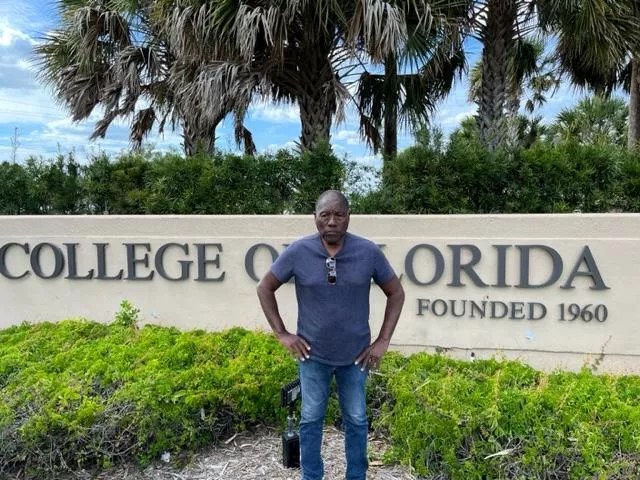
Marvin Dunn photo

Audio By Carbonatix
Editor’s Note: This profile is part of New Times’ People to Watch issue, spotlighting figures we expect to make a big impact in Miami in 2026.
Miami is a city known more for its surface-level trendy glitz and glamour than for substantially deep historical clout. Even the history it does claim is usually dressed up to look pretty: Art Deco fonts, vintage postcards, and a carefully curated past that looks great on a condo lobby wall.
But Dr. Marvin Dunn sees things through a different lens. The longtime Florida International University professor emeritus has spent decades pointing out the parts of local history that risk being forgotten and asking why they’re always the first to get erased. As one of the most prominent voices documenting Black Miami’s story, Dunn has devoted himself to the unglamorous work of public memory: Teaching, writing, touring, organizing, and, when necessary, making noise.
In 2026, he’s worth watching not because of any single fight, but because he has emerged as one of South Florida’s most persistent figures, insisting that history (Black history in particular) is not disposable, even when powerful political and financial interests would prefer it be treated that way.
The recent battle over the proposed Trump Presidential Library in downtown Miami is the clearest example of Dunn’s approach. When a valuable parcel tied to Miami Dade College was steered toward a Trump-controlled foundation, Dunn didn’t limit his objections to partisan politics. He challenged the underlying logic of the deal itself: Who public land belongs to, and who gets to decide its future.
“It hit me immediately as a theft of land that belongs to children unborn in Miami-Dade County,” Dunn said at the time. “You’re stealing land from children who are not even born yet, and any politician who would stoop to that…is entitled to my sense of anger and repulsion.”
That challenge briefly halted the transfer and forced the issue into the open, drawing hours of public testimony and scrutiny. Although the college’s board later re-approved the deal after a redo meeting and the lawsuit was dismissed, the episode served as a case study in what Dunn has been arguing for years: that procedural compliance is often used as a shield, not a safeguard; and that “by the book” doesn’t always mean in the public interest.
For Dunn, the library fight appears less as an endpoint than a symptom. It sits within a much broader struggle over who controls historical narratives, academic freedom, and civic space at a moment when public education itself is under sustained political attack.
In Florida, those pressures have been intensified by Governor Ron DeSantis’ campaign against so-called “woke indoctrination,” including the Stop WOKE Act, which took effect in 2022 and reshaped how race, history, and systemic inequality can be discussed in classrooms. Dunn has become one of the law’s most vocal critics, publicly pressing DeSantis on what, exactly, professors are now allowed to teach, and whether lived experience itself has become off-limits.
“We will not allow DeSantis to kill our history,” Dunn told New Times in 2023. “We just won’t allow it. We will take our history directly to the parents if that’s what’s required, and apparently, it is what is required.”
That defiance has taken practical form. Through the Miami Center for Racial Justice, which Dunn helped establish after the murder of George Floyd, he has worked to distribute banned books and create alternative pathways for students to access African American history at a time when school districts and universities are pulling back. His concern, he says, extends far beyond any single demographic.
“My concern is that our kids, not just Black kids, in our Florida schools will not know the very basic things about African American history,” Dunn told New Times. “They will not know about the essential issues that we’ve held as African Americans in this country or all the triumphs — that’s incredibly important for all school kids to know in this day and age.”
Long before these legislative battles, Dunn was sounding alarms about a different kind of erasure: Black burial grounds and historic sites that were neglected, paved over, or quietly absorbed into Miami’s endless development cycle. In neighborhoods like Allapattah and Overtown, he has repeatedly warned that progress often comes at the cost of memory and respect for the dead. That is a throughline that has shown up consistently in Dunn’s work: Politics and development don’t just alter the physical landscapes that we live in, but can literally and metaphorically erase parts of the past.
More People to Watch in 2026
Read our stories on some of the other individuals we’ll be watching this year:
Miami’s First Female Mayor Is Changing the Game
Inside James Fishback’s Outrage-Driven Run for Governor
Marco Rubio’s Meme-Worthy Rise to the Center of Trump’s Second Term
After Playoff Frustration, Miami Dolphins Hand Rebuild to Jeff Hafley
Is Sting Dion Miami’s Next Drag Superstar?
Eulois Cleckley Is Getting the Underline to the Finish Line
Renata Bozzetto Is Leading the Fight for Immigrants’ Rights in Florida
Leila Cobo on Miami’s Role in Latin Music’s Global Rise
Miami’s Bizzy Crook Celebrates Grammy Victory
New Wynwood Venue Midline Aims to Keep Touring Artists in Miami
…and more rolling out in the coming days.