Menemsha Films

Audio By Carbonatix
The first fifteen pages of screenwriter Maylen Dominguez’s film had been hiding in a forgotten thumb drive, a vestige of a past life working in New York. It was her daughter who rediscovered it one day and encouraged her to finish the work, this time in Coconut Grove. The resulting movie, Ethan Bloom, which screened at the Miami Film Festival last year and opens in wide release this month, is a universal story made in Miami.
“I think kids are extremely wise and, if we listen to them, they actually say these really profound and incredible things,” Dominguez says of the dialogue in the film. The sentiment could also explain why she listened to her daughter, who became a quasi-producer on the project, in the first place.
“My daughter was young when I wrote the script,” Dominguez says. “I had her read everything that I wrote, and she would call me out if there was something out of line. ‘No, we would never say that.’ And, so, I changed some things based on her feedback.”
Ethan Bloom is many things: A fantastic, affecting coming-of-age film. A sometimes absurdist, sometimes straight comedy. A story about how we struggle to navigate the invisible architecture of the transcendent amid both the joys and tragedies of life in this world. What it means to learn to stand alone — and how that can help us eventually find real community. A sweet, heartfelt Coconut Grove-shot indie antidote for a state reputation that sometimes gets reduced to Florida Man, guy-walking-into-the-liquor-store-with-a-gator memes. (Yes, A.C.’s Icees is in the film.)
It’s also more than all of that, though: It is a movie that entertains, but also — for those who feel separate, outcast, lost, unmoored by grief or lack of understanding — has the potential to provide spiritual sustenance; to empower, enrich, or even save lives.
“Sometimes we must reach beyond what we’re used to or what’s normal,” says Dominguez. “Sometimes we have to step into something that’s a bit unknown, something that makes us a little bit afraid — and maybe makes the people around us a little bit afraid — so that we can understand the very real universal truth that love does transcend the differences that we try to create and the different polarities that we see in the world.”
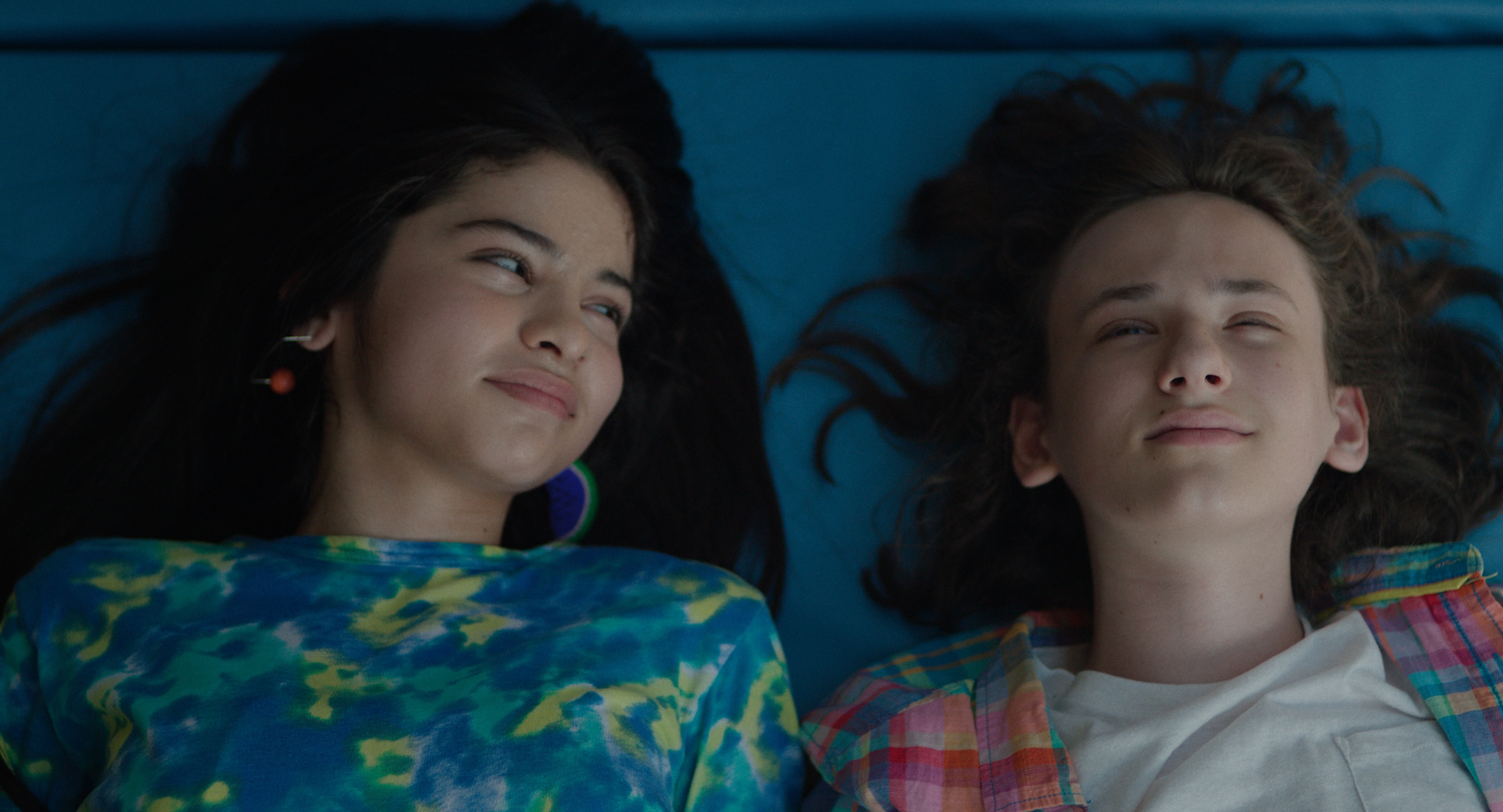
Here’s the setup: Reeling from his mother’s death, young Ethan Bloom (Hank Greenspan) begins to strike out “beyond” the confines of his loving yet somewhat rigid Jewish home for answers. At first, this primarily means exploring Catholicism, much to the dismay of his father (Joshua Malina), and even as he is bombarded with unvarnished antisemitism from a school bully. Once he begins the journey, however, Ethan learns you can’t put the genie back in the bottle and — per the Rumi quote, “As you start to walk on the way, the way appears” — an eclectic, sometimes eccentric cast of characters manifests to help guide him, including an unorthodox rabbi (Rachelle Lefevre), a tough-as-nails girl who becomes a friend (Caroline Valencia, who played young Selena Gomez on Only Murderers in the Building), a priest (Carlos Ponce), and others.
Along the way, Ethan does what we’ve all done: Stumble his way haltingly through first love. Strive to make his family proud while — inevitably — disappointing them. Feel alone, not just in a room full of people, but in a town full of neighbors. Find out there really is a light at the end of the tunnel — and, no, it’s not a train.
We don’t simply grapple with these questions in story form because most people don’t like to be lectured. It is because storytelling and archetypal character building allow us to bypass the analytical brain’s baggage and access deeper levels of emotion and fundamental personality.
“Since Ethan Bloom has started to screen, people have come up to me and said, ‘You know, I really felt like you expressed something that I’ve always thought. Like, why do I have to just be this one thing?’” Domiguez says. “As we start to expand our consciousness, we see we are really so much more than these limited ideas and different little boxes that sometimes we want to place ourselves in. As Walt Whitman said, we contain multitudes.”
That the film has resonated so powerfully with audiences in early screenings seems to bear this out, much to the gratification of director Herschel Faber, a self-described “comedy guy” (“I just naturally tend to make light of heavy situations,” he says) who plumbed new depths to adeptly steer the drama to the screen.
“Ethan Bloom gave me an amazing opportunity to connect with an audience emotionally and say something meaningful to them,” Faber says. “It’s why I make movies. To see someone shed a tear, or laugh, or be moved by something I had a hand in creating and capturing on film is incredibly gratifying.”
For Domiguez, it is also personal on a couple of different levels: First, she herself is a convert, though in the other direction, to Judaism. “Converting to Judaism was a profound experience for me, but it was also full of humor and humanity,” she says. “I wrote this story while playing with the beautiful, sometimes funny moments that happen when two different worlds and traditions come together.”
For Faber and Dominguez — both of whom grew up in central Florida and spent considerable time as kids in Miami and the Grove — the area’s diversity of cultures, individuals, and religions has played a large role in the film’s success.
“Florida gets a bad rap as a state,” Faber says. “It’s a place that is full of artists and forward-thinking people who are constantly creating and put new putting new ideas out into the universe.” Ethan Bloom — a thought-provoking, boundary-pushing, unconventional coming-of-age film that plays out across a gorgeously shot tropical backdrop — certainly fits the bill. “I spent a lot of my childhood in Coconut Grove,” he continues. “That area of Miami is changing so rapidly, and you really hope that all the quaint cafes and quirky small shops and artist retreats don’t end up going the way of the dinosaur in favor of high-rises and swanky restaurants. I wanted to immortalize and show the rest of the world what was so special about the old Grove.”
“Miami has so many different dimensions,” Dominguez agrees. “There are all these unique characters here who live life in very unique, interesting ways. It’s very inspiring to me. And, of course, these differences and all the sudden shifts that happen in life are mirrored in the unpredictable weather — the rain, sunshine, and wind. It really is the perfect setting for this film.”
In the end, Ethan Bloom is not an oracle or access to the mythical beast that is an accurate South Florida weather report. It is a brief for the transformational power of questioning without the need for a definitive — or divine — final judgment.
“When we’re faced with really big challenges, we tend to ask really big questions and look for really big answers,” Dominguez says. “Who am I, really? Why are we here? Why did this happen? Those are questions that I’ve been asking myself from the time I was little to now. And they’re the same questions that Ethan is asking. I think we all, as humans, are trying to figure out, ‘What does this all mean?’ Ultimately, it’s a very universal thing. And we can find comfort in that universality.”
Ethan Bloom. Friday, March 13, through Thursday, March 19, at Coral Gables Art Cinema, 260 Aragon Ave., Coral Gables; 786-472-2249. Tickets cost $12.75 via gablescinema.com. Opens in wide release Thursday, March 19.