
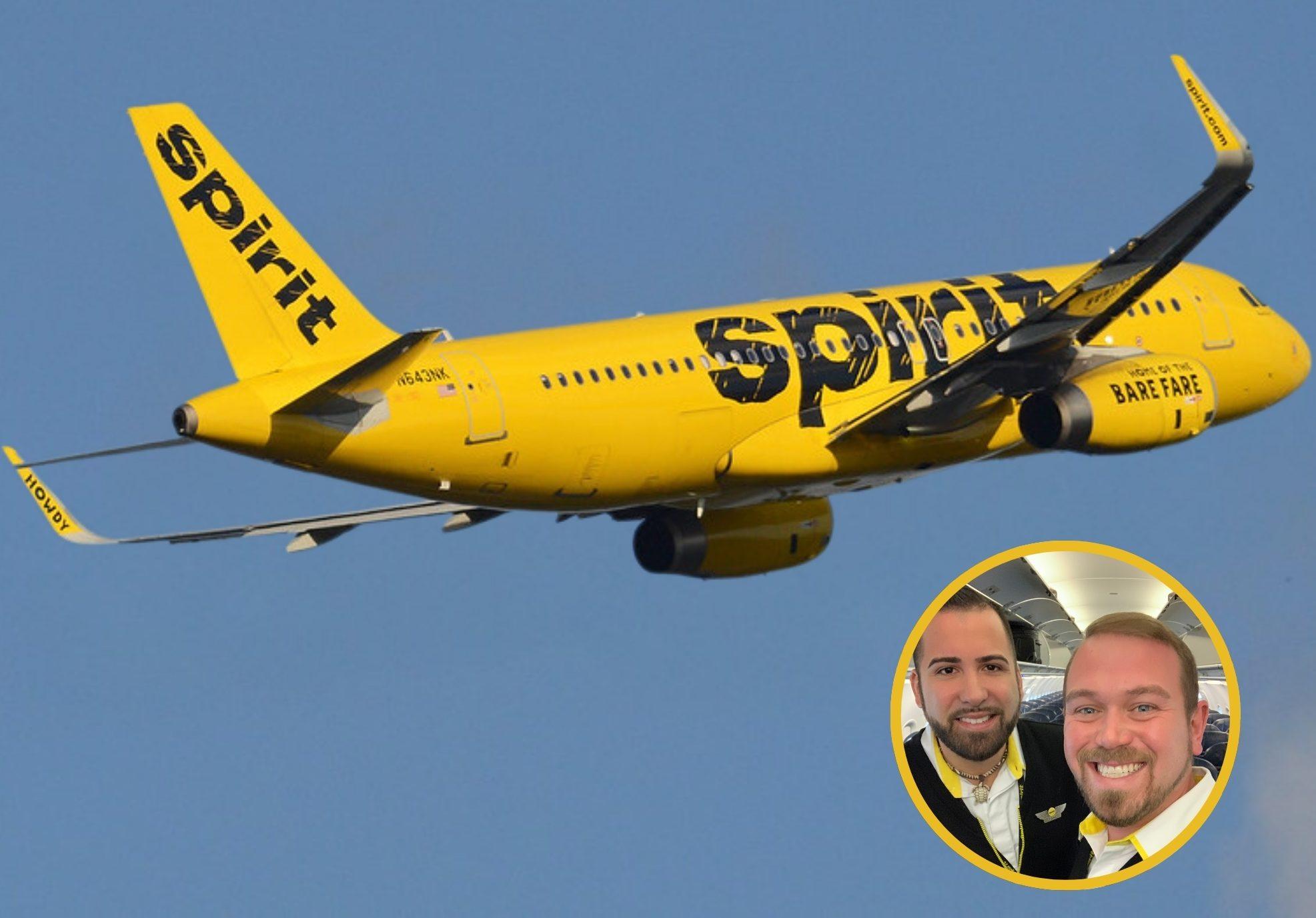
Photo collage made by New Times, photo of Spirit airplane by Alan Wilson from Flickr, overlaid photo courtesy of Nathan Wooddy

Audio By Carbonatix
Antonio Mariano knew Spirit Airlines was on the brink of collapse the night he took his last flight to and from Atlantic City. On that day, May 1, he put on his familiar black and yellow uniform. His husband, a fellow Spirit Airlines flight attendant, asked why he’d go to work at all, pointing out, “You might not make it home.”
By the time Mariano landed in his home airport of Fort Lauderdale, he saw the news was official: their jobs (and that of more than 4,000 others in Florida) were gone.
Mariano and his husband Nathan Wooddy are two among scores of former Spirit Airlines employees who have started GoFundMe accounts to help make ends meet since the company announced it couldn’t afford operating costs after jet fuel costs rose during the Strait of Hormuz’s closure.
The Oakland Park couple started their fundraiser to raise money for bills, groceries, and other essentials they say they’d otherwise be unable to pay for. The news of company closure struck Spirit employees in wildly different ways, with some seeing the writing on the walls months ago (like Wooddy) and others trying to ignore the signs (like Mariano), the couple told New Times.
“I woke up the day before, and we had a great conversation with the crew,” Mariano says. “We went out and it seemed like, ‘Oh we’re gonna get over this,’ and then the next day we woke up to the news that we just asked the government for $500 million.
“And that’s when I was like, ‘Oh no, this is turning into something else now?'”
He got to the gate for his last trip and, as he tells it, “I looked at my crew and I just lost it and they hugged me. They thought something was happening in my personal life, and I said, ‘You guys, you didn’t see the news today?’ and it’s like nobody knew. And we we wiped our tears away, and we got on that plane and were professional. We worked our last flights together, and we were still not thinking it was real until we landed in Atlantic City.
“Then when we landed in Fort Lauderdale. That’s when the article said, ‘Ceasing operations at 3 a.m.,’ and that’s when I knew that it was done.”
The couple tells New Times that the vast majority of Spirit flight attendants were deeply dedicated to their careers. Wooddy grew up in the industry: his father worked for Delta Airlines in Georgia and his mother for AirTran Airways. Mariano, on the other hand, came new to the field, where he found a network of people he loved working alongside, he tells New Times.
“The people made it worth going to work,” Mariano said. “The people were the most important part of it, and that’s what makes it hurt so much.
“Spirit will forever be an instrumental part of who we are as a couple.”
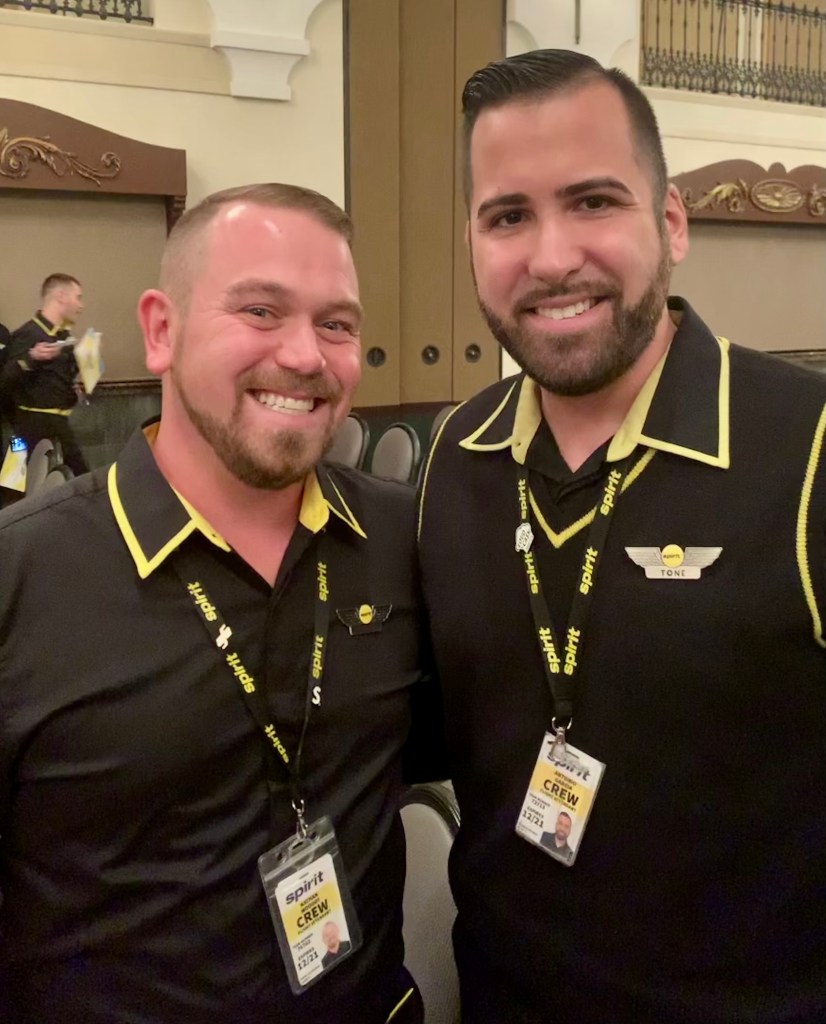
Setting the Record Straight
Some of the snootier among us have often criticized Spirit Airlines as the Carnival Cruise Lines of the skies (no shade to Carnival): a rowdy, debaucherous environment filled with the fringes of society. But according to the couple a bit closer to the matter, Spirit customers were often gracious and filled with praise for the airline and its flight attendants.
“We were hearing all the time from the passengers how they were so thankful for us. And, even towards the end, they were praying for us. Every time they would get off the plane, they’d say, ‘We’re praying for you guys. We don’t want to lose you guys.'”
The couple, who met and began their flight attendant careers at a different airline before taking (many) connecting flights with Spirit.
“This open my eyes to how important it was to have these types of low-cost carriers because we were transporting people that couldn’t normally travel,” Mariano tells New Times.
According to Wooddy, “It was a great company. No matter how much bad media there is about Spirit, they treated us really well and our quality of life was incredible. The people you worked with truly are like a family, like everybody just always has each other’s back. We wanted to retire there.”
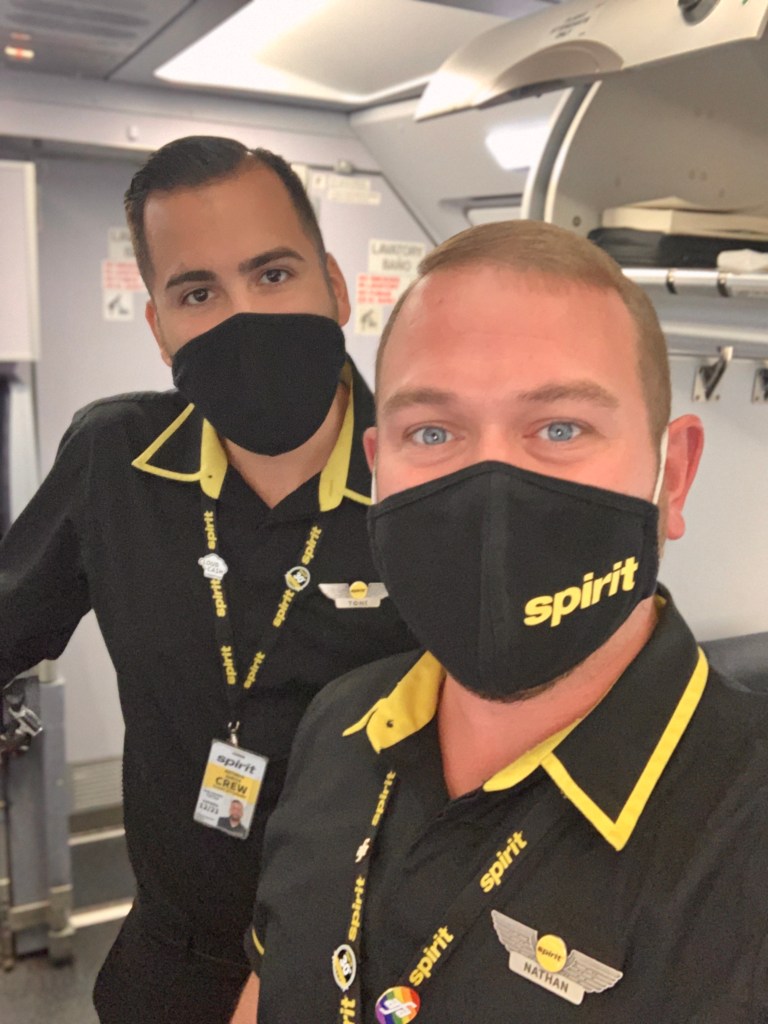
Grounded in a Competitive Market
While the couple has no intentions of leaving their profession, the flight attendant industry is a competitive one. By their estimation, it’ll take (optimistically) a year for them to find new flight attendant jobs.
It’s a competitive market in the best of times, not to mention the fact several thousand flight attendants just entered the job market, Wooddy tells New Times. And even if they found new jobs tomorrow, there’d still be a four-to-eight-week training period required to work for another airline.
“It’s scary, so we’re just thankful for any support we can get, and we’re actively working to try and figure out find something else,” Wooddy said. “But until then, we are gonna try to find other work. For now, we just get out of bed every day every day with our walk in the morning to get those endorphins going.”
This story has been corrected to reflect that Mariano was the one who took the last flight to Atlantic City.