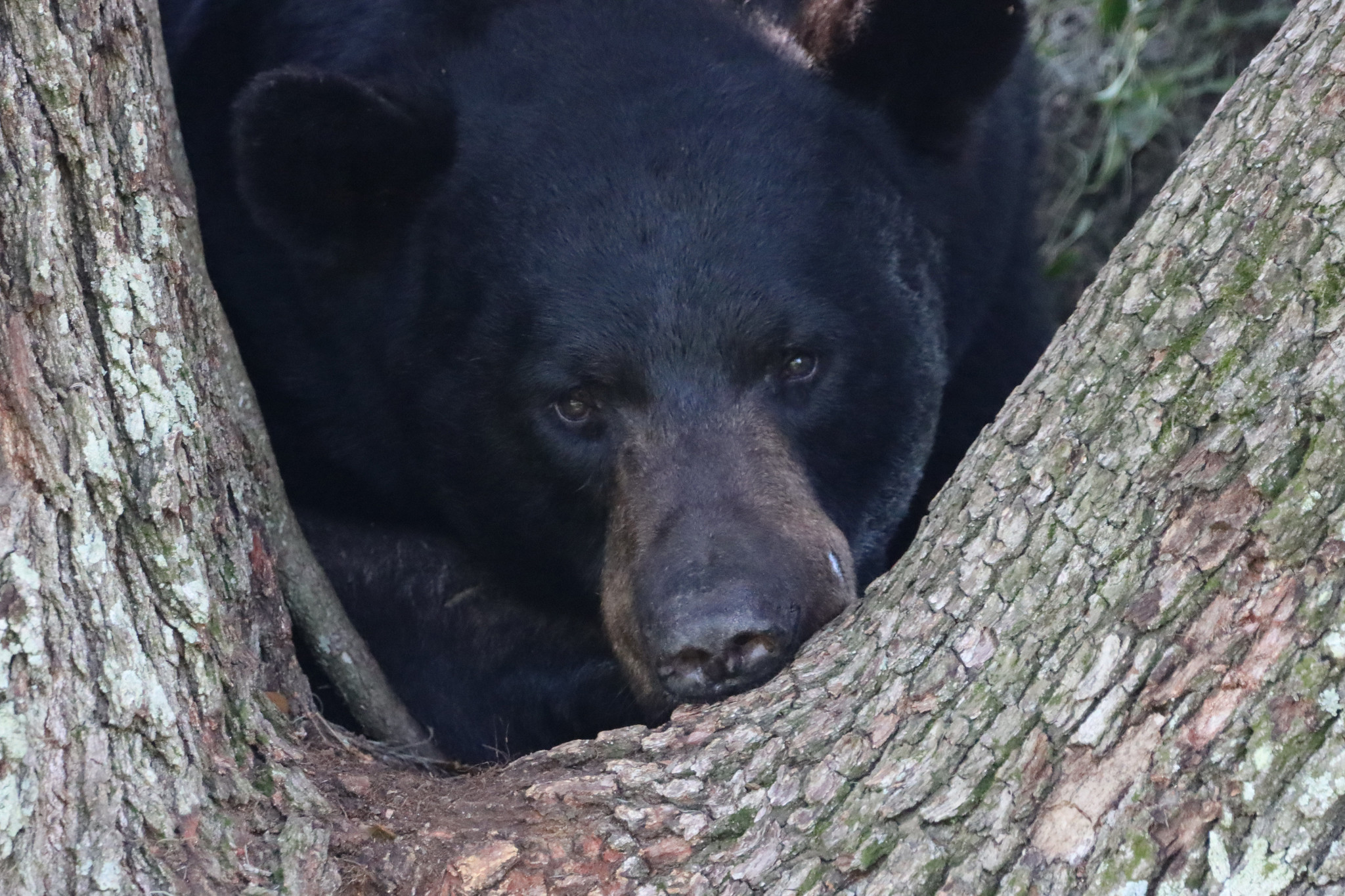
Photo by Karen Parker/Florida Wildlife Conservation Commission (FWC) via Flickr

Audio By Carbonatix
When I was growing up here in Florida, everyone revered science. We looked to high-IQ scientists to tell us how to fly to the moon, how to transplant a heart, how to fire up a laser, how the universe began with a Big Bang.
But science is clearly out of favor now, especially in Florida. If you don’t believe me, look at the argument the Florida Fish and Wildlife Conservation Commission put forward late last month to convince a judge to approve a different kind of Big Bang: the first bear hunt in ten years, which started on December 6.
An animal advocacy group called Bear Warriors United sued to stop the hunt, arguing that allowing people to blow away 172 bears over 22 days would fly in the face of science. The FWC’s attorney argued that there’s no law requiring the agency to follow this “science” stuff.
“There is nothing that mandates or controls how a commissioner votes,” the FWC attorney argued in a court filing, “nor requires that a commissioner base his or her vote specifically on a body of sound science.”
So beat it, you brainiacs! We don’t need no stinkin’ science! We can do what we want!
Clay Henderson, who helped create the wildlife commission 25 years ago, told me he was “just flummoxed by the FWC response. Their argument is the governor appointed them and the Senate confirmed them and that is all that matters. They are not bound by science.”
This certainly helps explain why the wildlife commissioners pushed for this hunt despite clear evidence that Florida’s bear population is in decline (more on that in a minute).
If they were following the science, they would hold off the hunt until they could get better information. Instead, they followed what I think of as the Veruca Salt Principle, which is “I don’t wanna wait! I want it NOW!”
When Bear Warriors United first sued, the organization’s founder, Katrina Shadix, told me she hoped the legal challenge would “shine a bright light to expose the FWC’s culture of corruption, as well as demonstrate the desperate and immediate need for massive agency reform.”
The suit failed to stop the hunt, but it sure achieved that goal of switching on the spotlight to show us what the wildlife commissioners are all about.
Repeating Mistakes
I was there in person for the last bear hunt back in 2015. The parallels to today are downright eerie.
The wildlife commission staff couldn’t say for sure how many bears there were, just like today. The hunt was massively unpopular with the general public, just like today. The commissioners who insisted on the need for a hunt sneered at the ignorant public trying to oppose them, just as the commissioners are doing now.
Only one commissioner voted against holding that 2015 hunt: avid outdoorsman Ronald “Alligator Ron” Bergeron, a rodeo champ, airboat pilot, and python hunter from Davie. Not exactly a shrinking violet, nor someone who tends to mince words.
“I’m a hunter myself and my family has been here for 170 years, all the way back to the 1840s,” he said ten years ago. “But I believe that we need to evaluate, take our time a little bit here.”
Waiting would have been the smart thing to do. The hunt turned into a colossal disaster.
Wildlife commissioners had given the hunters a week to kill about 300 bears. They nearly hit the limit after just two days, forcing the executive director to shut it down early. Meanwhile, among the dead were 36 lactating mother bears, which may have left behind orphaned cubs.
I contacted Bergeron last week to ask him about the sitting commissioners claiming they’re not bound by science. He told me that when he sat on the wildlife commission, he believed that science was essential to doing the job, which was — in case you forgot the name of the agency — conserving Florida‘s wildlife.
“I think the state’s iconic wildlife — the panther, the eagle, the manatee, the bear — deserve an even higher level of protection than other wildlife,” he told me.
Bergeron said he could support having a bear hunt if the science showed a need for one. If there were too many bears for the amount of food they usually eat, for instance, that would be ample justification for thinning them out.
But there’s no science showing that.
Instead, he pointed out, the estimated number of bears in Florida now — 4,050 — is fewer than the estimated number we had before the hunt ten years ago — 4,300.
“The population isn’t growing,” Bergeron said. “It’s stable.”
That means this isn’t a hunt to control the bear population, he said, but a hunt intended to provide some hunters with a trophy.
From what I heard last week, it’s even worse than that.
Juking the Stats
During the August commission meeting at which they approved the hunt, Commission Chairman Rodney Barreto bragged about the process behind their vote.
“We make decisions based on science,” said Barreto, a wealthy developer. But that was another untruth.
This is the same Barreto who, during a legislative committee meeting, denied any effort on his part to develop in a sensitive wetland, even though an official record indicated he had filed an application to do exactly that.
For its lawsuit, Bear Warriors United brought in a former FWC bear biologist to testify about what was wrong with the agency’s science claims.
After the case was decided, I talked to Darcy Doran-Myers, who worked for the agency for four years, about what she said in court. What she told me was disturbing.
It reminded me of a scene from The Wire in which one of the characters uses the phrase “juking the stats.” It means rearranging the official numbers, twisting them this way and that, so they look better than they really are.
The FWC has divided the state into seven “bear management units.” The hunt is taking place in four of them.
One of the units is called “Osceola.” It’s about as far north as you can go in Florida without winding up in Georgia. The region got its name because it encompasses the Osceola National Forest. It’s known as one of Florida’s most forested and least-developed bear management units.
A scientific abundance survey, presented to one of the FWC’s advisory groups a month after the commissioners’ vote to hold the hunt, reported that Osceola’s bear population has seen a steep decline. It now contains just 165 adult bears, down from 496 in 2014.
The state’s bear management rules — at least the ones they’re using this year — say that no hunting can occur in regions with fewer than 200 bears. Obviously, that would eliminate hunting in the Osceola region.
So, they juked the stats. The official estimate for the Osceola region wound up including bears from Georgia, too, Doran-Myers said. That boosted the number of bears in the unit to more than 300.
Then the FWC adjusted the total number of bears that could be killed. Originally, the commissioners had approved killing 187, but now it’s a slightly smaller number: 172.
Bear (sorry!) in mind that the Florida hunters can’t stray across the state line to kill their prey in Georgia unless they’re licensed in both states. If they aren’t, they can only shoot bears in Florida. But counting bears from a different state gives a different impression about how many targets there are.
“It’s totally illogical from any way I can look at it,” she told me.
Juking the stats also means that by allowing bears to be killed in the Osceola region, the FWC may imperil the future of that segment of the bear population.
That’s not “conservation” by any definition of the word.
There’s no good reason to have pushed this hunt ahead. Before the 2015 hunt, there were a number of bear maulings tied to human failure to properly dispose of garbage, so the argument for rushing the hunt then was to take care of that problem (even though we know now that a hunt has no effect on those incidents).
Those sorts of maulings have been stopped by better trash management. We did have one person killed this year by a bear, but that’s the first time that’s happened in Florida history.
Blood Money
Shadix’s organization and its allies fought back as best they could. They encouraged people who have no interest in killing bears to try to obtain hunting permits from FWC.
By one count, people who won’t hunt bears won 52 of the permits issued. That’s about 30 percent of all the permits, which should give you a good idea of how strongly some people want to protect the bears.
However, that may not help as much as it seems.
People who do manage to kill a bear have to turn in their official bear “tag” along with proof of their kill within 24 hours. Shadix pointed me to some social media posts by people in favor of killing bears. One, a woman from the town of Vernon (so odd and violent a place that it was the subject of an Errol Morris documentary), wrote, “I’m not using my tag until Bear No. 3.”
Some bear advocates are also offering to pay hunters with permits $2,000 not to kill a bear. Shadix said she’s seen social media comments from hunters about how they think that’s a cheap effort. They can make $10,000 by selling bear body parts such as gallbladders to people who use them for folk medicine.
So, to sum up, the state wildlife commissioners — all of whom were appointed by Gov. Ron DeSantis and most of whom are in the development business — ignored actual science and public opinion to hang a target on the state’s shrinking bear population and make a few people a lot of money.
Even worse, they’re allowing the use of bows and arrows, crossbows, and bait to lure wary bears close enough to shoot. (If there’s a hunt in 2027, they plan to allow the use of dogs to harry the bears, too.)
DeSantis could have put a stop to this if he wanted to. As I mentioned, he appointed all seven commissioners. He could have called Barreto and said, “Don’t do this.”
I asked his official spokespeople if he was going to step in and save the bears. As usual, I didn’t hear back from them, even to acknowledge my question. Shadix said her organization and others appealed to him for help. They, too, got radio silence.
But that’s understandable. DeSantis’ pro-development choices for the wildlife commission have done little to conserve wildlife, and he’s done nothing to rein them in.
During his years in office, we’ve seen a major manatee die-off and now there are signs that the population of the Florida panther is in decline. That’s our official state animal, barely saved from extinction once, now apparently headed for the exit door again.
When it suits him, DeSantis likes to pretend to be as green as a glass of beer on St. Patrick’s Day. But he’s not. His actions — or lack thereof — speak far louder than his words.
That’s just science.
Editor’s note: New Times occasionally shares articles from the Florida Phoenix, part of the nonprofit States Newsroom network. Contact the Florida Phoenix at info@floridaphoenix.com or follow the site on Facebook and X.