Photo by JHVEPhoto/Adobes Stock

Audio By Carbonatix
A University of Miami (UM) physics professor had discussions with disgraced financier and convicted sex offender Jeffrey Epstein about opening a physics center in the Bahamas, the latest Epstein files release reveals.
Five years after Epstein was released from jail on state prostitution charges as part of a sweetheart deal with the prosecutors, Thomas Curtright, a physics professor at UM, and Eduardo Guendelman, a physicist from Israel’s Ben-Gurion University of the Negev, emailed with Epstein to see if he would be interested in funding a theoretical physics center on Long Island in the Bahamas. They sought his input on potential subjects to explore, a name for the center, and employee recruitment, according to the emails. (All errors and typos appeared in the original emails.)
Guendelman seemingly first approached Epstein about funding the venture in February 2015.
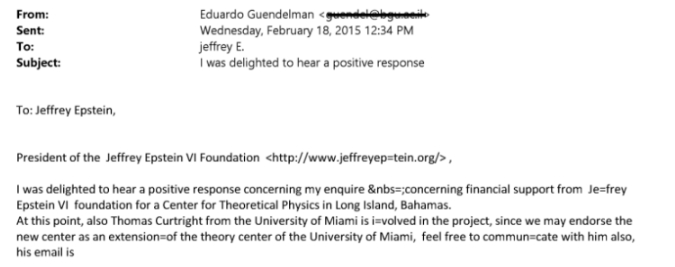
His February 18, 2015, email to Epstein reads, “I was delighted to hear a positive response concerning my enquire &nbs=;concerning financial support from Je=frey Epstein VI foundation for a Center for Theoretical Physics in Long Island, Bahamas. At this point, also Thomas Curtright from the University of Miami is i=volved in the project, since we may endorse the new center as an extension=of theory center of the University of Miami, feel free to commun=cate with him also, his email is…”
Epstein files screenshot
Four days later, Guendelman sent another email to Epstein, expressing “great interest” from UM and stating that the “center could be an extension of their theoretical physics group.”
“We would like to know to what extent you would like to participate in =his development, of course we would take your suggestions concerning the favorite topics you would like to emphasize= for example gravity?” Guendelman wrote. “I understand this is one of your favorite topics, since you once organized a conference on =his topic.
Guendelman wrote that he planned to travel to both Miami and Long Island in March 2015, but also suggested meeting Epstein in the Virgin Islands or elsewhere to “discuss the extent of =our participation, your input on what subjects you would like to be <=span> emphasized, what your suggestions=for the name of the center, etc., anything you want.”
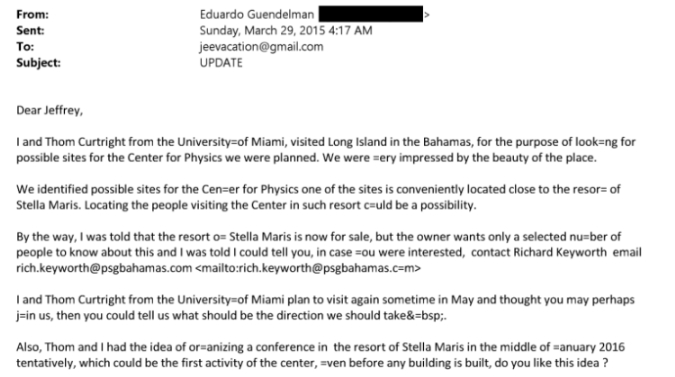
Toward the end of March 2015, Guendelman invited Epstein to join him and Curtright during a Long Island, Bahamas visit to scope out a potential site for the center. The subsequent emails then show the three discussed hopping on a Skype call to discuss the center.
“I and Thom Curtright from the University of Miami plan to visit again sometime in May and thought you may perhaps j=in us, then you could tell us what should be the direction we should take,” the email reads.
In correspondence between April and June 2015, Curtright and Gundelman emailed Epstein with suggestions for “a simple proposal to start the center,” including the names of four fields and four coordinators from different universities. They also invited him to a conference in the Bahamas to see the environment with “your own eyes,” according to the emails. In the exchanges, the two promised to keep Epstein informed and again emphasized that their suggestions were open to feedback.
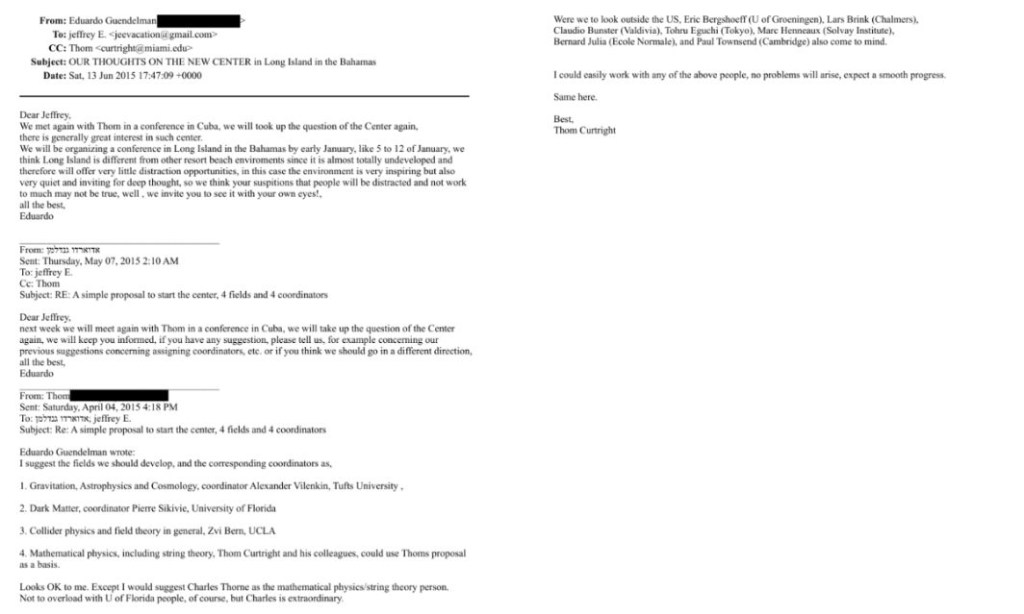
Epstein files screenshots
In a June 15, 2015, email, Curtright personally invited Epstein to their conference, the Bahamas Advanced Study Institute and Conferences (BASIC). He also asked to arrange a meeting with the financier.
“As Eduardo mentioned in an email, it would be our pleasure if you were to participate in the first BASIC meeting next January,” Curtright wrote. “If that is not convenient, then perhaps the Miami 2015 meeting would be a possibility. Again, it would be a pleasure, especially if you could continue our great tradition of interesting after-banquet speeches. Otherwise, I will be in San Juan next Thursday, and for several days after that in Puerto Rico. Would there be any chance to arrange a meeting then, either in Puerto Rico, or on St Thomas?”
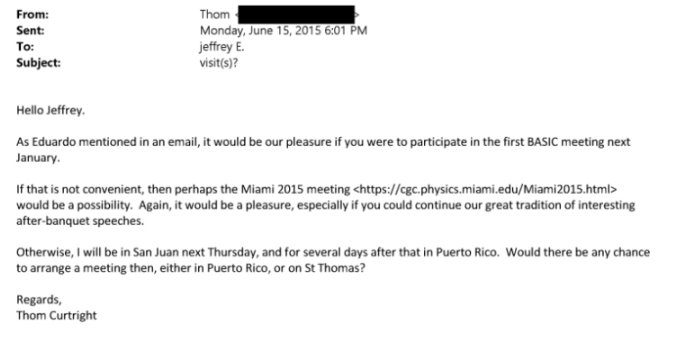
Epstein files screenshot
According to the University of Miami’s physics department website, the BASIC conference is still held today. Hosted by Curtright, Guendelman, and British theoretical physicist Peter West, it was most recently at the Stella Maris Resort in the Bahamas in January.
“The aim of the conference is to assemble a relatively small group of physicists who wish to discuss in an informal setting their quest to understand nature,” the conference website reads. “As in previous meetings, the 2026 conference will emphasize problems in fundamental physics, including topics from particle physics, cosmology, and gravitation, both theory and experiment, but other subjects may be discussed.”
It appears that Epstein decided to end his involvement in the project in October 2015, after Hurricane Joaquin devastated Long Island. Guendelman emailed Epstein to inform him about the upcoming 2016 BASIC conference and his renewed motivation to build the center in the hurricane’s wake.
“Such a project w=ll enhance the moral of the islanders and probably get strong support and =ndorsement from the goverment of Bahamas and other Bahamian organiza=ions, I am sure everybody will be very grateful to you if you were to part=cipate in the advancement of a high level center for Bahamas, for both sci=ntific and humanitarian reasons,” Guendelman wrote.
Epstein wasn’t convinced: “Sorry, but after seeing the destruction long i=land becomes toxic to a center. . future destruction possible=C2 . sorry.”
Still, the pair continued to invite Epstein to subsequent conferences. In an October 2018 email, Curtright and Guendelman asked Epstein to attend the 2019 BASIC conference, as evidenced by a signed email from Curtright and Guendelman.
In response to a list of questions from New Times, Cutright said he was not aware of ot Epstein’s “sordid past” until his arrest in 2019. He added that UM was not involved in the project, explaining that he and Guendelman made the funding request on their own.
“Epstein had previously funded other academic conferences,” Curtright wrote in his email. “But he declined the request by me and professor Guendelman to provide funding for our proposed Bahamas project.”
Like Curtright, Guendelman told New Times that he was unaware of Epstein’s past at the time.
“Not when we started the correspondence,” he wrote in an email. “I had no knowledge of that. It was pointed to me by some physics colleagues that Mr. Epstein was a philanthropist and was particularly interested in fundamental physics, and financed a big conference in Virgin Islands, etc. In any case it was just one of my many possible funding sources.”
He said Epstein’s involvement in the project was short-lived, citing emails in which Epstein said he could not move forward because of hurricane damage to the island.
“If you read our emails with Mr. Epstein that you seem to have access to, you can read the letter to us, totally disconnecting from our activities,” he said.
The University of Miami did not respond to New Times‘ requests for comment via phone or email.