
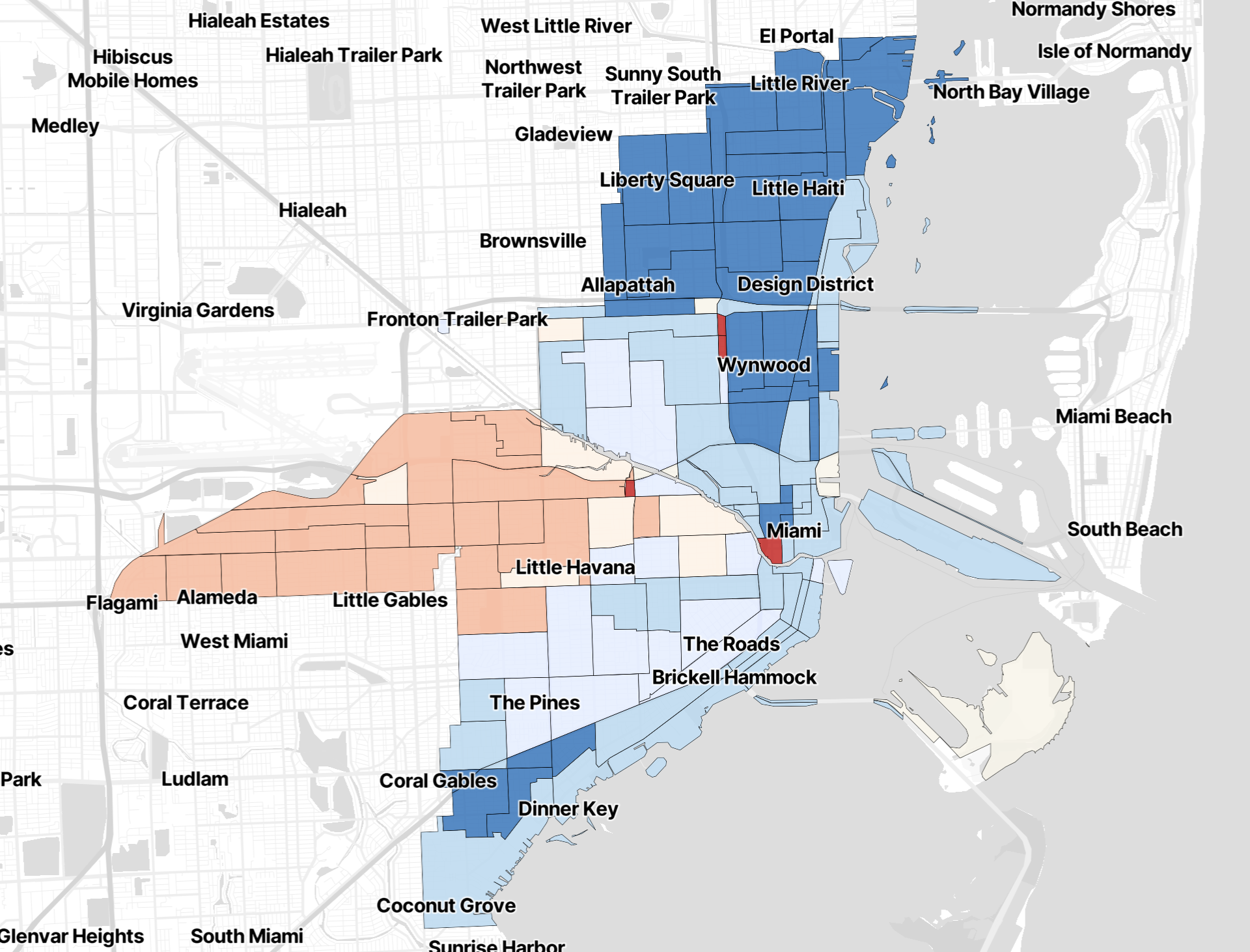
Map by Patrick McCaslin

Audio By Carbonatix
A year ago, Miamians awoke to the news that Miami-Dade County had gone red, by a lot. Now-President Donald Trump had won 55.2 percent of the vote, far surpassing Kamala Harris’s 43.8 percent.
On Tuesday, Magic City inhabitants elected Eileen Higgins as the first Democratic mayor of the City of Miami in nearly three decades, marking the first time a woman has held the position in city history. Higgins, endorsed by the Democratic National Committee, ran against Trump-endorsed Emilio González. Higgins garnered 59 percent of the vote, with 22,142 Miamians voting in her favor, while Gonzalez earned the remaining 41 percent, or 15,097 votes. The hyperlocal election was largely seen as a litmus test for anti-Trump sentiment in a region that once seemed so sure of the president.
What does Tuesday’s election say about attitudes toward Trump? We crunched the data and linked an interactive map so you can dig in:
Higgins’ Win Is Surprising, but Not a Shock
While Miami-Dade County voted red in 2024, the City of Miami had remained a sea of blue. Harris won the city with 52.2 percent of the vote, and many large precincts (with 1,000 or more voters) even saw Harris surpass 70 percent. If those precincts continued to vote Democrat, Higgins could have easily won.
But Higgins managed to flip dozens of precincts that voted for Trump last year. Of the 57 Miami precincts that chose Trump in 2024, 27 of them flipped to Higgins in 2025.
With those extra precincts, Higgins improved on Harris’s 2024 tally by seven percentage points, winning 59.5 percent of the vote.
Largely Latino Precincts Drive Change
At least 85 percent of the 27 precincts that voted for Trump in 2024 and Higgins in 2025 are predominantly Latino communities. That includes precincts in Allapattah, parts of Little Havana, and Coconut Grove. At least 60 percent of these areas have large immigrant communities.
That shift comes after a year of aggressive tactics from Trump to curb immigration, including erecting a detention center in the Everglades, ending Temporary Protected Status for Venezuelans and Haitians, and conducting U.S. Immigration and Customs Enforcement (ICE) raids. A poll released earlier this year indicated that the majority of Miamians had soured on Trump’s approach to immigration.
Higgins has stated that she disagrees with the city’s decision to sign a 287(g) agreement, which effectively allows ICE to partner with and deputize the Miami Police Department. As mayor-elect, she plans to limit the agreement’s impact on the city, she says.
In 2024, Trump won predominantly Latino Miami precincts by a razor-thin margin of 0.05 percentage points, receiving 49.3 percent of the vote. Though in Tuesday’s runoff, 61 percent of voters in those same precincts chose Higgins.
Higgins Dominated in White and Black Precincts
In both primarily white and Black precincts, Higgins received a higher share of the vote than Harris did the previous year.
Across all predominantly white precincts, Higgins won 64.8 percent of the vote, while González won 35.2 percent. In 2024, 55.2 percent of those precincts voted for Harris, while 43.2 percent voted for Trump. In mostly Black precincts, the margins were even wider, with Higgins winning 89.7 percent of the vote and González taking just 10.3 percent. Harris received 79.1 percent of the vote in predominantly Black precincts during the year prior, and 19.3 percent of voters chose Trump.