

Photo by Neil Rasmus/Patrick McMullan Company; headline screenshot via New York Times; email and message screenshots via U.S. Department of Justice

Audio By Carbonatix
Convicted child sex offender and disgraced financier Jeffrey Epstein utilized a vast network to commit his crimes, including doctors and medical specialists across the globe. Recent reporting from the New York Times documented the “small stable of doctors” that offered elite medical services to Epstein and the women surrounding him.
Dr. Bruce Moskowitz, a West Palm Beach internal medicine specialist who also offers concierge care to the ultra-wealthy, was one of those doctors.
In addition to treating Epstein’s routine medical issues, including bloodwork and back pain, Moskowitz also facilitated care for the women around him, often directing Epstein to physicians and gynecologists in other states and around the globe. And the connection between Epstein and Moskowitz didn’t end at the examination table or the reception desk.
Emails and text messages released as part of the U.S. Department of Justice (DOJ)’s latest Epstein file release reveal that the disgraced financier communicated regularly with Moskowitz, arranging dinner plans, inviting him and his wife Marsha to his New Mexico ranch, asking him to treat his two “friends” for gonorrhea, and contributing more than $200,000 to the doctor’s healthcare foundation. New Times pored over nearly 3,000 DOJ documents illustrating the layered relationship between Epstein and Moskowitz to produce this reporting.
While serving as Epstein’s primary care physician and “internist to the world’s wealthy,” as Epstein described, Moskowitz was quietly shaping policy at the U.S. Department of Veterans Affairs (VA) during President Donald Trump’s first administration. In 2018, ProPublica reporter Isaac Arnsdorf described Moskowitz as “one-third of an informal council that was exerting sweeping influence over the VA from Mar-a-Lago.”
From 2010 to 2019, Moskowitz also appears to have exercised considerable influence over Epstein’s medical care.
Moskowitz did not return New Times‘ phone calls requesting comment.
Medicine without Boundaries
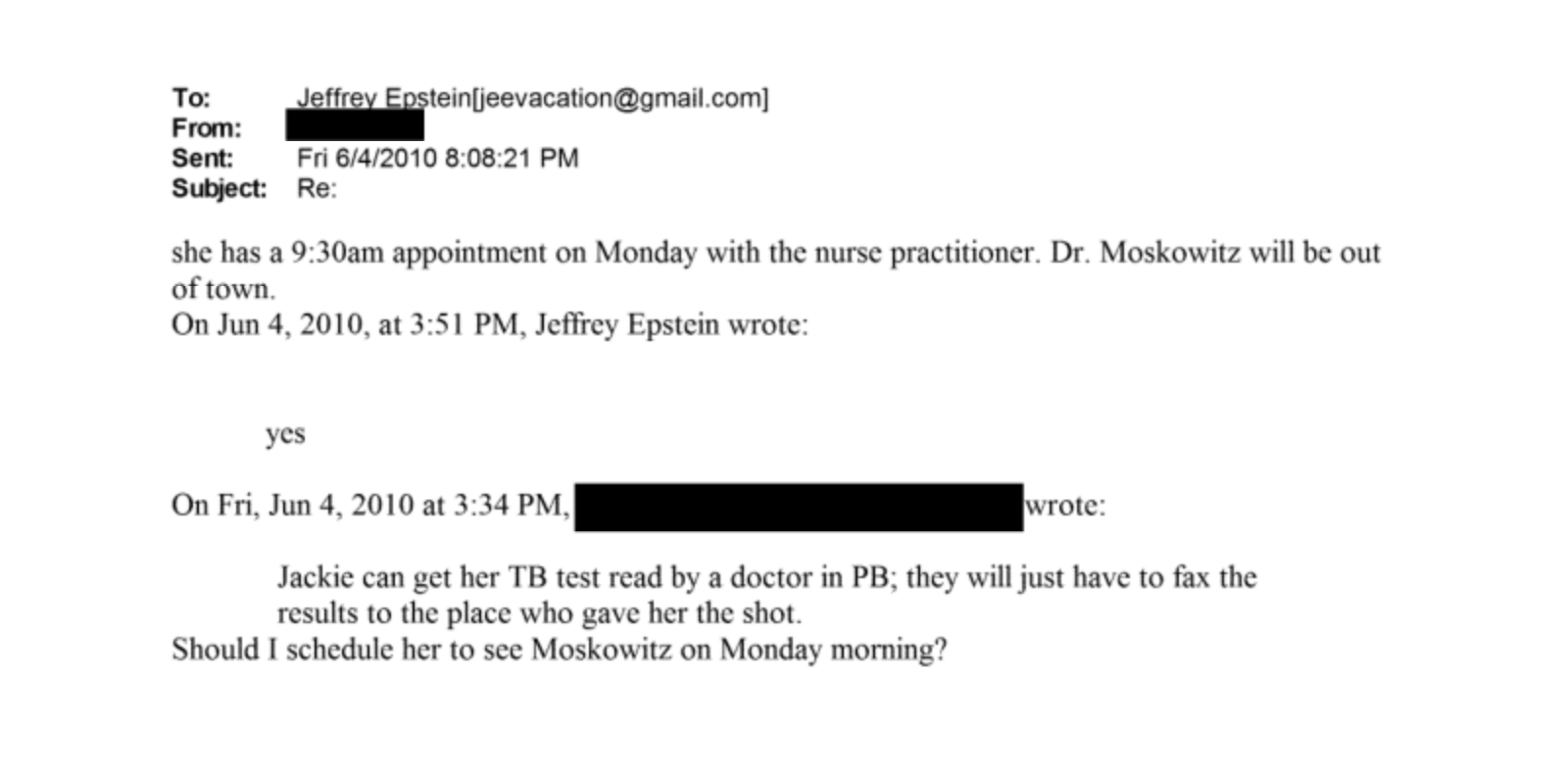
On June 4, 2010, a Friday, Epstein received an email from a redacted address. “Jackie can get her TB test read by a doctor in PB; they will just have to fax the results to the place who gave her the shot. Should I schedule her to see Moskowitz on Monday morning?”
Seventeen minutes later, Epstein responds, “yes.”
Screenshot via U.S. Department of Justice
Later that evening, another email, replying to Epstein, confirms Jackie’s 9:30 a.m. appointment with a nurse practitioner the following Monday. “Dr. Moskowitz will be out of town,” the email continues.
The exchange marks the first in a trove of emails and text messages involving Epstein, Moskowitz, and their associates. Some correspondence concerns Epstein’s personal healthcare, while others refer to the medical care of “girls,” “friends,” “women,” “partner,” and to referrals to “a gyno” and other specialists.
In a January 2018 text thread, Epstein appears to test positive for gonorrhea, a sexually transmitted infection.
“Awake?” he asks the doctor at the wee hour of 4:05 a.m. “Nothing urgent positive gonorhea results.”
Moskowitz responds promptly at 4:07 a.m.: “At Er call me early”
The two then discuss whether the strain is “the chronic version and/or the drug resistant strain,” and the “culprit.”
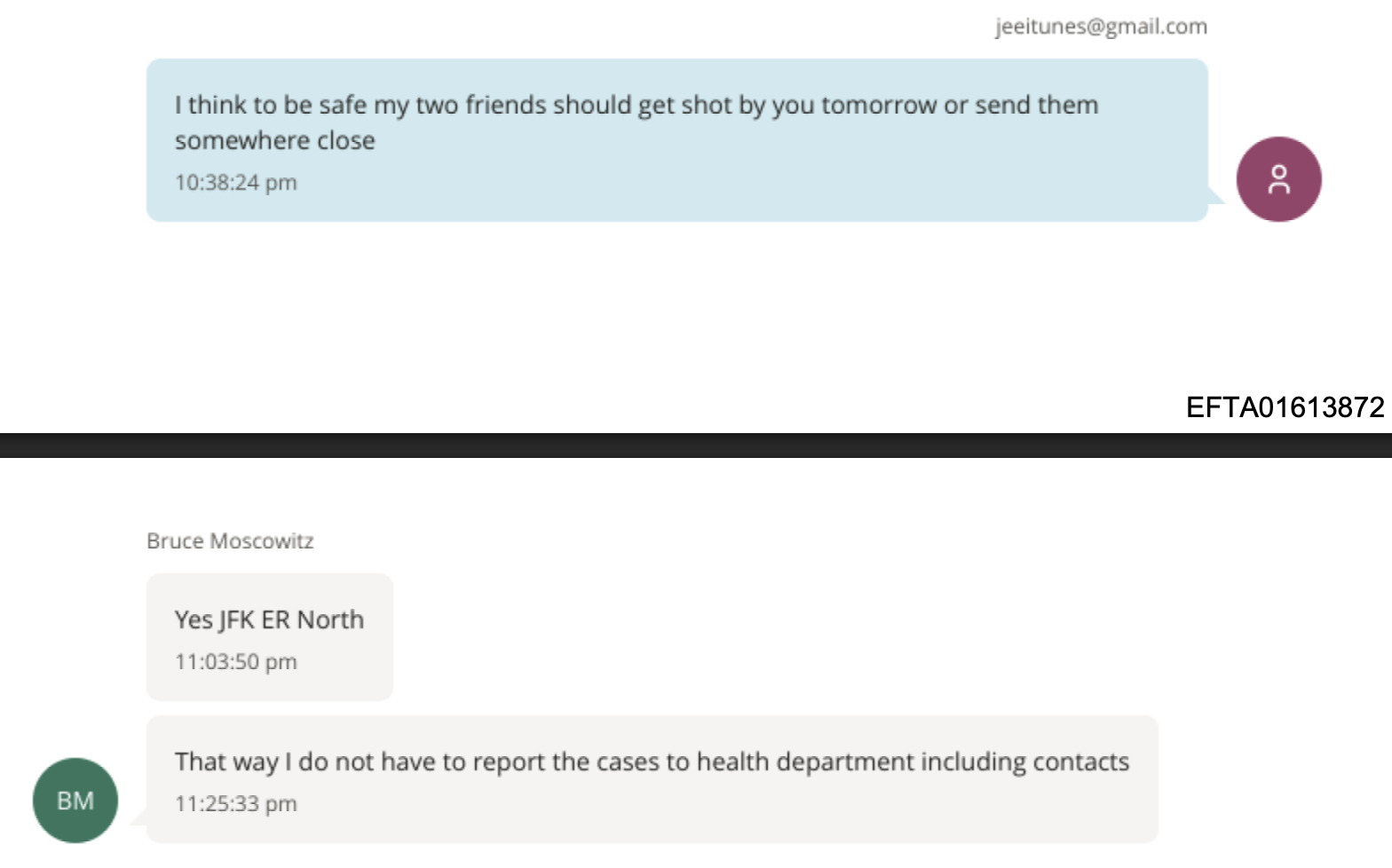
“I think to be safe my two friends should get shot by you tomorrow or send them somewhere close,” Epstein texts Moskowitz later that night. “Yes JFK ER North. That way I do not have to report the cases to health department including contacts,” Moskowitz writes.
Screenshot via U.S. Department of Justice
The following day, Epstein texts Moskowitz again to inquire about the friends’ care. “Do they say their friend had gono,” he asks. “They say a friend overseas,” Moskowitz responds.
In June of the same year, Moskowitz appears to refer Epstein to a Paris doctor. “Emergency Concierge Medicine in Paris- The English speaking physician will come directly to the hotel or residence,” he writes from his iPad.
In December of 2018, Epstein requests another STI test, this time for chlamydia. (This one was negative.)
The pair’s emails contain a range of other odd requests. In one exchange, Moskowitz appears to refer Emirati businessman Sultan bin Sulayem to a New York City gastroenterologist. In another, Epstein asks where “these girls should go to freeze eggs.” Other messages seek recommendations for a “good shrink psychopharmacology” for a 35-year-old woman on antidepressants.
New Times could not reach Sultan bin Sulayem for comment on this story.
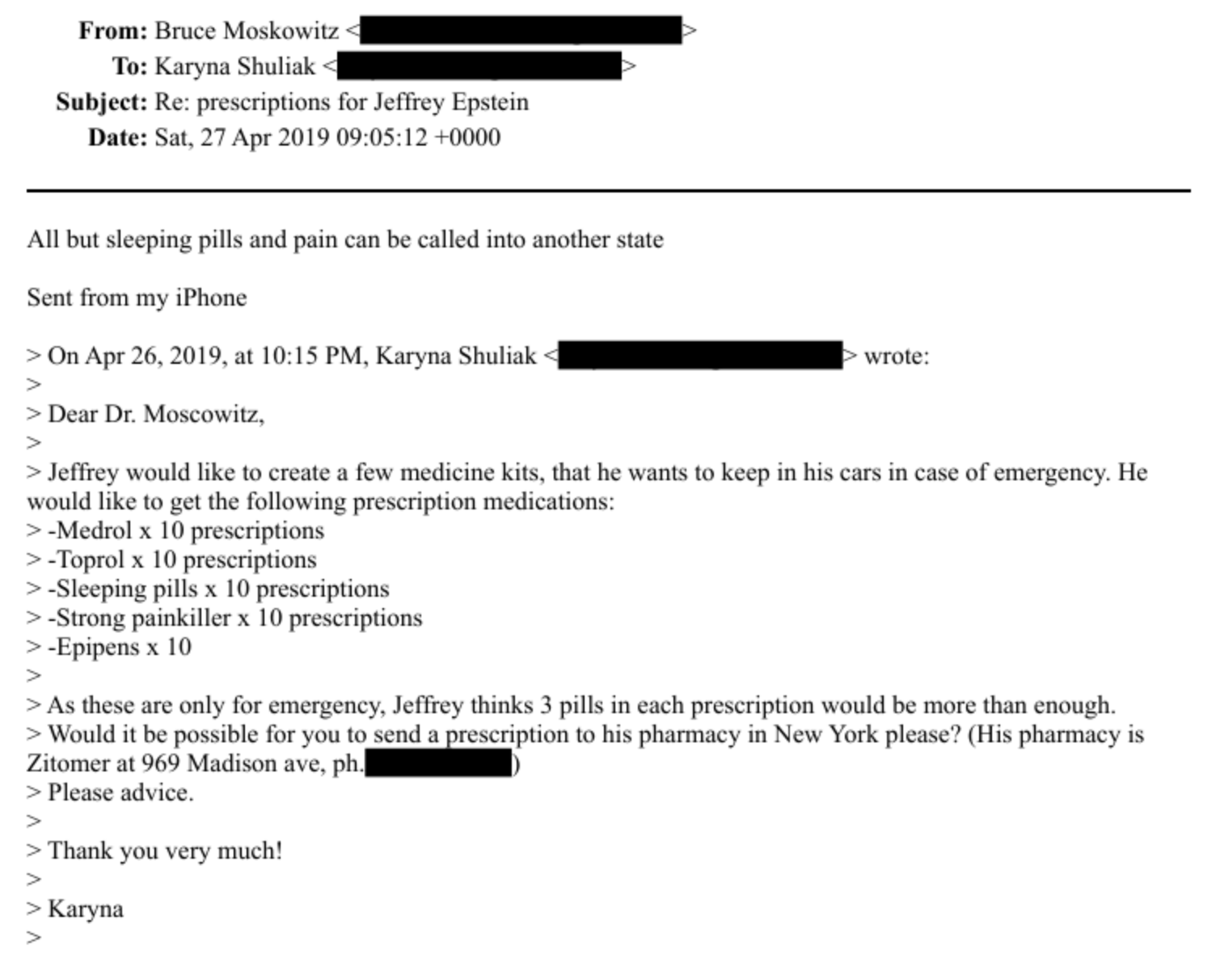
In April 2019, longtime Epstein romantic partner Karyna Shuliak asks Moskowitz to prescribe medication “to create a few medicine kits, that he wants to keep in his cars in case of emergency,” including sleeping pills, painkillers, and EpiPens. “All but sleeping pills and pain can be called into another state,” Moskowitz replies.
Screenshot via U.S. Department of Justice
In a May 2019 iMessage exchange, Epstein cryptically writes, “Emergency room equipment?” Six minutes later, Moskowitz responds, “Will discuss with Clayton Cowl who is in charge of this at Mayo and designs for private planes and yachts.”
And Moskowitz’s gynecologist recommendations span from Albuquerque, New Mexico, to Manchester, England, depending on Epstein’s needs at the time.
From Medical Affairs to Veterans Affairs
As Moskowitz catered to Epstein and other members of the Palm Beach elite, he also had a seemingly close connection with then-President-elect Donald Trump.
In December 2016, he helped put together a small group of national health leaders and hospital executives to meet with Trump at Mar-a-Lago, alongside then-Republican National Committee chairman Reince Priebus and then-top Trump aide Steve Bannon.
“He’s familiar with me, and I’m familiar with him,” Moskowitz told health publication Stat News about his relationship with Trump in January 2017.
An August 2018 ProPublica investigation found that, in the early days of Trump’s first administration, Moskowitz was part of a three-member informal council quietly shaping policies at the VA.
Referred to inside the VA as “the Mar-a-Lago Crowd,” Moskowitz, then-Marvel Entertainment chairman and billionaire Ike Permullter, and lawyer Marc Sherman allegedly called the shots at the department and influenced policy affecting millions of Americans without any “transparency, accountability, or oversight,” and despite no U.S. military or government background.
The three men maintained that they worked on a “voluntary basis,” were not seeking financial benefits, and did not “possess any authority over agency decisions.”
In February 2018, Moskowitz complained to Epstein that his conference call with the VA was “now up to 3 hours long.”
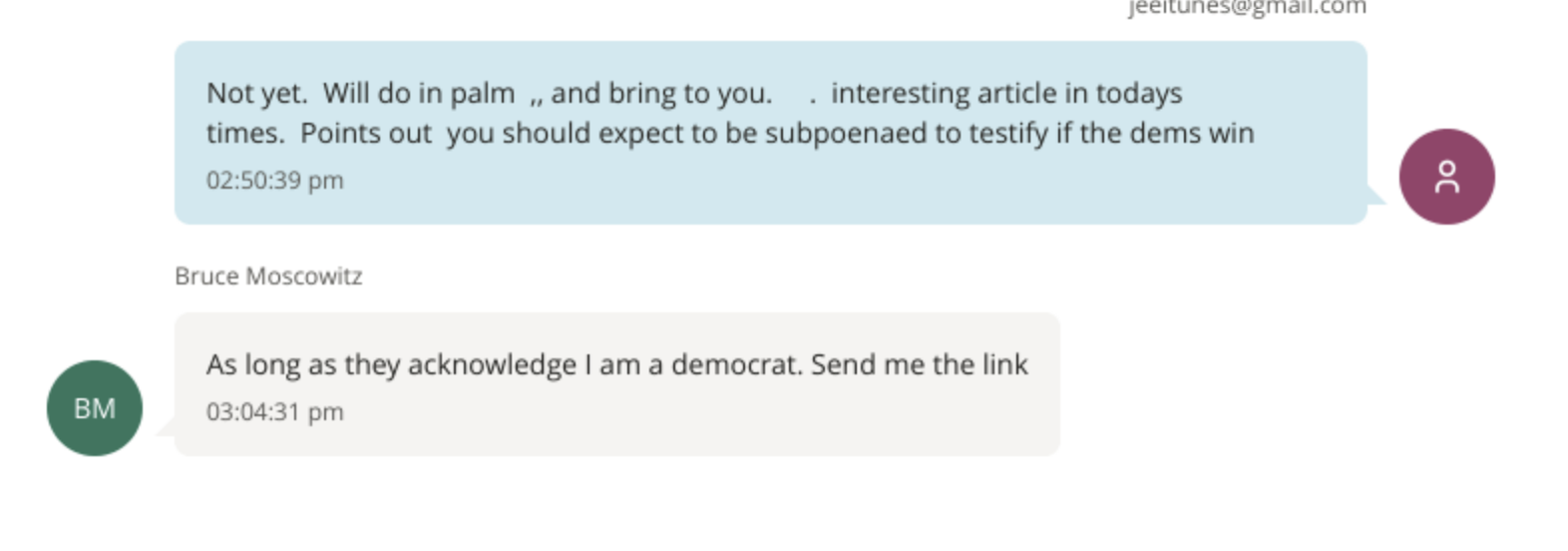
In late August 2018, the two discussed the potential fallout of a VA scandal between messages about Epstein’s urine and blood tests. “Interesting article in todays times,” Epstein wrote. “Points out you should expect to be subpoenaed to testify if the dems win.” Moskowitz doesn’t seem too worried. “As long as they acknowledge I am a democrat,” he writes back. “Send me the link.” Epstein responds with a link to a New York Times story.
Screenshot via U.S. Department of Justice
Three years later, the Democratic chairs of the Veterans Affairs and Oversight and Reform Committees released documents as part of their investigation, claiming they showed that the trio violated the Federal Advisory Committee Transparency Act, and “sought to exert influence over government officials to further their own personal interests.”
“In for a couple of million”
In exchange for Moskowitz’s care and loyalty over the years, Epstein rewarded the doctor with financial contributions, stays at his New Mexico ranch, and offers of lavish perks, including a New York City apartment and Epstein’s car and driver.
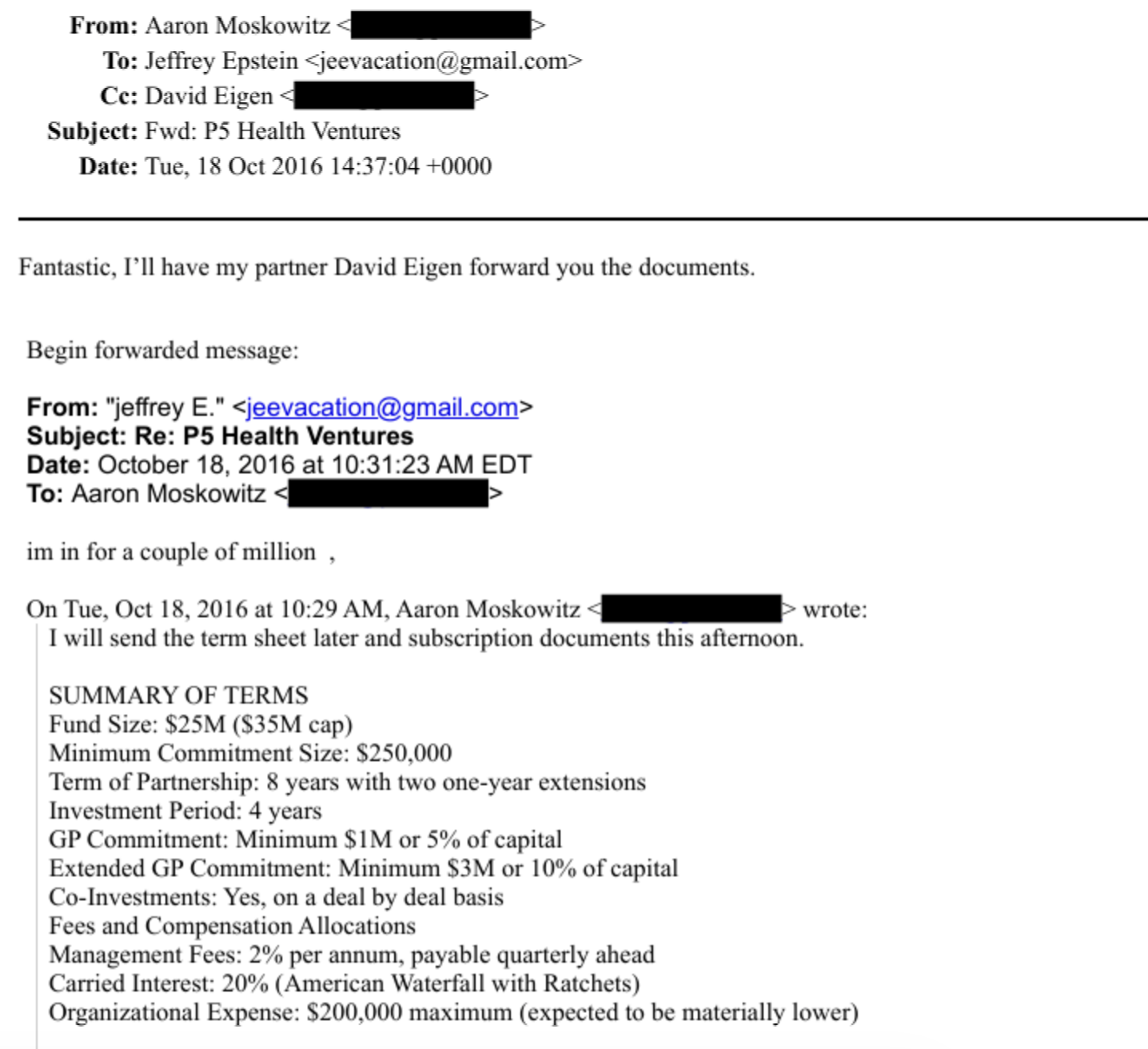
Between 2014 and 2017, the convicted sex offender contributed at least $220,000 to the Bruce and Marsha Moskowitz Foundation. According to its 501(c)(3) tax filings, the foundation “provides to qualified organizations that improve patient safety and the quality of healthcare.” Epstein also said that he was “in for a couple of million” in their son Aaron’s health venture, a 2016 email reveals.
Screenshot via U.S. Department of Justice
In April 2016, Epstein, who declined what appears to be a New York City dinner invitation from Moskowitz because he was in the Caribbean, offered his car and driver to the couple.
In June 2017, Moskowitz and his wife stayed overnight at Epstein’s New Mexico ranch. He emailed Epstein on June 5, “Not sure if we are at ranch or having a major hallucinatory experienc=!!!”
Marsha emailed Epstein to thank him for their experience at his “oasis.” “Even though we only stayed one night it wi=l be memorable forever,” she wrote. “Thank you so much!” Later that month, Moskowitz requested Epstein’s mailing address so that Marsha could send a thank-you gift.
When Marsha dealt with health issues in July 2018, Epstein offered the couple a New York apartment “for as long as you need.”
As Miami Herald journalist Julie Brown started writing her “Perversion of Justice” series in 2018 about accusations that Epstein sexually abused dozens of underage girls, Moskowitz and his wife offered Epstein their support. In one email, he told Epstein that Marsha considers him “like a brother.”
In a November 2018 email titled, “Marsha and I are there for you,” Moskowitz writes to Epstein, “Marsha said anything that she can help with let her know.” Epstein responds that the bad press wouldn’t bring up his cholesterol.
“Marsha was livid with the press,” Moskowitz writes back, “she almost punched her ipad!”
