

Audio By Carbonatix
A new law that increased the penalties for illegally covered license plates has immigration advocates worried that more undocumented immigrants will be targeted and detained on roadways.
Florida statute 320.262, which went into effect on October 1, makes it illegal to cover, obscure, or interfere with the “legibility, angular visibility, or detectability of the primary features or details, including the license plate number or validation sticker on the license plate.” It has turned what was once a non-criminal citation into a second-degree misdemeanor, carrying penalties of up to a $500 fine, 60 days in jail, or both.
Immigration attorneys fear this new law will be another way for law enforcement officers to pull over and detain undocumented immigrants.
“It’s another pretext to stop a vehicle,” Vilerka Bilbao, an immigration and human rights lawyer based in Jacksonville, tells New Times. “If the officer says, Well, you know, I couldn’t really read the tag, and the issue is that, even at the end of the day, let’s say their cover wasn’t actually covering the sticker or the license plate number, and it was lawful. Now they have an [U.S. Immigration and Customs Enforcement] (ICE ) hold, and it’s almost impossible to get someone out right now from immigration detention without filing a habeas lawsuit in federal court, so it’s just going to have more people end up in detention.”
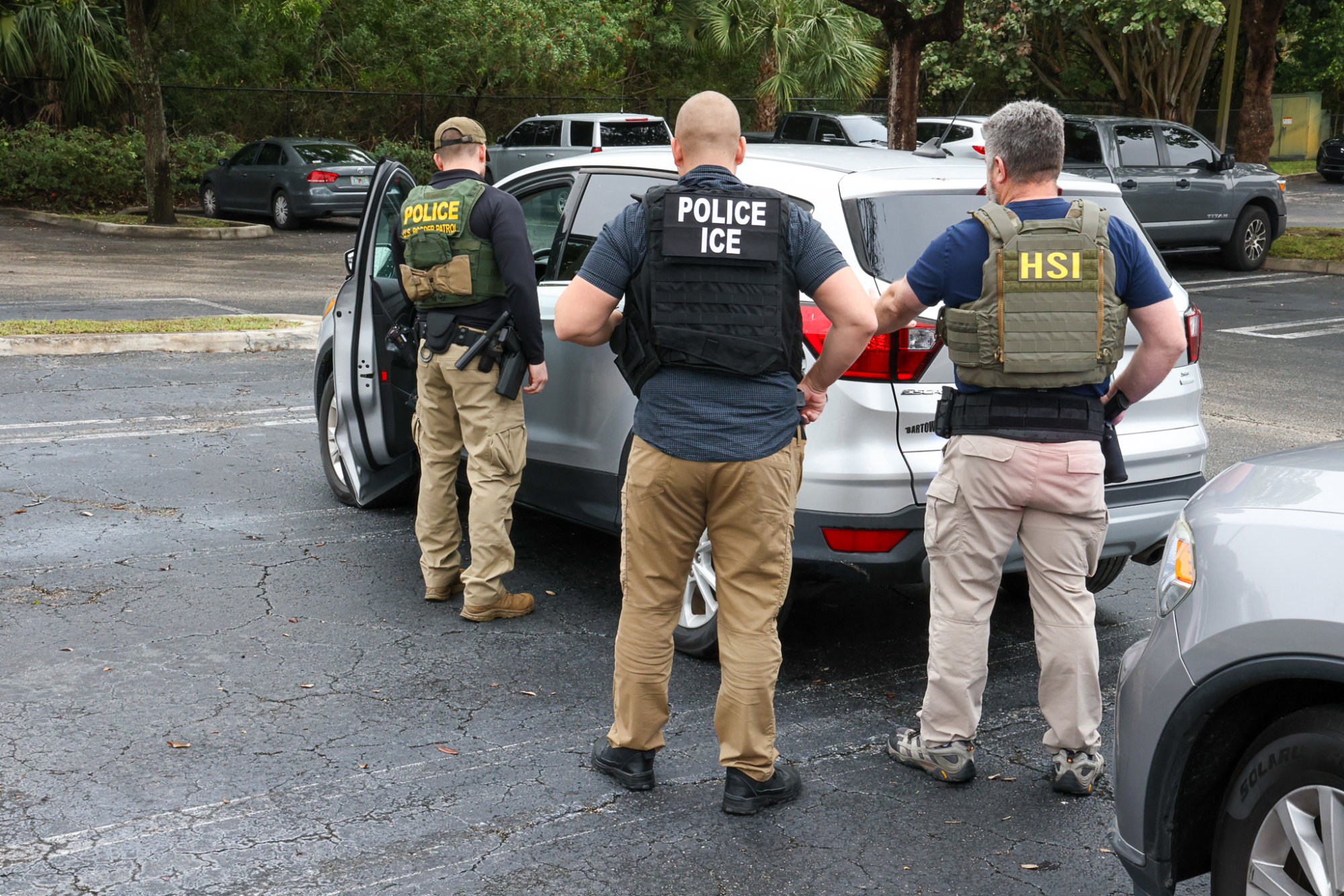
Since President Donald Trump announced his promise to carry out the most extensive deportation program in U.S. history, countless news stories have described how traffic stops in Florida have resulted in detentions of undocumented immigrants. On December 10, the longtime manager of the upscale Bice Ristorante on Worth Avenue in Palm Beach was pulled over for tinted windows and later taken into custody by U.S. Customs and Border Protection. The 53-year-old, who had been in the U.S. for 30 years, is now being held at the controversial state-run facility Alligator Alcatraz deep in the Florida Everglades, despite not being cited for tinted windows that day.
An NBC 6 South Florida analysis of the men booked at the state immigration center from July 3 to October 15 revealed that 300 of the 1,769 men listed with “criminal convictions” have traffic offenses, excluding driving under the influence of drugs or alcohol, hit-and-run, and vehicular manslaughter. Another man told the Sun Sentinel that a Florida Highway Patrol trooper stopped his pickup truck because the “Sunshine” letters at the bottom of the license plate were difficult to read. He said five immigration agents then showed up, questioned them about their legal status, and later detained his father and another passenger.
“It’s all over the state. We’re getting sometimes people being detained without authority because there has been no crime committed, like the person wasn’t actually speeding, the person didn’t actually have a broken taillight,” Bilbao adds. “But once the person is detained, and once they determine that person is an immigrant, and sometimes, just by the mere fact that they don’t speak good English, they speak broken English, or they can barely communicate with the officer. At that point, they’re running their name through the immigration databases, which they’re allowed to do.”
The vague language of the new license plate cover rules has sparked confusion within the community, as drivers are unsure if they can be pulled over for their decorative or car dealership license frames. Last week, a Davie Police officer wrongfully arrested a 41-year-old man for having the “S” in “Sunshine State” covered at the bottom of the plate by the frame on his rental car. Following his arrest, the department apologized, blaming the error on the statute’s vague wording.
“At the initial release of this updated law, the wording was vague, unclear, and appeared to be open for misinterpretation,” Davie Police said in a statement. “Since the release of a memo of clarification from the Florida Police Chiefs Association was provided to our department, our officers are educated on the application and use of this statute. Unfortunately, it appears his arrest was invalid, and we extend our apologies to Mr. Dawson.”
Amid the confusion, the Florida Department of Highway Safety and Motor Vehicles (FLHSMV) clarified that a license plate frame is permitted as long as it does not cover the license plate numbers and the decal in the top right-hand corner.
“The Department of Highway Safety and Motor Vehicles does not consider the information on the bottom of the plate to be a primary feature of the plate,” the memo stated. “A plate frame that impinges on the information at the top of the plate is permissible, as long as law enforcement is able to identify the state that issued the plate.”
Yareliz Mendez-Zamora, a policy coordinator at the American Friends Service Committee, tells New Times that people in her chats, which have become lifelines for migrant communities to learn about immigration enforcement operations, are concerned about the new law and are trying to keep each other informed to avoid being targeted. Bilbao recommends that people remove their license frames for added safety.
“That way, there isn’t even a reason to pull you over,” Bilbao says. “Honestly, there are so many people who are so scared of everything that’s happening right now.”
While Bilbao acknowledges that the law may have been intended to prevent drivers from covering their license plates when going through highway tolls, she says U.S. citizens should also be alarmed.
“It’ll affect U.S. citizens because there’s another reason to pull us over,” she adds. “There’s an extra reason for police to be involved in our lives, and nobody really wants the police involved in our lives unless we are asking for help. So for the most part, we want police out of the way, out of our private lives, and this is just another reason for them to intervene.”