
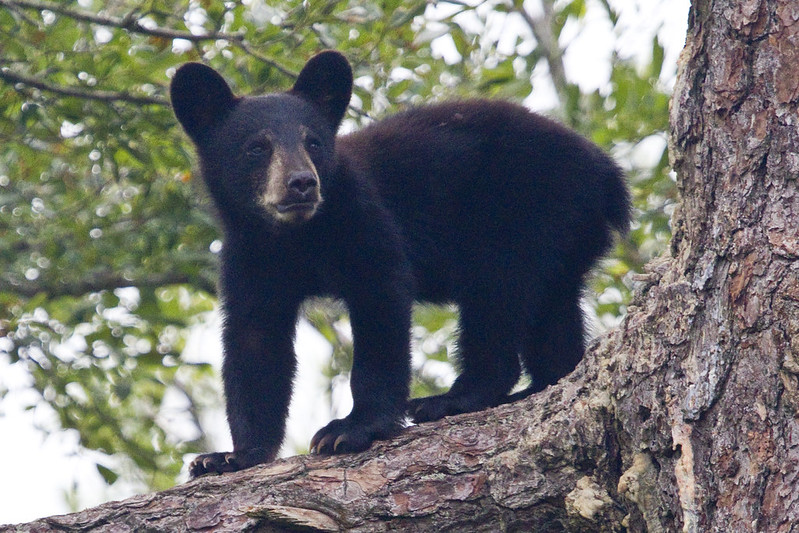
Photo by Orsulak from Flickr

Audio By Carbonatix
Florida wildlife officials are hailing December’s black bear “harvest” as a safe and successful event, noting hunters killed dozens of bears during the highly criticized, state-sanctioned hunt.
After months of debate and protest, the Florida Fish and Wildlife Conservation Commission (FWC) approved the 2025 Black Bear Hunt, citing a need to cull rising bear populations, largely due to increasing interactions with humans throughout the state. FWC officials released results from the hunt this week, which ran from December 6 to 28.
FWC issued 172 permits (a drop from numbers previously reported by officials) across four bear hunting zones throughout the state, including vast stretches of the Florida Everglades in South Florida. Each permit allowed the “harvest” (killing) of one bear within the assigned zone. Hunters harvested 52 bears during the hunt, according to a preliminary FWC report. Officials noted they will release a full harvest report in the coming months.
“The 2025 black bear hunt, rooted in sound scientific data, was a success,” FWC Executive Director Roger Young said in the news release. “We’re proud to have joined the more than 30 states that manage black bears with regulated hunting. The limited number of permits issued in areas with the largest bear populations and other components of the hunt prioritized a conservative approach that ensures the long-term health of bear populations in Florida, while providing opportunity for hunters.”
Some opponents of the hunt may argue it was not a success, pointing to the wide gap between the number of bears harvested and the number of permits issued. Animal advocacy historians may also note the comparatively low total, especially when contrasted with the last hunt a decade earlier, which FWC officials halted early after hunters killed nearly 300 bears in just two days. December’s low kill count could be the result of animal advocates applying for (and securing) black bear permits with the intention of sitting out the hunt, effectively subtracting a legal kill from the total, as reported by WPLG.
For months, opponents of the hunt vehemently disagreed with FWC’s repeated claims about its basis in data. Opponents who spoke at FWC meetings in August and November noted that the agency’s decennial black bear census was scheduled to be released after the final vote on the hunt, even though the hunt was largely predicated on claims that black bear populations are growing.
FWC released preliminary data on the census in September showing black bear populations in the Osceola region decreased by 66 percent over the past decade — a far cry from proponents’ warnings that populations are increasing statewide.
The region, which encompasses the Osceola National Forest between Tallahassee, Jacksonville, and Gainesville in north Florida, serves as an indicator for populations across the state, Rhonda Roff, conservation chair for the Sierra Club Calusa Group, wrote in a statement. FWC researchers found black bear density in the region dropped from about 0.12 bears per square kilometer in 2014 to 0.04 in 2024, representing an estimated decline from around 500 to 167 bears. The data comes from a preliminary release of FWC’s decennial Florida black bear census (attached at the bottom of this story), which the agency shared with bear conservation groups.
“The FWC uses population models to set harvest quotas, but those models are now based on data collected a decade ago, and the Osceola numbers show that the real world is diverging sharply from their projections,” Roff said in a statement to New Times. “The steep decline in Osceola — one of Florida’s most forested and least-developed bear management units — suggests bear populations are far more vulnerable than the models indicated.”
After months of repeated questions, New Times has yet to hear back from the FWC on a request for statewide data on black bear encounters with humans, which proponents argued were on the rise. FWC has a black bear sighting map on its website, showing encounters over the past five years, but the underlying data is not available.
Despite FWC’s own data disproving the argument of FWC officials, the hunt went on as planned last month, marking the first state-approved bear hunt since 2015. Some officials, like FWC chief conservation officer George Warthen, even argue that the state-sanctioned bear killing is actually just proof of a symbiotic relationship between bears and people.
“It’s about helping bears succeed over the long term in our state and is a way for us to guide an iconic Florida species into the future, for their benefit and ours,” he said in a news release.
In the release, FWC noted an increased officer presence helped lead to “strong compliance with regulations.” FWC officials issued one warning to a hunter for a minor (unspecified) violation.