Photo by Jean-Claude De L’Herbe

Audio By Carbonatix
Fort Lauderdale artist Jean-Claude De L’Herbe says he doesn’t care much for political figures like Elon Musk.
But when an opportunity arose to paint a mural funded by the tech entrepreneur — and to get paid well for it — he didn’t hesitate.
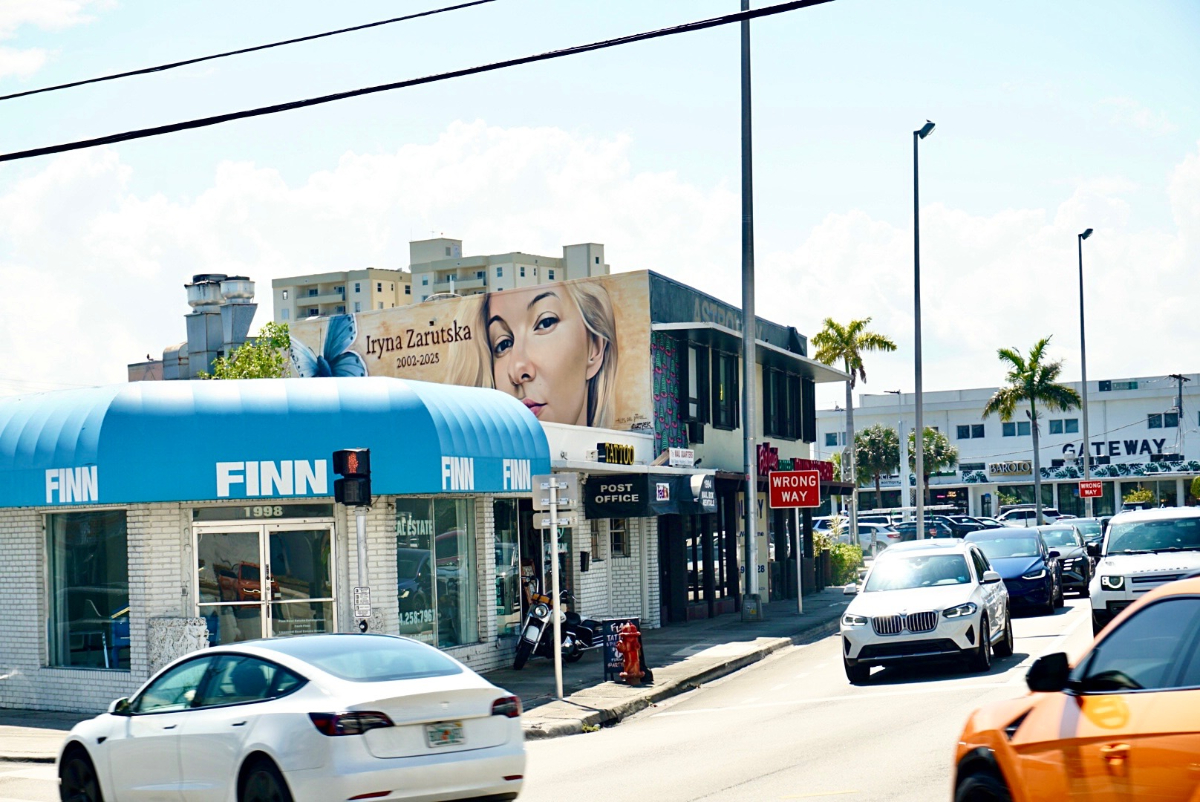
De L’Herbe tells New Times he worked with several other artists in late February to design and paint a mural of Ukranian refugee Iryna Zarutska, who was stabbed to death on a light rail train in North Carolina last year. Painted on the side of Big Louie’s Pizzeria in Fort Lauderdale and overlooking East Sunrise Boulevard, the mural features a large spray-painted portrait of the young woman’s face.
You might be wondering: if Zarutska died in North Carolina, why is there a mural of her all the way down in South Florida?
The mural appears to be part of a nationwide campaign funded in part by Musk and other conservative donors, who contributed more than $1 million to commission large-scale murals of Zarutska in cities across the country. The effort has drawn backlash in some cities, where critics say it politicizes Zarutska’s death.
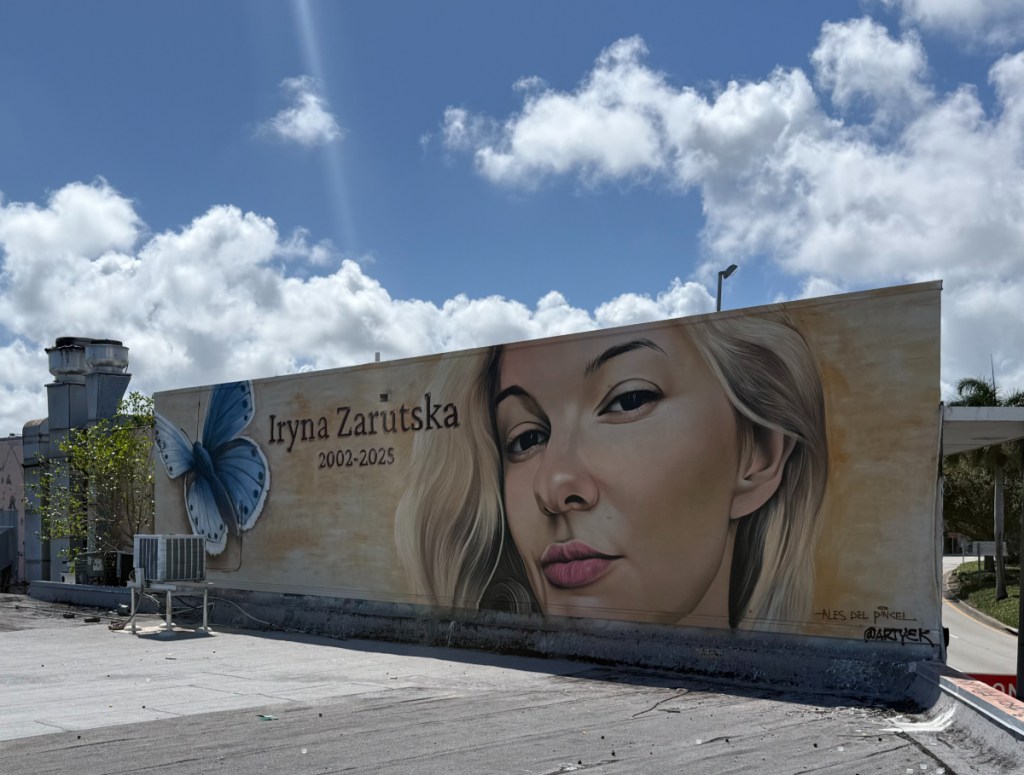
Photo by Jean-Claude De L’Herbe
Last August, Zarutska was fatally attacked while traveling home on public transportation from her job at a local pizzeria. Her alleged killer, Decarlos Brown Jr., has a history of serious mental health issues and was previously arrested 14 times; his mother told the Charlotte Observer that Brown believed he was being controlled by a chip in his head.
Zarutska’s death was quickly politicized, with president Donald Trump, Vice President JD Vance and their MAGA allies using the killing to attack Democrats’ “soft on crime” policies. President Donald Trump called for the death penalty for Brown, whom he called an “ANIMAL.” Zarutska’s mother, Anna Zarutska, was later recognized by Trump during his State of the Union address, where she sat next to Erika Kirk, the widow of slain conservative commentator Charlie Kirk.
Several weeks after her death, Trump supporter and tech CEO Eoghan McCabe announced on X (formerly known as Twitter) that he would pay artists $10,000 a piece to paint murals of Zarutska’s face in cities all over the country. The initiative was funded with an additional $1 million donated by Musk. In a post on X, manosphere influencer and self-described misogynist Andrew Tate also pledged $1 million.
De L’Herbe says he discovered the initiative online, submitted examples of his work, and went through an application and contract process.
“I got a response from someone in January saying, ‘Do you have a wall we can select?'” he tells New Times. “I really thought it was a scam. I didn’t believe it until the person got the money wired to my account.”
De L’Herbe declined to disclose the exact amount he was paid for the mural but said it was “a large amount.”
“It was nice,” he says.
Since late last year, murals of Zarutska have popped up in places like Washington, D.C., Los Angeles, Providence, Rhode Island, Fort Lauderdale, and Miami. While supporters have framed the initiative as a memorial for the young woman, the murals have become somewhat of a political flashpoint — echoing the national debate that followed her death. People criticized the murals as “propaganda,” with some accusing their financial backers of “exploiting” Zarutska’s death to push a broader political agenda.
De L’Herbe emphasizes that for him, however, the work was never political, but “just a job.”
“People drink wine in front of paintings, and they say, ‘Oh, what was the artist thinking? What is the importance of this?'” De L’Herbe says. “We’re just trying to eat.”
He continues: “We did it because we’re artists, we wanted to get paid, and we wanted to make a beautiful mural.”
In an Instagram post, De L’Herbe shared a video showing how the mural came together. People appeared to respond positively in the comments.
“🙏🙏🙏,” one person commented.
“That’s beautiful,” another wrote.
“<3 Rest in peace,” a third replied.
In December, McCabe posted a photo on X showing what appears to be a mural of Zarutska in Miami’s Wynwood neighborhood. He credits the art to Miami-based artist Disem and California-based muralist Matthew Cadoch. Disem declined to comment to New Times, while Cadoch could not be reached.
Neither artist responded to New Times‘ request for comment via Instagram DM.
McCabe’s chief of staff told the Guardian that the project was “funded by Elon Musk ($1m), Eoghan McCabe ($500k), and a long list of smaller donors ($200k)”. McCabe raised more than $104,000 in donations on GiveSendGo, which bills itself as a “Christian” alternative to sites like GoFundMe.
Neither McCabe’s chief of staff nor Musk responded to New Times‘ request for comment via email.
In a previous statement to the Guardian, McCabe wrote that “our murals aim to memorialize the story of an innocent young woman who was killed in a horrific, senseless crime.”
Nonetheless, the murals have sparked controversy across the country.
After a mural of Zarutska popped up on a building in Brooklyn, one graphic artist who lives near the Bushwick mural told the New York Post: “This woman – it’s unfortunate what happened to her – but how do you connect her to Bushwick? A lot of people around here don’t like [Elon Musk] so maybe this is his way to use his money to stick it to us.” Days after the mural went up, “Fuck Trump” graffiti reportedly appeared in its lower corner.
In Providence, Rhode Island, where artists recently began working on a mural of Zarutska on the side of a popular Providence LGBTQ+ nightclub, the club announced in a social media post Monday evening that management decided to discontinue the mural and “move forward with removal as soon as possible.”
This came after Democratic politicians, including Providence mayor Brett Smiley, called for its removal, labeling it divisive.
Rhode Island State Rep. David Morales, who is running for mayor of Providence, criticized the motivations of those backing the project and said the mural “does not reflect our values” (to which Musk asked on X: “What are his values?”)
“We’re seeing a right-wing movement that is exploiting the death of the refugee for the purposes of trying to spread division,” Morales said.