

Ian Gavan/Getty Images

Audio By Carbonatix
It’s no exaggeration to say the entire world is mourning the loss of Dolly Parton, but South Florida residents might get a visit from another larger-than-life Dolly soon, as the next tropical storm is set to bear the same name.
The name has many asking: was this just a coincidence, or do hurricane namers just have great taste?
Known to millennials as the godmother of both Miley Cyrus and Hannah Montana, Parton was universally adored not only for her country music and songwriting (including “I Will Always Love You,” “Jolene,” and “9 to 5”) but also for her philanthropic endeavors. So news of her death Tuesday weighed heavily on the hearts of people across social, political, racial, and religious divides.
But Parton’s death actually had nothing to do with the newest tropical storm bearing her name. Meteorologists at the National Oceanic and Atmospheric Administration (NOAA) actually set the name six years ago when it released its list of named Atlantic storms for 2026.
It’s actually far from the first time meteorologists have used the name Dolly for a hurricane. According to NOAA, scientists recycle a list of names every six years, so we may see Dolly on a regular rotation.
“The only time that there is a change in the list is if a storm is so deadly or costly that the future use of its name for a different storm would be inappropriate for reasons of sensitivity,” according to NOAA’s website.
NOAA officials haven’t officially named the storm in question a hurricane yet because it hasn’t reached the wind speed minimum (38 mph) to be classified as a tropical depression, although it could reach that point by Thursday. Currently a few hundred miles off the coast of Cabo Verde, the storm has a 60% chance of becoming a named tropical storm, but whether it’s too soon to tell whether it will strike South Florida, National Weather Service forecaster George Rizzuto tells New Times.
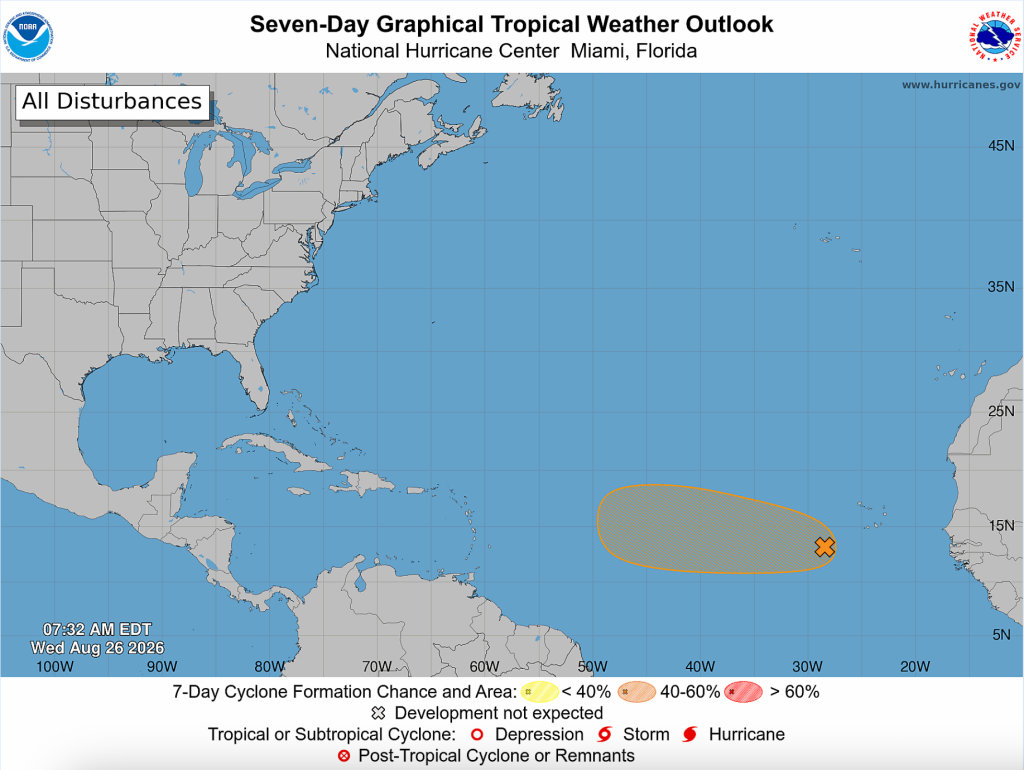
There’s currently no Hurricane Dolly, and if it continues to weaken, there won’t be one at all, Rizzuto says.
“We have a tropical wave that could develop over the next seven days into a tropical storm as it drifts generally westward,” Rizzuto says, noting that’s about all the information forecasters have to offer at this point.
A clearer picture of where the storm is heading will materialize in the next five days, Rizzuto says.