
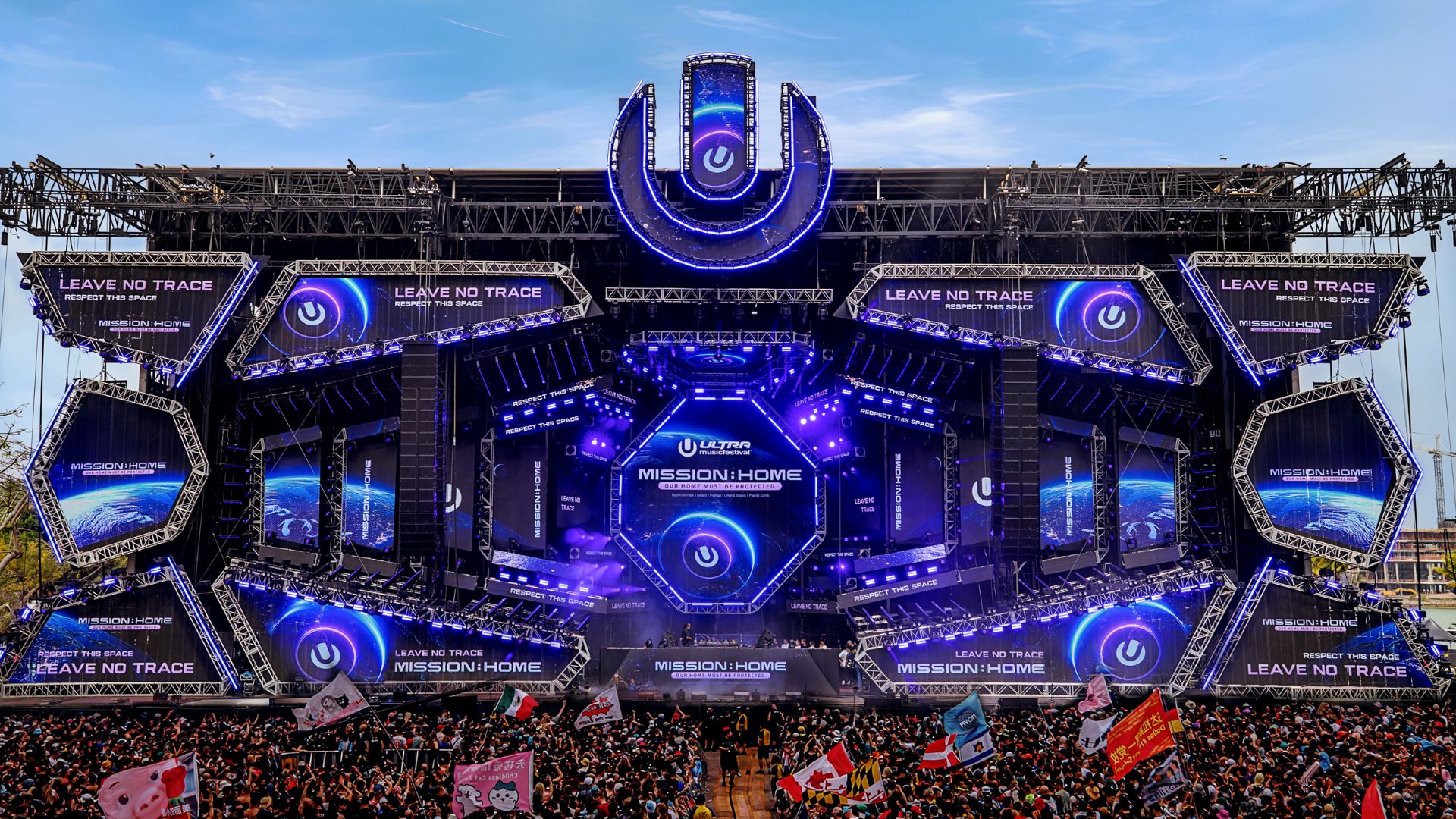
Ultra photo

Audio By Carbonatix
Most post-festival grounds fall just a few steps below a landfill. Water bottles lie on the floor, contorted, like fumigated bugs. Flat-as-pancake-stomped cans are discarded on the ground. Cigarette butts lay in waste, and there is a formidable thickness of grime and sweat all over. Adding insult to injury, when debris is scattered so close to an aquatic ecosystem, for example, Bayfront Park, it can seem as if the litter is mocking the pristine waters.
Ultra Music Festival and its “Mission: Home” sustainability program have set a goal to keep the water flowing through Bayfront Park unaffected for the past 6 years and are undoubtedly leading the way for eco-friendly music festivals in North America.
It’s quixotic to think that the grounds are cleaned up each night with some magical vacuum cleaner: It’s through the efforts of the festival, especially its Sustainability Director, Vivian Belzaguy Hunter, and her six-person team, who manage Bayfront Park before, during, and after the festival, and make each day seem like new.
“Of course, there is trash after every music festival,” Belzaguy tells New Times, “but you can tell the difference with a festival that really went out of its way and employed a waste management partner that actually cares to keep it under control.”
Belzaguy’s duties run far past putting up passive “Recycle Here” bins or telling attendees to be “mindful” when discarding their cups and plates. Mission: Home adopts a holistic approach that extends throughout Miami, having educated 8.2 million individuals, diverting nearly 400,000 pounds of waste, and donating over 84,000 pounds of resources back to the community.
Mission: Home began in 2019 when Ultra moved to Virginia Key. That year became memorialized with the infamous walk across the Rickenbacker — but to Belzaguy, who first worked with Ultra that same year, the Virginia Key edition was an environmental success. Virginia Key and community organizations enforce strict rules to preserve the lush land and coast while keeping nearby residents unbothered. Any festival aiming to host at Virginia Key must work assiduously to safeguard the land.
“Part of the deal with moving to Virginia Key was having a real plan with real initiatives,” explains Belzaguy. “There were about thirteen initiatives agreed on with community organizations and Ultra. We delivered more than we were asked, with over twenty initiatives. Two shining moments from that year were that some community organizations conducted a ‘secret shopper’ style audit during the festival, and we got an ‘A.’ We also received a letter from the park that we did an incredible job of understanding how to mitigate our impact and clean up afterward.”
Belzaguy, a Miami native, worked in event programming for over two decades, including events and festivals at Virginia Key. During her career, she became more environmentally conscious — striving to make common sense fixes like recycling and composting to lessen her footprint. She pivoted to specialize in promoting environmental initiatives at festivals after observing the lack of environmental deference at big-scale events.
Ultra Returns to Bayfront Park With 61 Green Initiatives
When Ultra moved back to its home at Bayfront Park in 2022, Belzaguy noted that the City didn’t impose nearly as many austere environmental rules. “It’s an urban park, but it’s still right against the bay,” she points out. “It’s a location that still can have an environmental impact.” The festival kept Mission: Home indefinitely, now with sixty-one environmental initiatives. “We put the initiatives into five objectives: pollution presentation, nature preservation, waste reduction, climate actions, and community engagement. We have fully gotten behind it, and compete on a global scale.”
Indeed, Mission: Home has garnered awards, including the first-place SUNsational Award in the Sustainability Program category at the Florida Festivals and Events Association; a notable mention in the music business publication IQ Magazine’s 2025 Green Guardians, sharing the honor with Coldplay and Massive Attack. Ultra recently received A Greener Future‘s “Greener Festival” certification and became a finalist in the A Greener Future award for community action, making it the only American festival nominated. Stated in A Green Future’s press release, the award intends to “celebrate the most innovative and greenest events, venues, and organizations from across the globe over the last 12 months.”
Festival-goers can visit Ultra’s Eco Village to engage in educational activities during their music breaks, with educational activations from five local environmental and social organizations present on-site, including: Clean Miami Beach, Debris Free Oceans, Love the Everglades Movement, F Fentanyl, and CLEO Institute. Prior to the festival, anyone can volunteer for Ultra’s annual shoreline clean-up at Bayfront Park, taking place Saturday, March 7th.
Belzaguy adds that Mission: Home also strengthens Miami’s community by providing almost 20,000 pounds of food and beverages to the local Miami Rescue Mission annually after the show. Ultra also hosts community events, such as its “Bayfront Bark” pet adoption event and its annual “Making Waves” cleanup. Fans can also donate money towards school supplies, uniforms, and other resources to Lotus House for a chance to win a trip to Ultra 2026.
Each year brings a collective groan from Downtown residents opposing Ultra’s three days of noise, lighting, and attendees. Though reasonable, a fair debate also requires weighing the festival’s broader impact on the city beyond a single weekend of high-decibel electronic music. “I hope people can see this program as a way to give back to our local community,” counters Belzaguy, “and I hope we can be given a shot to see the impact we have made.”
Ultra Music Festival 2026. Friday, March 27, through Sunday, March 29, 2026, at Bayfront Park, 301 Biscayne Blvd., Miami; ultramusicfestival.com. Tickets from $479.15 via ultramusicfestival.com