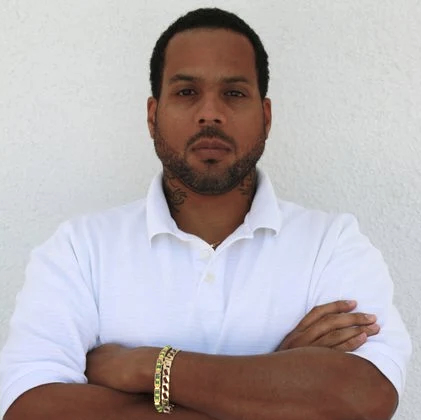

Andrew Grams press photo via New World Symphony

Audio By Carbonatix
This weekend at the Adrienne Arsht Center, Andrew Grams stood before the New World Symphony as the guest ensemble with the ease of someone who understands both the weight of history and the thrill of reinvention. The program, an ambitious exploration of jazz and classical music’s long, intertwined dialogue, felt less like a museum piece and more like a living conversation, pulsing with improvisation, memory, and distinctly American spirit.
Grams, former music director of the Elgin Symphony Orchestra and a familiar presence in major concert halls, marked a personal milestone with the performance. While New World Symphony is based at the Frank Gehry–designed New World Center in Miami Beach, the ensemble regularly appears as a guest orchestra at major venues, including the Adrienne Arsht Center downtown. Though he has spent decades inside the Arsht, this weekend marked his first time conducting there since the venue opened nearly 20 years ago, when he appeared as assistant conductor of the Cleveland Orchestra. “I’ve been in the concert halls, but not as a conductor,” he said in an interview with New Times. “This will be my first time conducting since it opened twenty years ago.” The return carried emotional resonance, underscoring the sense of continuity that ran throughout the evening’s repertoire.
The concert, presented at the Adrienne Arsht Center with the New World Symphony as the guest orchestra, centered on works that exist at the intersection of classical tradition and jazz innovation. Duke Ellington’s reimagining of Tchaikovsky’s Nutcracker Suite opened the night, immediately setting the tone. Ellington’s version doesn’t merely reinterpret the ballet — it reframes it, infusing Tchaikovsky’s melodies with swing, blues harmonies, and rhythmic elasticity. In Grams’ hands, the piece felt playful yet pointed, a reminder that American music has always been shaped by the convergence of European forms and the African diaspora. As Grams noted, Ellington “brilliantly marries classical and jazz and tells an epic story, which is symphonic in scale.”
That idea of storytelling emerged again and again. “Symphony orchestras require the audience to focus on a piece’s oral history,” Grams explains, a concept that resonated strongly in Ellington’s monumental Black, Brown and Beige. Written as a sweeping narrative of Black life in America, the work unfolded with gravity and pride, reclaiming space within the symphonic canon for histories long marginalized. Under Grams’ direction, the New World Symphony Fellows approached the piece not as an artifact, but as a living document.
At the heart of the evening was George Gershwin’s Rhapsody in Blue, performed with the Marcus Roberts Trio. “Rhapsody in Blue is Americana at its finest,” Grams says, and the performance affirmed that claim. Gershwin’s iconic opening clarinet glissando gave way to a work that is at once mindful and deeply emotional. “The jazz element that Gershwin uses throughout the piece is both intellectual and heartfelt,” Grams notes, a balance that the orchestra and trio captured with remarkable clarity.
Marcus Roberts, a South Florida native, former member of Wynton Marsalis’ bands, and professor of jazz piano at Florida State University, brought his celebrated interpretation of the piece to the stage. His approach, first recorded on the critically acclaimed 1996 album Portraits in Blue, leans heavily into improvisation, allowing the music to breathe and evolve in real time. Alongside drummer Jason Marsalis and bassist Rodney Jordan, Roberts transformed Rhapsody in Blue into a shared dialogue, with each musician shaping tempo, texture, and mood on the fly. Their improvisational moments injected spontaneity into the symphonic framework, blurring boundaries in a way Gershwin himself would likely have applauded.
The program also included Darius Milhaud’s La création du monde, a jazz-inflected work inspired by the composer’s experiences in 1920s Harlem. Its angular rhythms and bold harmonies sounded strikingly modern, even a century later. James P. Johnson’s Victory Stride closed the evening on an exuberant note, swinging with confidence and joy.
For Grams, working with the New World Symphony Fellows — members of America’s Orchestral Academy — is as meaningful as the repertoire itself. “It’s a joy working with young fellows and witnessing their evolution as musicians,” he says. The NWS fellowship program, which brings together musicians typically aged 22 to 30 for intensive three-year residencies, emphasizes not only technical excellence but also entrepreneurial thinking and community engagement. “It’s important for young musicians to learn not just about the greats of classical music like Beethoven,” Grams adds, “but also the greats of jazz like Mary Lou Williams as well.”
That openness to perspective runs both ways. “I enjoy learning how kids see the world,” Grams says, underscoring the reciprocal nature of mentorship at NWS. The Fellows’ curiosity and willingness to question tradition infused the performance with urgency and relevance.
Hovering over the evening was a quote often attributed to Igor Stravinsky: “Good composers borrow, great composers steal.” The line felt particularly apt for a program that celebrated transformation rather than purity. Gershwin borrowed from jazz, Ellington stole from classical forms and made them his own, and Milhaud absorbed Harlem’s soundscape into European modernism. What emerged was not imitation, but innovation.
As the final notes faded, the audience was left with a sense that American music, like America itself, is defined by exchange, adaptation, and reinvention. Under Andrew Grams’ thoughtful and energetic leadership, the New World Symphony reminded listeners that the past is not something to preserve behind glass, but rather something to engage with, challenge, and reimagine in the present.
That spirit of reinvention continues later this month as New World Symphony returns home to the New World Center for a major two-program event celebrating the music of composer John Adams. On Saturday, January 17 at 7:30 p.m. and Sunday, January 18 at 2 p.m., NWS Artistic Director Stéphane Denève joins Adams himself on the podium, alongside Icelandic pianist Víkingur Ólafsson, for a retrospective that spans Adams’ bold, genre-defying career. The January 17 performance will also be presented as a WALLCAST® concert, livestreamed for free via NWS Inside and projected in 4K onto the New World Center’s iconic exterior wall in SoundScape Park. As New World Symphony marks the 15th anniversary of its Frank Gehry–designed home, the Adams programs, blending innovation, accessibility, and deep musical inquiry, stand as a fitting continuation of the ideas explored at the Arsht: that American music is most powerful when it remains open, evolving, and in dialogue with its time.
John Adams with Denéve & Ólafsson. Saturday, January 17; 7:30 pm and Sunday, January 18; 2:00 pm at the New World Symphony, 500 17th St, Miami Beach; 305-673-3330. Tickets range from $25.00 to $170 and are on sale now at www.nws.edu