
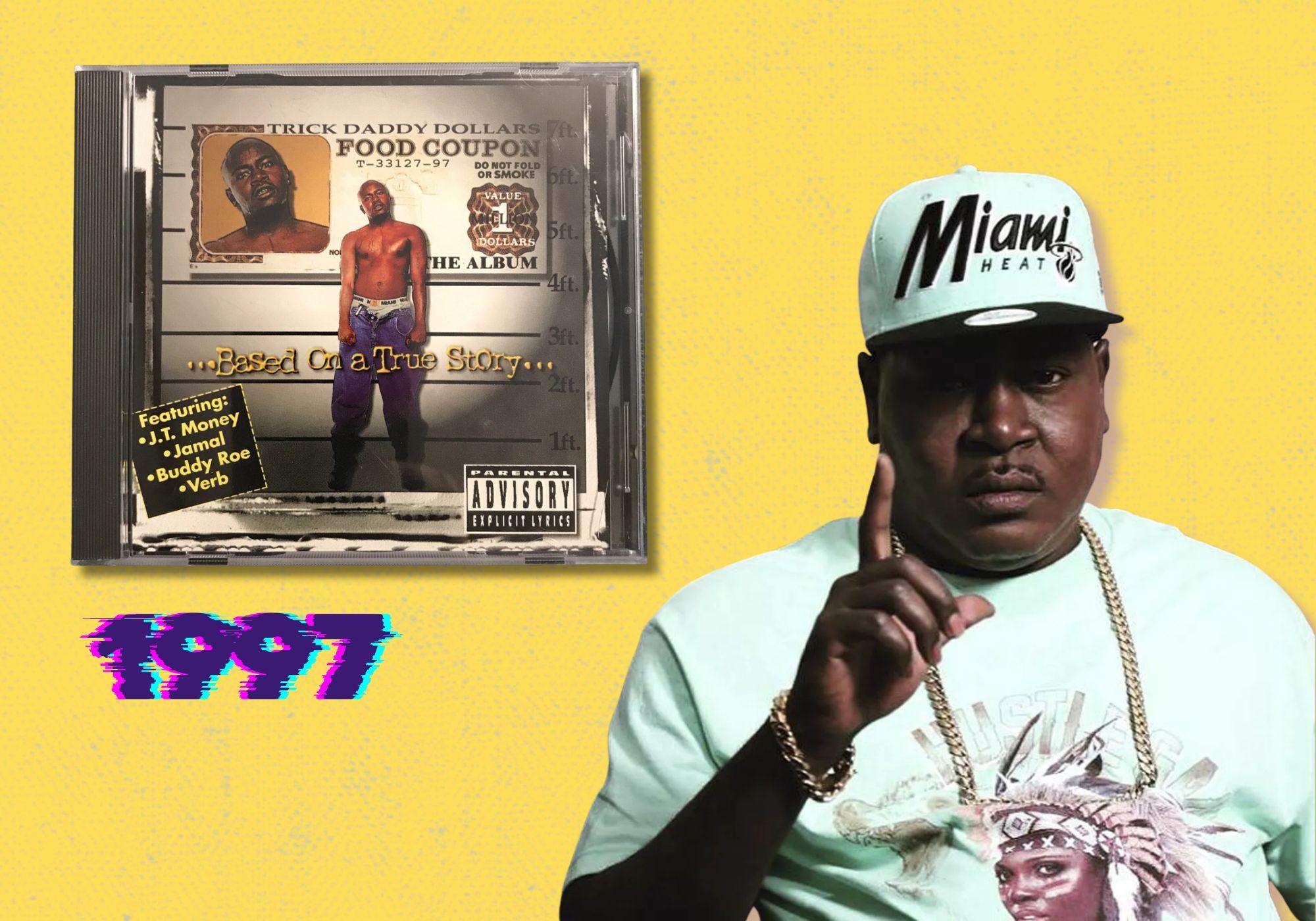
New Times collage. Trick Daddy photo by Slip-N-Slide Records.

Audio By Carbonatix
Long before he was cooking in front of television cameras, opening restaurants, or launching his own cookware line, Trick Daddy was documenting life on Miami’s streets through his music. On July 29, 1997, the Miami rapper released his debut album, Based on a True Story, through the then-fledgling Slip-N-Slide Records and Warlock Records, introducing the world to a voice that would help redefine Southern hip-hop.
The album marked the only release under the name “Trick Daddy Dollars” before he dropped the “Dollars” moniker for his sophomore effort, www.thug.com. More importantly, it established a grittier blueprint for Miami rap at a time when the city was still largely associated with the party sounds of Miami bass.
Anchored by the emotional spoken-word opener “Based on a True Story, Part I,” inspired by the death of his brother “Hollywood”, the album balanced raw storytelling with street anthems. Tracks like “‘Bout a Lotta Thangs,” featuring Buddy Roe, delivered a heavy Southern bounce, while “I’ll Be Your Player” showed a slower, more sensual side. “Pimp,” featuring Buddy Roe and JT Money, further showcased the chemistry between some of Miami’s prominent voices of the time.
Looking back during a 2015 interview with Revolt, Trick Daddy explained that he never set out to become a conventional rapper. “I told Luke, I don’t wanna rap, like, I don’t wanna rap. I could rap fast, but I don’t wanna rap the booty song, the, the nothing music. And I just put all my problems and I, and I always though that music is supposed to take you somewhere, you know? I put all my problems, like, sort of like the blues, and I, and I made it, I made it my business not to ever get caught up in lies and scandals and never be, try to be something that I ain’t. And then I always just, my life stories and things I believe and things I saw and I done, I put it in my music.”
That commitment to authenticity became the defining characteristic of Based on a True Story. Born Maurice Samuel Young at Jackson Memorial Hospital and raised by his mother alongside 10 siblings in Liberty City’s Liberty Square housing project — better known as Pork-N-Beans — Trick Daddy rapped about the realities he experienced rather than trying to imitate trends from other regions.
His perspective also helped put Miami and the South on the national hip-hop map. During the same Revolt interview, Trick Daddy reflected on breaking through in a music industry that largely overlooked Southern artists.”I came to New York City years ago, me and Master P was one of the first two from the South that they actually played on New York radio.”
At the time, Southern rap was still fighting for recognition beyond its own region. “At that time they didn’t respect the South. They thought all we had was the beautiful women and the good drugs, you know, and the nice ones and the cars. And they didn’t know. And so when, once I opened the eyes to the South, everything got just broad open. Then, you know, Juvenile came with the hard record. This was all around the time when Pac and Biggie had just died… it took me like four albums to realize I was famous because I was just doing what I believed.”
For Trick Daddy, success was never about celebrity as much as responsibility to the community he represented. “I’ma do my music right. I’ma represent my city. I’m gonna represent my people to the fullest. And I, I can’t let my people down. And I always do it for the struggles, the bases, the bonds, everybody that’s doing time in the county jail.”
Commercially, Based on a True Story peaked at No. 59 on Billboard’s Top R&B/Hip-Hop Albums chart and sold more than 350,000 copies. While it wasn’t an immediate mainstream blockbuster, its impact would prove far greater than its chart position suggested. The album helped establish Slip-N-Slide Records as one of Miami’s defining hip-hop labels, laid the foundation for Trick Daddy’s platinum-era success, and shifted the perception of Miami rap beyond bass music toward deeply personal street storytelling.
Nearly three decades later, Based on a True Story remains one of the defining documents of Miami hip-hop; an album that introduced one of the city’s most influential voices by doing exactly what its title promised: telling the truth.