
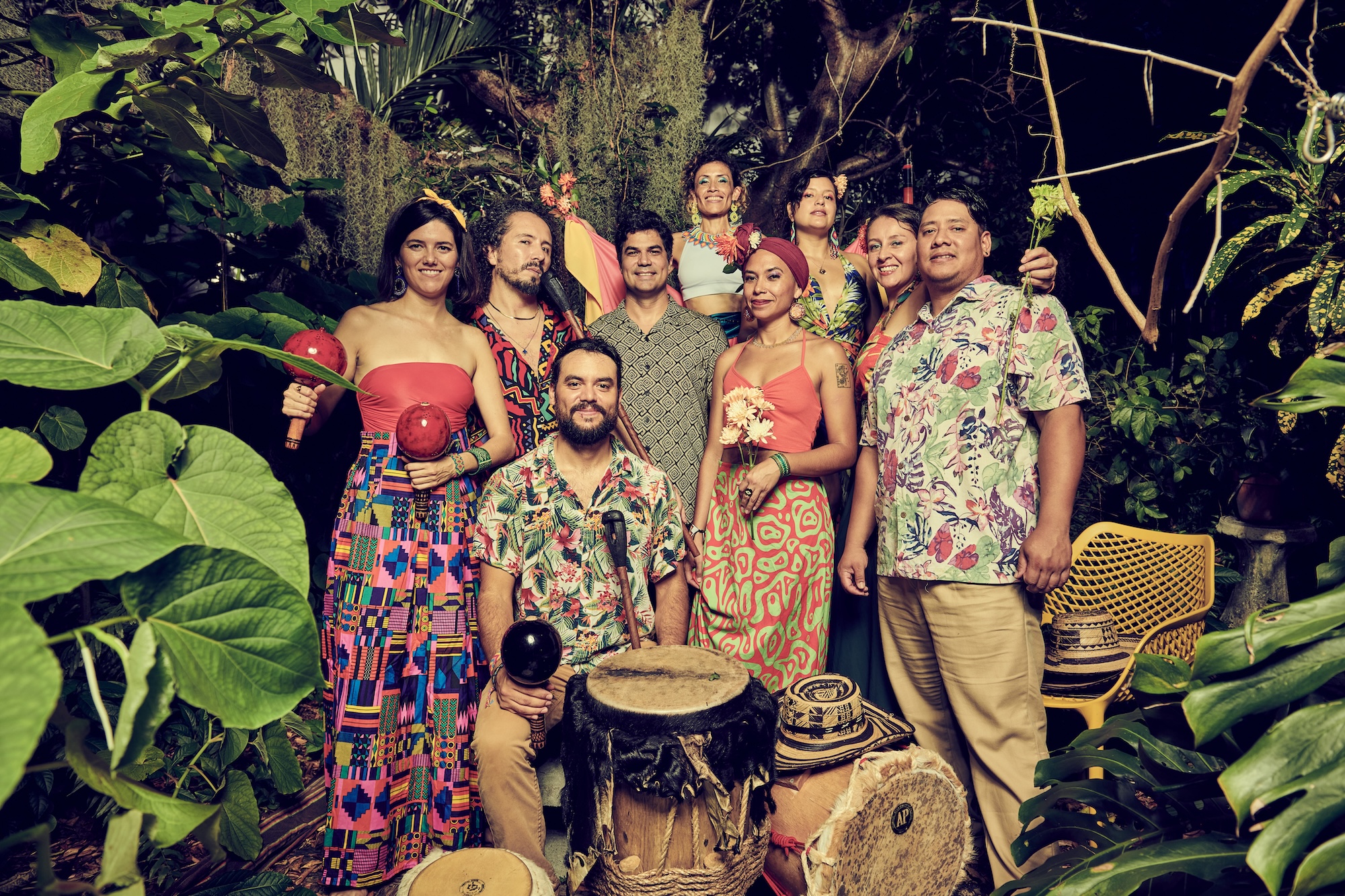
Photo by Andres Serrano.

Audio By Carbonatix
Today is Local News Day
A national day of action to support and celebrate the trusted local journalism that strengthens communities. If you believe local news matters — this is the day to show your support. Make a contribution today to help keep our reporting free and accessible to all.
Cumbia is often something you hear before you know its name. It arrives early, at family parties, backyard gatherings, long afternoons that stretch into the night, folded into the background of daily life. For Juliana Jimenez Jaramillo, member of the Miami-based band Pazyflora, it was never introduced as a genre to be studied, but rather as something to be absorbed. That feeling is where the story unfolding across Miami begins.
Over the past few years, local bands have been turning toward early forms of Colombian cumbia not to reproduce them nostalgically, but to understand what they carry and how they might speak in the present. What’s unfolding is not a revival, but a practice: a way of listening, researching, and making music rooted in lineage, place, and the active building of community in a city shaped by migration.
Cumbia emerged along Colombia’s Caribbean coast from the convergence of Indigenous and African cultures under colonization. Rooted in drums and flutes tied to rural life near rivers and the sea, it was communal from the start — a music of gathering, movement, and survival. As it traveled, it absorbed new sounds without losing its rhythmic core.
For Pazyflora, that practice began almost inadvertently. Jimenez Jaramillo describes her relationship to cumbia as something that grew through proximity: friends, collaborators, relationships, rather than formal training. Over time, intuition gave way to intention. For her, the work is exploratory, taking her to places like San Jacinto, one of cumbia’s birthplaces, and through conversations, rehearsals, and shared listening. “Research,” she says, is sometimes indistinguishable from playing — in both senses of the word.
Sound itself becomes a guide. Early cumbia is built from a small constellation of instruments — three drums, maracas, guacharaca, and gaitas — each made from materials tied to a specific geography: wood from local trees, animal skins, and flutes fashioned from cactus and beeswax. For Jimenez Jaramillo, returning to these sounds is not about purity or hierarchy. “One cumbia is not better than another,” she says. “But those original instruments, that live sound, connect you directly to the music’s origins. You feel it when you play it.” There is an ethics embedded in that materiality, a sense that sound carries the life of what it’s made from.
Questions of authenticity inevitably surface around cumbia, what counts as “real” and what has drifted too far. Sonora Tukukuy’s Alejandro Angee recalls being told after a show that what they played wasn’t “real” cumbia. “What we do is cumbia in its rhythm, in its form and ancestry,” he says, “but with the heritage we grew up with.” For the band, honoring cumbia’s roots means embracing a music shaped by movement and adaptation, rather than freezing it in time.
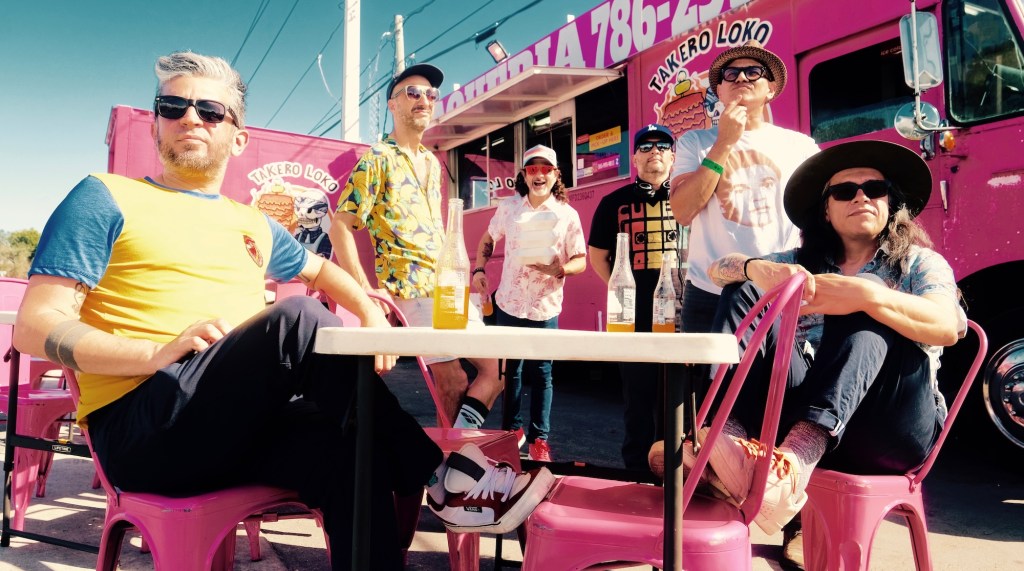
Photo by Carlos Chacin
Angee and bandmate Gabriel Ayala have made music together for more than three decades, passing through punk, indie, rock, and electronic scenes. In retrospect, Angee realized cumbia had never really left. “Half of the songs were cumbia,” even in their earliest projects. Historically marginalized in parts of Latin America and associated with rural life and communities outside dominant narratives of refinement and taste, cumbia nevertheless persisted as an everyday presence. As Ayala notes, it has always carried the weight of history. “It documents struggles in every country it has traveled to.” That history doesn’t disappear when the music moves; it accumulates.
The band’s emergence is inseparable from Casa Cumbia, a shared rehearsal space that emerged during the pandemic and quickly became a communal gathering point. For Angee, it mattered less as a venue than as a community. “It doesn’t happen without our community,” he says, emphasizing the space’s role as more than just a venue. West of I-95, outside Miami’s usual cultural corridors, Casa Cumbia became a site of continuity in a city often defined by flux. Angee likens cumbia’s current moment to the early days of hip-hop: accessible, malleable, and open to reinterpretation. Like early sampling and remix culture, cumbia invites participation. Its rhythms form a framework others can enter, reshape, and extend — turning Miami not just into a place where the music is played, but into an archive in motion, where tradition is preserved through transformation rather than preservation.
Peruvian psychedelic cumbia, much of it rooted in the Amazonian regions of Peru, evolved through a collision of local rhythms and imported rock records, says Miami-based musician and promoter Mario G. Garibaldi, who has worked closely with the genre’s pioneers. Bands like Los Mirlos helped shape a distinct electrified sound that differed from Colombian, Mexican, or Argentine traditions, expanding the genre’s international reach.
“Psychedelic cumbia is intricate but familiar at the same time,” Garibaldi says. “People recognize the guitars, the delays, the reverse, the wahh. It feels new, but it also feels like something they’ve heard before.” In Miami, that recognition has fueled growing interest among DJs, bands, and audiences alike.
“Cumbia is also a music of resistance,” says Alejandro Angee.
That sense of collective memory is especially evident in Cumbiamba, one of the newer bands to emerge from Miami’s growing cumbia ecosystem. At their shows, cumbia is not remembered privately or nostalgically, but communally — on the dance floor, across generations. Band members describe seeing grandparents, parents, and children dancing together, some encountering these songs for the first time outside of family gatherings, others recognizing sounds they grew up with but hadn’t heard live in years. In this setting, Miami is not just a backdrop but an active environment. It is shaping how these traditional forms evolve as personal histories overlap and become shared experience. What’s carried forward is not just repertoire, but a living relationship to the music, one that is renewed each time the audience responds, dances, and folds their own memories into the sound.
Across these projects, joy emerges as a shared practice — one that carries political weight without needing to announce itself. Dance, pleasure, and togetherness become ways of asserting presence. “Cumbia is also a music of resistance,” says Alejandro Angee. The act of gathering, moving, and finding euphoria together holds its own form of defiance, a refusal to retreat into silence or fear. For members of Cumbiamba, that responsibility is explicit. Percussionist Cristina Bouza frames cumbia as a music of dignity and resilience, carried forward through land, ancestry, and community.
For Jimenez Jaramillo, that shared presence is inseparable from questions of home and migration. Making music in Miami, she reflects, carries particular weight for immigrants at a time when visibility can feel precarious. “It’s an act of defiance,” she says. Sound becomes both refuge and declaration, a way of holding memory while claiming space. What’s unfolding in Miami is not about preserving cumbia as it once was, nor reinventing it beyond recognition. It is about lineage: roots growing deeper so that branches can stretch further. Here, cumbia continues to move, carrying its past into new terrain — alive, collective, and unfinished.