Photo by Michele Eve Sandberg

Audio By Carbonatix
Jordon King has only lived in South Florida for four years, but he already knows more about the Everglades than many who’ve lived here their whole lives.
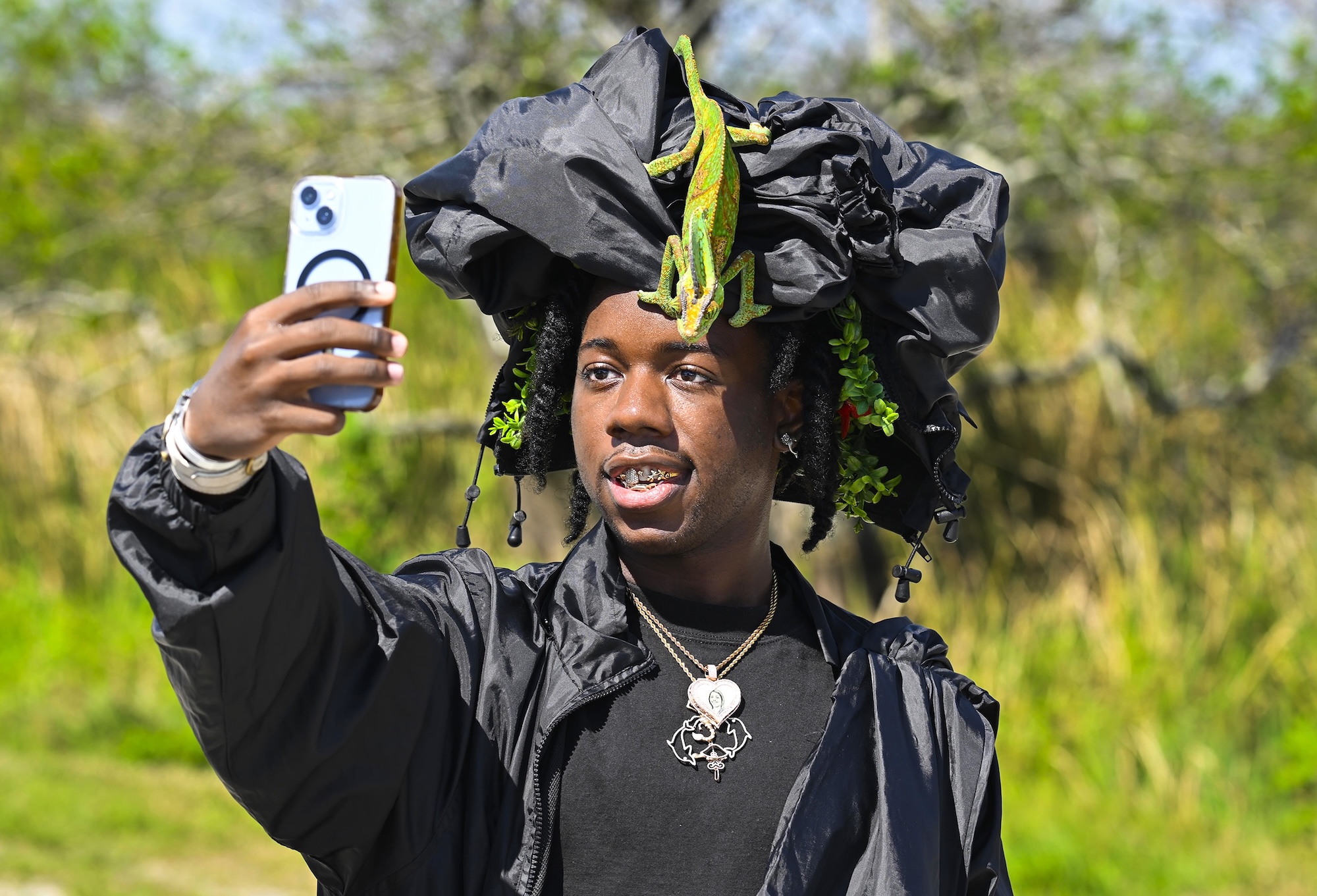
With a killer fashion sense, a vine-crept golden grill, his pet chameleon Krome, and (most importantly) a wealth of biological information behind his soft-spoken voice, King is a Pokémon gym leader come to life. His love of animals began to bud in his hometown of Kingston, Jamaica, and fully bloomed in the Everglades. Today, he shares his insights on social media and in Miami-area schools, where, for Black students in particular, he’s an important reminder that there are successful working scientists out there who look just like them.
“When I was growing up, I didn’t see a lot of people like myself doing any type of work that I do now,” King tells New Times. “So I feel like it’s important for younger kids to see me doing this type of work. It’s important to tell them how I got here, and that they could also do it, too.”
Journey to the Center of South Florida
When King was 13, his family moved from Jamaica to Brooklyn, New York. He’d spent much of his childhood outside climbing trees; an adventurous bent that inspired him to pursue a degree in biology.
“Science was always my favorite topic,” he remembers. “Growing up in Jamaica helped that, too, because the landscape made me more curious about the environment.”
A research fellowship with a biology professor studying animals in the Everglades and his pursuit of a Master of Science in Environmental Biology led him to Florida International University (FIU). The move fueled an appreciation for a landscape that, even for many locals, is an acquired taste.
“At first, I was timid, just because of the Everglades’ gators and stuff like that, but I quickly fell in love with it,” he tells New Times. “I love reptiles. I wasn’t in love with reptiles when I was younger, but I really like them now.”
His chameleon, Krome, is named after the avenue that runs parallel to the Everglades.
From School to Social Media (And Back Again)
King works full-time as an environmental scientist for a local contracting company, mostly testing soil samples. But he’s been building a social media presence in his spare time. Since October 2025, he’s amassed more than 120,000 followers on Instagram and TikTok.
“My social media presence began as me wanting to share my journey for fun,” he says. “It kind of just took off by accident.”
His accounts are filled with videos of him wading through sawgrass-strewn waters in search of the colorful wildlife hidden within — invasive Jesus lizards (the ones you’ve seen running across water on National Geographic), chameleons, iguanas, day geckos (which inspired the Geico gecko), sulcata tortoises, and many other species. King often finds what he’s looking for: Many clips show him holding the animals and offering facts about them, like a more fashionable Steve Irwin.
It’s those clips that have attracted the attention of local educators, who reach out with invitations for King to speak at elementary, middle, and high schools across South Florida. Since last fall, he’s taken his expertise to more than a dozen schools where, with Krome in tow, he tells students about his adventures in the swamp and how he managed to go to grad school for free.
“I want to focus strictly on kids and the younger generation — early career scientists, whether it be undergrad students or high school kids,” he says. Monetizing his platform and becoming a full-time influencer aren’t priorities, he says, but he is interested in turning his pastime into a full-time career.
Though those plans are still in flux, he has some ideas: “I would be interested in helping people achieve their goals when it comes to research and academia. I like giving back to the community, especially people who don’t have the opportunity to get exposed to research like I did.”