©Thomas Canet

Audio By Carbonatix
Keep Miami New Times Free
We’re aiming to raise $7,500 by April 26. Your support ensures New Times can continue watching out for you and our community. No paywall. Always accessible. Daily online and weekly in print.
It’s 1986. David LaChapelle is 22 years old, and his then-editor, Andy Warhol, sends him to Miami on assignment for Interview magazine. He’s in an $11-a-night hotel on a South Beach that is quiet in a way that will be unthinkable within a decade, looking out across an empty beach at the winter waves crashing in as they have for millennia upon millennia. And yet, something in the air is shifting.
“You could just feel it,” LaChapelle tells New Times. “You could just feel that something was going to happen.”
Indeed, it was — both for Miami and LaChapelle. The former became — well, you know — the bustling, trendsetting metropolis which houses this very publication. And the latter would soon establish himself as one of the most celebrated fashion and celebrity photographers ever, period, shooting David Bowie, Elton John, Eartha Kitt, Gloria Estefan, Sade, Muhammad Ali, and Hillary Clinton among many others for essentially every major magazine that mattered culturally.
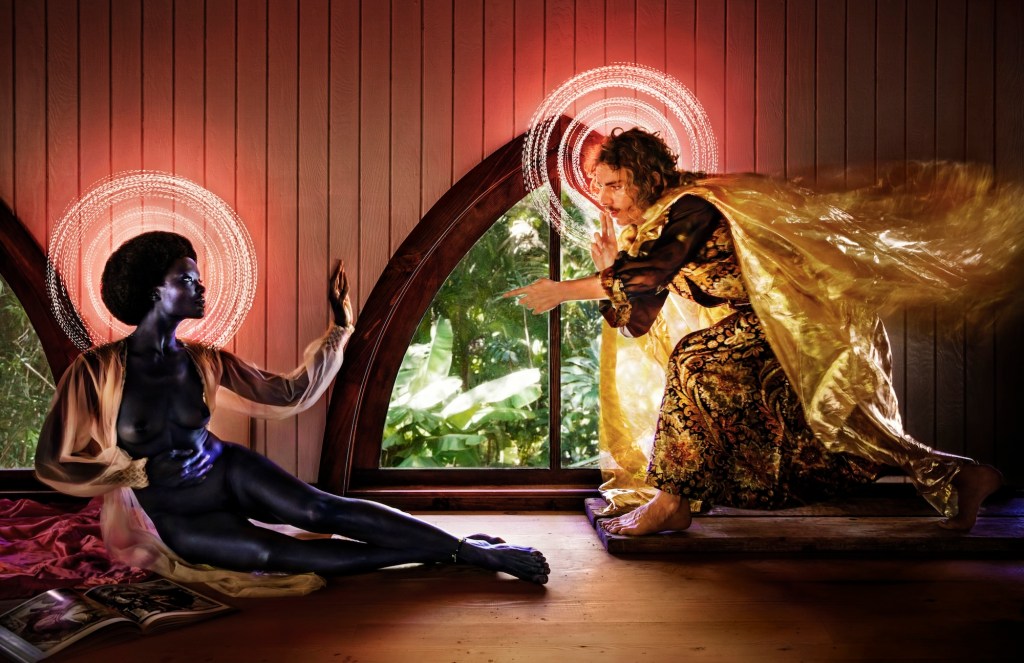
Now, LaChapelle returns to Miami with the debut of “Vanishing Act,” an exhibition at VISU Contemporary that features more than 30 career-spanning works, including the world premiere of nine new pieces.
These beguiling, vibrant, heightened visions of our world are philosophical and provocative — of a piece with the fine art he’s been leaning into for years now — and grounded in the active, consistently-nurtured faith which is of critical importance to LaChapelle both as an artist and a human being navigating our increasingly strange existence.
What does this mean on a practical level? Well, he prays daily. He practices gratitude hourly. And he makes time to stay connected to the transcendent through immersion in nature and solitude. “Those three things combined keep me in this world, but not of it, you know? That’s what I think keeps me sane and free from fear of the many things we could be afraid of right now,” he says.
That spiritual underpinning is reflected in “Vanishing Act.”
“In a way, it’s a reply to the culture,” LaChapelle says of his work in the VISU show. “As artists, we can choose what we create, so why would I want to create work that adds to the darkness and confusion of our world right now? Just turn on the news — it’s already right there. Why create more of that? I see it, and I want to go the opposite direction. Whatever’s going on in my life – whatever struggles, breakups, heartbreak — I want to put out beautiful works that are inspiring and of the light. I am not here to dwell in my darkness or anyone else’s. I want to focus on the goodness, love, and beauty that still remain in this world. Why not nurture that?”
And if you think LaChapelle doesn’t recognize the dichotomy in his own work, think again. “A lot of young people probably go to my shows because of the work I’ve done in popular culture, which is not that deep, you know? And then, once they’re there, they’ll see the pictures that aren’t on Instagram — the ones I put my heart and soul into; the ones that I’m trying to touch people in a deeper way with. And I do see how they work together in that way.
“Maybe life is like a pool,” he adds, airily. “It would be boring if we always swam in the shallow end or the deep end. I think it’s nice to swim back and forth. And that’s what I try to do in my artwork.”
© David LaChapelle
It’s worth noting here that in 2012 LaChapelle told Blouin Artinfo that the two artists who influenced him the most were…Michelangelo and Michael Jackson. There is a connecting thread between those two ends: Clarity of intent.
In LaChapelle’s estimation, a plague of vagaries has descended upon the contemporary art world, and he’s seeking to counter it. “With a lot of exhibits today, people have to read a big wall of text to understand it,” he says. “They need someone to explain the meaning to them…I like clarity, not confusion. Just like I like light instead of darkness.”
It’s that sort of self-awareness — perhaps even self-interrogation — that allows LaChapelle to remain such a vital and impactful voice in a popular arts landscape that is in a state of flux, if not outright devolution, thanks to a tidal wave of generative AI and social media-truncated attention spans for which the culture was, to put it gently, ill-prepared.
“I still think in analog,” LaChapelle says. “I worked for so many years in analog — I spent a lot of time in that East Village dark room. So, even though the physical means of getting to the final piece have changed, my thought process is very much the same as it always was…I think very theatrically. And the tableaus I create, it’s like putting on a play. I make the sets, cast them, choose the colors and palette, and use very hands-on, intuitive direction to direct what the figures will be doing.”
The truth is, LaChapelle’s success in the shallower end grants him the breathing room to imbue the work with that precious clarity, that light. “I like having one foot in the world of popular culture…it also sustains my artwork, because I’m free of having to worry about whether it will sell or not,” he says. “I can make work that’s really from my heart and not think about sales because it’s not the only way I generate income. I am my own benefactor in that sense, which is very liberating.”
It also allows LaChapelle to entrust smaller, scrappy, passion-driven galleries with his deepest end work.
“For a young gallery in Miami Beach to be presenting new, world-premiere works by David LaChapelle is nothing short of extraordinary,” VISU Contemporary owner and curator Bruce Halpryn says. “Our mission has always been to showcase cutting-edge, thought-provoking art that resonates with today’s cultural pulse. To be one of two galleries representing LaChapelle’s work in the Americas is a tremendous honor — and speaks to Miami’s growing stature as an art world capital.”
The VISU show also reflects LaChapelle’s understanding and acceptance of a world in which the relationship between artist and viewer has been levelled, if not democratized. Our aforementioned attention spans are shorter than ever, and the power of images has been diluted in the common imagination. This might be demoralizing to some, but to LaChappelle, it’s a signal to double down.
“I have to work harder than ever on making my image compelling enough to hold someone’s attention long enough for them to understand what it is that I want them to understand, or to feel what it is I want them to feel,” he says. “Beauty, to me, is the tool to accomplish that. Even when there are ideas or feelings I want to express and get out into the world that are challenging or not pretty, I use beauty to make sure people don’t just walk on by.”
David LaChapelle’s “Vanishing Act.” On view through January 31, 2026, at VISU Contemporary, 2160 Park Ave., Miami Beach; 305-496-5180; visugallery.com. LaChapelle will attend the grand opening at 9 p.m. on Friday, December 5.