
Photo by Zachary Balber

Audio By Carbonatix
Art Deco turned 100 this year, and it doesn’t look a day over…
Well, okay, so some of these buildings are in spectacular shape, and others look like the architectural equivalent of Flossie Dickey. Nevertheless, this school of design remains as interesting, affecting, and popular to us as it was to the 16 million people who first flocked to the highly influential 1925 Paris L’Exposition internationale des arts décoratifs (International Exhibition of Modern Decorative and Industrial Arts), at which the consensus of the intertwined art and architecture worlds sets its rough date of birth.
A year after that expo, the Great Miami Hurricane of 1926 — the “Big Blow” — devastated South Florida, killing more than a hundred locals, damaging or destroying 5,000 buildings, and causing more than a billion dollars in adjusted damages. It created a lot of suffering, but also a metaphorical blank canvas for new structures and architectural approaches. Tropical Art Deco became all the rage, and today, the Miami Beach Architectural Historic District is “home to the largest concentration of Art Deco architecture in the world, with more than 800 preserved historic buildings.”
Here are 13 of the most striking examples in Miami.
Ace Theater
While wide swaths of Miami Art Deco are revered and maintained, some important pieces of history have nevertheless been neglected.
Enter the Ace Theater. Built in 1930, it was the “only entertainment facility to serve the Black community in Coconut Grove” — and beyond — “during the segregation era,” a historic preservation designation report notes. The theater closed in the late ’70s and is currently owned by Dorothy M. Wallace — one of the first two African American alumni to receive a master’s degree from the University of Miami in 1963 — and her daughter, Denise. While it sat empty for years, its designation as a historic site by the city of Miami in 2014 and its addition to the National Register of Historic Places paved the way for a long-overdue restoration of this cultural and Art Deco landmark. (See the work on the playfully block-y marquee with a 96-year-old Wallace beaming in the background above.)
Bass Museum
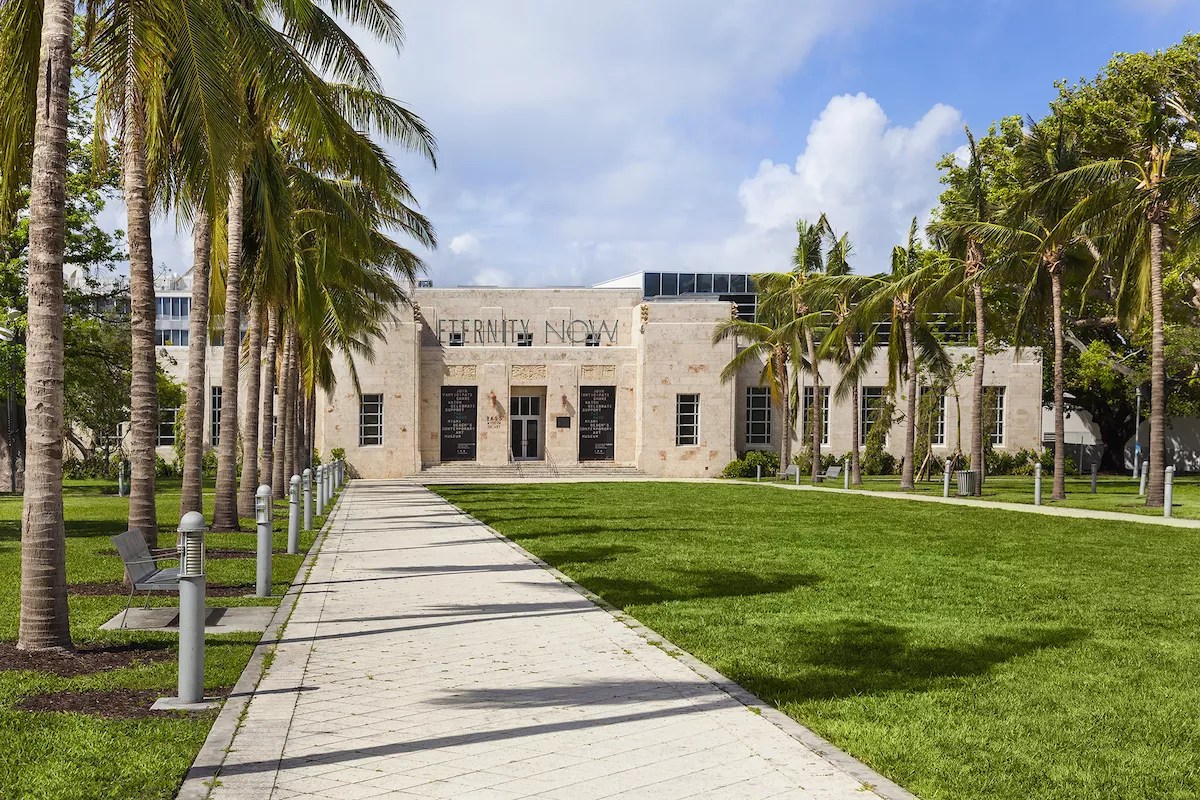
Even in one of the most Instagrammable cities in the world, the neon seafoam words, “Eternity Now,” festooned across the epic and imposing paleolithic coral Art Deco façade of the Bass Museum is a sight to behold — a decree that simultaneously blasts grandiloquence and simmering subtextual profundity, the sort of yin and yang duality to which denizens of the greater Miami area are by now very well accustomed. Originally designed in the early 1930s by Russell Pancoast — also the man behind Lincoln Road’s Mead Building and the Miami Beach Women’s Club — to serve as the Miami Beach Public Library and Art Center and “the first public exhibition space for art in South Florida,” the building became the Bass Museum of Art after John and Johanna Bass donated their private collection to the City of Miami Beach in 1964, making the National Register fourteen years later. As an architectural-adjacent bonus, it’s one of the best places to see daring modern art in the city.

Photo by Shawn Macomber
Cameo Theater
Damn, has the Cameo Theater lived. Not many spaces can claim to have launched with a classic Hollywood gala (“Miami’s Newest and Finest Theater,” a 1938 ad for the debut reads, adding, “See Yourself in the Movies to Be Taken of Tonight’s Opening”) before eventually putting on Sunday services for soldiers during World War II, hosting Yiddish vaudeville for Holocaust survivors, platforming Black Flag, and serving as a location for a hot ‘n’ randy Elton John video. Even now, abandoned after a stint as a nightclub and looking as if it had been reimagined by the designer of a punk rock venue bathroom stall, there is a “if you build it, they will come” magic to the façade of glass blocks and grand topline sculptures that suggests its story is not yet fully told.
Cardozo South Beach
The Cardozo looms large in the modern Art Deco imagination. Not only does its classic architecture serve as a backdrop for popular films ranging from The Bird Cage, There’s Something About Mary, and Marley & Me to Any Given Sunday and the 1959 Frank Capra-directed Frank Sinatra vehicle A Hole in the Head, but the property has also been owned by local royalty Gloria and Emilio Estefan since 1992. The hotel reopened in 2019 after a four-year, $15 million renovation, which, in a pleasant twist, sought to bring the original aesthetic to the surface — including a restoration of the original lobby terrazzo floor — rather than gutting it out of all-but-surface existence. That’s a labor of love approach that makes sense when one considers that Gloria has said in several interviews that she first told her mother of her plans to buy the hotel during a family beach day when she was a mere two years old.

Photo by Shawn Macomber
Colony Theater
For many tourists, The Colony is very likely their first encounter with Miami-style Art Deco splendor. It is, after all, not only smack dab in the middle of Lincoln Road, but also a lovingly maintained showstopper of a building that breezily rivals anything else on that consciously beautified stretch. Not for nothing was it nicknamed the “Beauty Queen” in the 1930s, back in its early days as a Paramount Pictures-built and administered movie theater — no small feat when Carole Lombard is among your visitors. Of course, as the setting for Nip/Tuck, Miami also appreciates a good facelift, and so kudos to the City of Miami Beach for investing in a $6.5 million restoration of the façade and lobby in 2006. Don’t just gawk at the outside, though: The Colony is home to Miami New Drama, which puts on consistently top-tier theater productions.
Miami Beach Lifeguard Towers
Maybe other cities corral their lifeguards into drab, scrubby shacks, but here in Miami, your rescuer is not only going to be a physical specimen who makes Baywatch look like a reality TV show about the World’s Ugliest Dog Contest, but they’re going to be swooping out of one of 36 Art Deco-inspired huts shellacked in the brightest of bright colors. Even our first responders don’t give a second thought to being fashion-forward.

Photo by Shawn Macomber
Miami Beach Patrol Headquarters/Miami Beach Post Office
Municipal architecture doesn’t exactly have a great reputation — these are people who take “brutalist” as a compliment, for Frank Lloyd Wright’s sake. Not Miami Beach, though. Both Miami Beach Patrol Headquarters (actually the current home of Ocean Rescue) and the city Post Office are works of art in and of themselves. Start at Beach Patrol, which kind of looks like what might happen if SpongeBob and Squidward’s house had a baby: It’s on a lovely Miami Beach boardwalk facing the ocean and right behind the Art Deco Welcome Center and Museum, which faces a stretch of Ocean Drive that includes the highly modernized Art Deco landmark The Clevelander. From there, the Post Office is maybe a ten-minute walk. Once you’ve taken pictures of its distinctive outside architecture, be sure to go inside to stand in the middle of the awe-inspiring rotunda, complete with a fountain, ceiling installations, a mural, and…yes, P.O. boxes.
Miracle Theater
Yes, Virginia, there is Miami Art Deco off South Beach — and this jewel in the heart of Coral Gables is a perfect example of it. First opened as a classic movie house in 1948, the building was purchased by “The City Beautiful” in 1995 to serve as home to the Actors’ Playhouse theater company, which puts on a steady stream of smart, fun, and delightful local productions for all ages. You want swoon-worthy? Check that wraparound marquee, the swooping restored tile design on the floor of the exterior lobby, the old-school glass-encased box office — and that’s all before you enter the breathtaking interior of the building! The brightly lit “miracle” beacon beaming up from the marquee is some real truth in advertising.
The National
Even among the hundreds of landmark structures in the Miami Beach Art Deco Historic District, the National Hotel stands out. That’s not just because of its distinctive exterior, sweeping up fourteen stories to a brightly lit silver cupola; or the fact that it boasts the longest infinity pool in a town where the race to aquatic infinity is virtually its own competitive sport; or the gorgeous ceiling mosaic recreating “Young Lady in Green,” a 1927 painting by Polish artist and Art Deco pioneer Tamara de Lempicka (1894-1980), whose profile recently got a much-needed restoration with the excellent 2024 documentary The True Story of Tamara De Lempicka & the Art of Survival; or its elegant yet slyly irreverent lobby. No, it’s all these things, together; a synergy that offers visitors a transportive, immersive, and unique experience.

Miami Dade College photo
Tower Theater
Yes, Calle Ocho has some Art Deco for you, too. Next to Domino Park and across the street from the legendary Ball & Chain, the gorgeous Tower Theater boasts its own rich legacy. It opened in 1926 as the “finest state-of-the-art theater in the South,” but shifted cultural gears in the 1960s when Cuban refugees began to arrive in the neighborhood. “For many Cuban families, films at Tower Theater Miami were an introduction to American culture in addition to pure entertainment,” its website notes. “Soon, the theater altered its programming to include English-language films with Spanish subtitles, and eventually Spanish-language films.” The theater closed in 1984 but was eventually leased to Miami-Dade College, where it spent years as the home of the Miami Film Festival. (The theater was designated Best Art-House Cinema by New Times in 2014, 2021, and 2023.) In 2024, the city controversially cancelled that lease. Since then, the building has hosted an exhibition on Celia Cruz, and in 2025, Miami Film Festival Gems returned to the venue for the first time in three years.
Waldorf Towers
Designed by the prolific Miami architect Albert Anis, Waldorf Towers, built in 1937, is both modest and regal, making the most of its three-story canvas, which incorporates smooth wraparound curves, “eyebrow” ledges, phalanxes of glass blocks, and, in the Tropical Deco coup de grâce, a glass panel encased “crow’s nest” tower with so lovely a view Rapunzel would probably keep her hair in a bun and just order room service.
Señor Frog’s (RIP)
Sometimes, to see the true power of an aesthetic — especially in a city such as Miami, which exists in an almost constant state of churn — we must look at what it outlasts. The building at 1450 Collins Ave., which is among the most whimsical and alluring of examples of Art Deco on Miami Beach, sat shuttered for years, awaiting redevelopment after the Mexican food joint Señor Frog’s closed during COVID. Most recently, it’s been an upscale clothing boutique, and there have been reports that it might become a hotel — not the most novel of prospects on Miami Beach, but no doubt profitable considering the market. (The property’s last sale price was $10 million.)
Let’s pour one out, though, for the still-standing Henry Hohauser-designed façade dreamy enough to have represented — drawing from this excellent, concise history — Hoffman’s Cafeteria (1940-1975; with a three-year stint as an Army mess hall), a senior citizen dance hall (the Warsaw Ballroom, 1975-1981), Ovo supper club, the rock-n-roll-n-2500-gallon-shark-tank China Club, a younger, wilder version of the Warsaw Ballroom again (1988-1999), Jerry’s Famous Deli, and Mister Amphibian. Throughout it all, it has maintained its grandeur and impact, straight through to this day.