Photo by Karli Evans

Audio By Carbonatix
Reader support matters more than ever
We're in the final stretch of our summer campaign. Our goal is to raise $10,000 by August 9 to support the journalism our community relies on. Reader support is helping shape the future of local news.
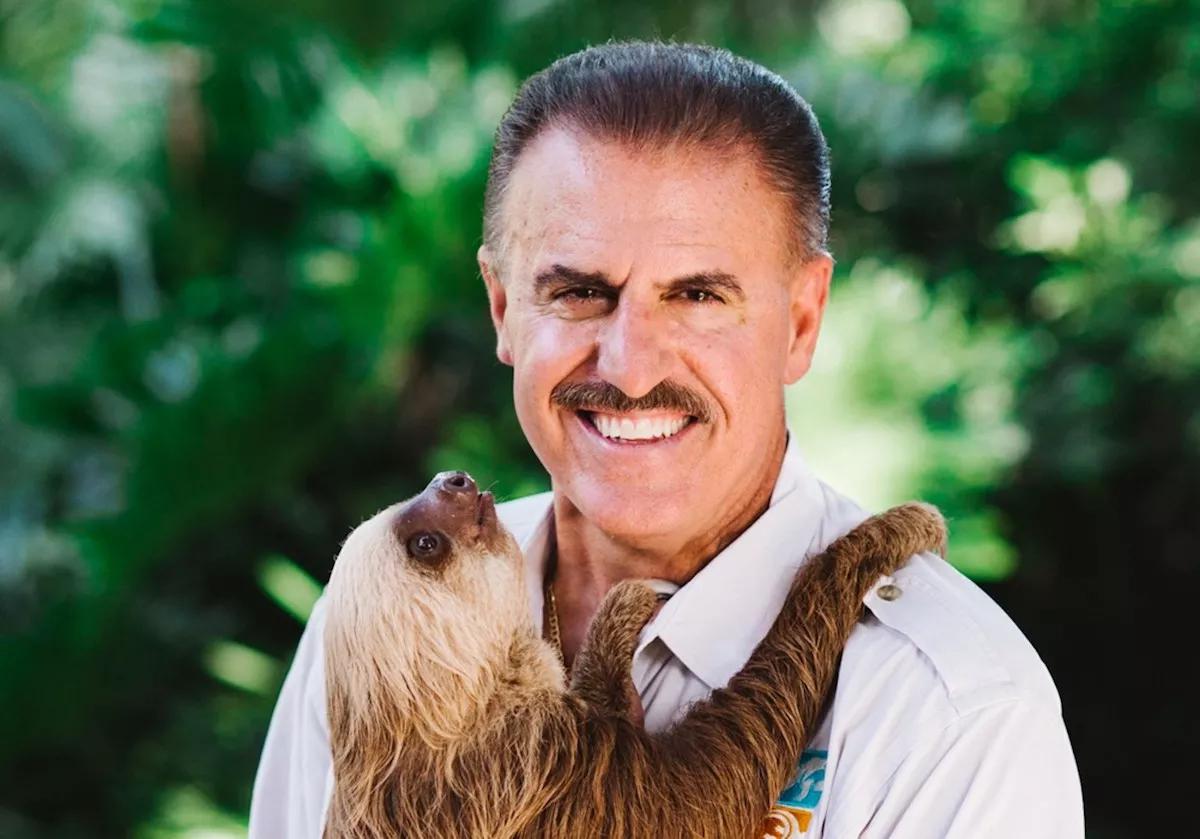
Bullied and silenced by a language barrier, an elementary-aged Ron Magill found a friend in a schoolyard squirrel that ate peanuts right out of his hand. That lunchtime bond sparked a lifelong obsession with animals, transforming a lonely child into one of the world’s most recognizable faces in wildlife conservation.
“He wasn’t judging me, he wasn’t calling me names, he wasn’t making fun of me,” remembers Magill, now 66, of the creature. “I think that was the moment I said to myself, I’m going to do something with animals.”
After 46 years of service, which he calls “the experience of a lifetime,” Ron Magill has retired from his position as Zoo Miami‘s communications and media relations director, a Miami-Dade County role at the institution where he started out as a zookeeper.
Magill isn’t going far: He’s stepping into a new role specifically tailored for him: goodwill ambassador and conservation liaison for the Zoo Miami Foundation, a nonprofit arm of the park.
While Magill expresses profound gratitude for his tenure with the county, he attributes his retirement to the zoo’s shifting organizational structure, acknowledging waning patience for the inherent bureaucracy of local government.
Three years ago, Magill made headlines when he publicly opposed his employer’s Miami Wilds project, a water theme park planned on Zoo Miami property. Magill initially supported the proposal, but when Zoo Miami’s conservation team unearthed a grim reality — that the project sat on a critical habitat for several endangered species — he changed his mind, putting him at odds with a supervisor who forbade him to speak out against it.
“I looked him straight in the face,” Magill remembers. “I said, ‘You can tell me what I’m forbidden to say as Ron Magill from Zoo Miami, but you can’t tell me what I’m forbidden to say as Ron Magill, private citizen.’ And that became a new mantra for me.”
Leveraging his long-standing media relationships, Magill took to the airwaves to voice his concerns, and the message resonated, sparking a wave of local activism, including among students at Florida International University and the University of Miami. The fallout culminated in a high-profile rally outside the zoo, where Magill stood alongside county commissioners to protest the development. With his involvement, opposition reached a critical mass, prompting Miami-Dade County Mayor Daniella Levine-Cava to rescind the project’s lease.
Reflecting on the episode reminds Magill why he’s opted to go in another direction.
“By moving over to the foundation, now I don’t have to deal with that red tape,” he says. “I can still do the things I love without that burden of wondering: Oh my God, is this going to be a conflict of interest? And it’s a huge relief.”
An unclear path
Magill enrolled at the University of Florida in the 1970s as an Animal Science major with aspirations to become a veterinarian, but he quickly realized that wasn’t the exact path for him.
“I couldn’t wrap my head around chemistry,” says Magill.
But he knew he wanted to work with animals. He kept his major and did a work-study program at the Florida State Museum (now the Florida Museum of Natural History on the UF campus).
During his senior year, Magill learned of the construction of Metro Zoo (later Zoo Miami). He applied for a position at Crandon Park Zoo, whose staff and animals would eventually be transferred to Metro Zoo. Magill was offered a position and told he had to start immediately. Although he says leaving school was a difficult decision, he chose to accept the position. Though he did not return to complete his degree, UF recognized Magill with a Distinguished Alumnus Award in 2022.
The great communicator
“I’ve always been impressed with his ability to sell the zoo and himself pretty well,” says Zoological Supervisor Carl Burch, who has known Magill for more than 40 years and worked with him at both Crandon Park Zoo and Zoo Miami.
On his first day on the job, Magill was assigned to work with Burch in the bird department. Burch, who is the only person at the zoo with seniority over him, recalls being impressed that Magill wasn’t deterred by the grim task of feeding live rabbits to the condors. He also remembers noticing that Magill wasn’t as reserved as other people who work with animals tend to be.
“He’s bigger than life,” says Burch. “He’s extraordinarily good with animals. And his demeanor is what gets people’s attention; he’s able to do tremendously good things because people will listen to him.”
As the zoo’s communications director, Magill made television appearances on high-profile programs, including “Good Morning America,” “The Today Show,” “Sábado Gigante,” and “The Dan Le Batard Show.” Memorably, during Hurricane Andrew, Magill worked with the media to describe how the storm affected the city at large and the zoo, bringing it the necessary attention to rebuild facilities and habitats damaged by the storm. The attention attracted A-list visitors, including Shaquille O’Neal, Christina Aguilera, and Michael Jackson. Today, Magill says the zoo is better off because of the storm.
Impact outside Miami
During his nearly five-decade-long career, Magill’s reach has expanded far outside the confines of Zoo Miami. His advocacy has resulted in the protection of the harpy eagle, which Magill helped make Panama’s national bird. In the early 2000s, he launched the Cheetah Ambassador Program to raise awareness of the feline’s conservation status and the importance of its habitats.
His inviting personality, media savvy, and knack for connecting with children have also led to a fruitful relationship with the Make-A-Wish Foundation, through which he has granted more than 30 wishes.
Michael Cooley remembers Magill inviting his now-8-year-old daughter, Amelia, to a private feeding of giraffes and other behind-the-scenes activities in 2022, when she was battling leukemia.
“He’s incredibly energetic and very funny,” says Mr. Cooley, who still keeps in touch with Magill. “He was 10 times more than I could have ever expected.”
Magill says he’ll continue to work with Make-A-Wish, one of the many obligations he’s looking forward to in semi-retirement. He’s been married to his wife, Rita, for nearly 40 years, and the couple has two adult children. He’ll have more time now to enjoy his hobbies, too, which include: traveling, photography, and going to plays.
But even as his storied role with the county comes to a close, his love of animals — and his work to advocate for them — will also continue.
“Every day, I learn from animals,” says Magill. “I think if people observe animals closely for longer periods of time, they’ll learn a lot about themselves, about how to survive, and about how to get along.”