
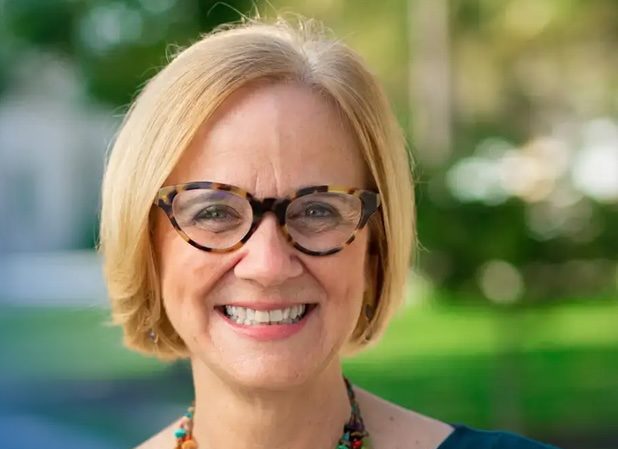
Photo from Eileen Higgins’ campaign website

Audio By Carbonatix
Editor’s Note: This profile is part of New Times’ People to Watch issue, spotlighting figures we expect to make a big impact in Miami in 2026.
For the first time in Miami’s history, the city is being led by a woman — in the only major U.S. metro founded by one (shoutout to Mary Brickell). And in 2026, that woman is Eileen Higgins.
After defeating Trump-backed Emilio González in December 2025, Higgins became the first Democrat in nearly 30 years to win Miami’s mayoral seat. Now, her early moves on immigration enforcement, affordable housing, and City Hall reform are being watched closely, not just by Miami residents but also by a national audience looking to see how Democratic mayors navigate a second Trump administration.
Higgins is still something of a political newcomer by South Florida standards. She first entered office in 2018, winning a special election to the Miami-Dade County Commission, where she went on to represent a conservative-leaning district that includes Little Havana. There, she leaned into the nickname “La Gringa” (Spanish shorthand for a white, non-Latin American woman) and built a reputation as a pragmatic dealmaker, touting nearly $3 million in small-business grants and the creation or planning of roughly 7,000 affordable housing units.
Her background sets her apart from much of Miami’s political class. Born in Ohio and raised in New Mexico, Higgins moved to Miami in the early 2000s after earning degrees in mechanical engineering and business from the University of New Mexico and Cornell University — a résumé that now informs her technocratic pitch for fixing City Hall.
Higgins did not return New Times‘ requests for comment.
Miami Agenda
Housing sits at the center of Higgins’ mayoral vision. Throughout her campaign, she promised to cut red tape, overhaul permitting, and root out corruption so that “government can get to work creating a prosperous and affordable future for all residents.” She has also pledged to improve transit and walkability, invest in flood mitigation, and restore public trust in a City Hall long marred by scandal.
But it is immigration where Higgins has drawn her sharpest contrasts with the Trump administration. After Trump endorsed González, she openly distanced herself from what she called the president’s “cruel” policies.
“We are an immigrant-based place. That’s our uniqueness. That’s what makes us special,” she told Madrid-based newspaper El País during the campaign.
Since taking office, Higgins has emerged as a vocal national figure on the issue. In a January interview with Newsweek, she argued that Miami’s diversity has strengthened the city, not weakened it. And during a recent appearance on CBS News’ Face the Nation as part of a bipartisan panel of mayors, she warned that aggressive U.S. Immigration and Customs Enforcement (ICE) tactics were sowing fear and threatening Florida’s already-fragile healthcare system (where more than 25 percent of hospital workers are immigrants).
“We are going to comply with the law, but we are not going to help beyond that,” Higgins said. “ICE and its tactics have been in my community for over a year … causing great fear and terror in our residents.”
She has also criticized the Trump administration’s decision to end Temporary Protected Status (TPS) for Venezuelan and Haitian immigrants — two communities with deep roots and large populations in Miami.
“Haiti is not safe, Venezuela is not safe,” Higgins told CBS News. “Our economy is at stake, and our humanity is at stake.”
For a city shaped by exile, migration, and boom-and-bust politics, Higgins’ term is already becoming a test case: Can a Democrat with national ambitions govern Miami differently, and visibly, in an era defined by polarization?
More People to Watch in 2026
Read our stories on some of the other individuals we’ll be watching this year:
Inside James Fishback’s Outrage-Driven Run for Governor
Marco Rubio’s Meme-Worthy Rise to the Center of Trump’s Second Term
After Playoff Frustration, Miami Dolphins Hand Rebuild to Jeff Hafley
Is Sting Dion Miami’s Next Drag Superstar?
Eulois Cleckley Is Getting the Underline to the Finish Line
Marvin Dunn Preserves Florida’s Black History — And Present
Renata Bozzetto Is Leading the Fight for Immigrants’ Rights in Florida
Leila Cobo on Miami’s Role in Latin Music’s Global Rise
Miami’s Bizzy Crook Celebrates Grammy Victory
Eric Fuller and Jeremy Waks of Midline Aim to Keep Touring Artists in Miami
…and more rolling out in the coming days.