
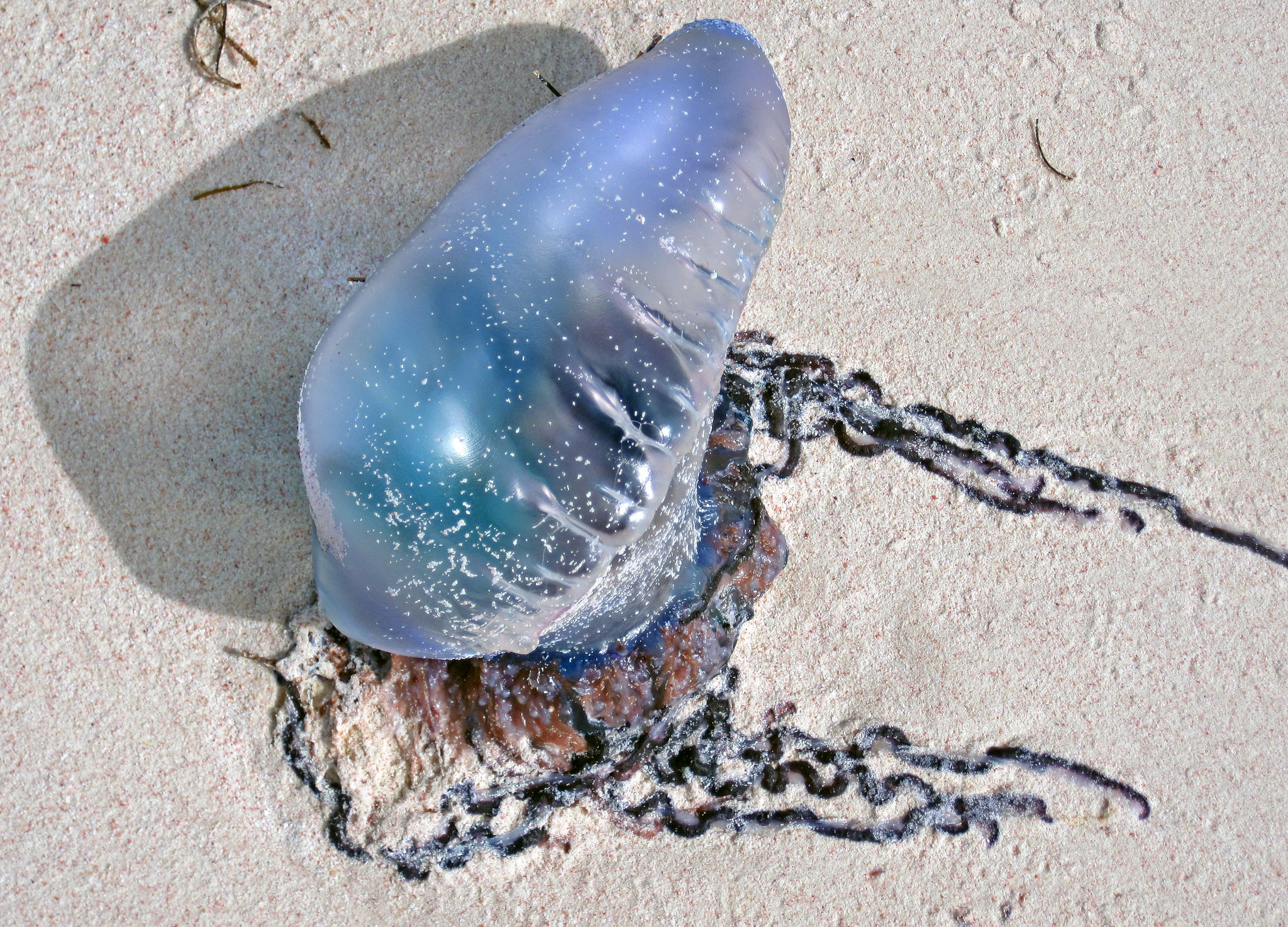
Photo by James St. John from Flickr

Audio By Carbonatix
South Florida’s scorching summers mean many beachgoers wait until winter to stroll along the white sand. But those who aren’t native to South Florida may be surprised when their beach walk takes them past what appears to be aliens disguised as blue Walmart bags from the ’90s.
Upon closer inspection, most people realize these otherworldly monsters are actually marine organisms, specifically the Portuguese man o’ war. Palm Beach County Parks and Recreation note the man o’ war, known for its trademark translucent-blue plume and curly tentacles, is known to wash up on South Florida beaches between November and April.
It’s also known for its excruciatingly painful stings.
Stings often leave whip-like, red welts on the skin and can remain up to three days, according to Palm Beach County Parks. The issue is so prevalent that lifeguards are equipped to treat such stings (don’t worry, they use distilled vinegar, not urine). If a lifeguard is nowhere to be found, remove any visible tentacles from the skin without using your hands — a stick or towel will suffice. Then, flush the area with saltwater and apply a hot or cold compress to relieve pain. If you experience shortness of breath, call for emergency medical help.
While man o’ war can wash up on beaches as far north as New England, they more commonly appear in places like Florida and Texas. Even with that massive area to consider, it’s hard to imagine a worse invasion than what happened in South Florida in February 2011. According to NBC 6, Fort Lauderdale saw nearly 500 man o’ war stings on the beach in just two days.
“Invasion” would probably come across as harsh to any man o’ war reading this. That’s because the consensus among scientists says strong winds are responsible for pushing the creatures onto shores, where they meet their demise, although their wiry tentacles remain venomous even after they perish.
But the most interesting fact about the man o’ war may have been discovered this summer. The study, conducted by a team of worldwide researchers, shows the man-o-war is actually four individual, specialized organisms combined into one. Think Zords combining in Power Rangers or two kids stacked up under a trench coat and fedora.
While it may seem stranger than fiction, colonial organisms (siphonophores) are nothing new to those who study the animal kingdom. According to Oceanographic Magazine, scientists repeatedly dismissed the idea each time it came up in the 18th and 19th centuries. Each of the four parts handles an essential function: floating, capturing prey, feeding, and reproduction, according to the National Oceanic and Atmospheric Administration.